If you are starting a business, sooner or later someone asks what your product does and why anyone would want it. Answering that in a sentence or two is harder than it sounds. So, what is a value proposition? It is that answer written down: who the product is for, the problem it handles for them, and why it is a better choice than what they do now. Getting it right early shapes what you build, who you talk to and what you say when you talk to them.
Short lessons on this kind of early founder work, from finding a real problem to building a first AI project and launching it, are the subject of AI Entrepreneur, under its "Your first business" part.
What is a value proposition?
In marketing, a value proposition is the value a company or product delivers to a particular group of customers. In practice it works as a positioning statement: a few lines that sum up why a specific person should use this product instead of something else.
It is not a slogan and it is not a list of features. A slogan aims to be remembered. A feature list says what the product contains. A value proposition says what changes for the customer, and for which customer. "Uses a large language model" is a feature. "Cuts the time a cafe owner spends on the weekly rota from three hours to ten minutes" is a value proposition, or the start of one.
There is one more distinction worth keeping in mind from the start. The value proposition a company writes is a claim. The value a customer actually perceives is subjective, and the two can differ. A founder can believe the product saves time while the customer mostly values that it stops arguments about who works Saturday. When the two disagree, the customer's version is the one that decides whether they keep using it.
Where the phrase came from
The phrase is credited to Michael Lanning and Edward Michaels, two consultants at McKinsey, who used it in a 1988 staff paper titled "A business is a value delivery system". Their point was that a business promises customers some value, a mix of benefits and what it costs them, and that promise is its value proposition.
That framing still helps. It treats the product as a promise, and a promise has two sides: what you offer and what the customer gives up to get it. The customer gives up money, but also time to learn a new tool, the effort of switching, and the risk that it does not work. A strong value proposition is one where the benefit clearly outweighs all of that for the person reading it.
The four parts of a value proposition statement
A typical value proposition statement names a few things: the area the company works in, what it offers, who its target customers are, and what sets it apart from other options for those customers. For a small, new business, that comes down to four parts you can write in plain words.
- Who it is for. A group narrow enough that you could find ten of them this week. "Small businesses" is too wide. "Cafe owners with 5 to 15 staff" is something you can act on.
- The job and the pain. What they are trying to get done, and what goes wrong or costs them today.
- What it does. The outcome your product produces, said in terms of the job, not the technology.
- Why this over the usual way. The thing your product does that their current approach cannot. Every customer already has a current approach, even if it is a notebook or doing nothing.
The last part is the one founders skip most often, and it matters most. If the customer's current way is good enough, the first three parts can all be true and still nobody switches.
Start from the customer's side
A popular tool for working this out is the value proposition canvas, a close look at one part of the business model canvas: the fit between a group of customers and what you offer. The order it asks you to work in is the useful part.
You begin on the customer side. First you list the customer's jobs, the things they are trying to get done. Then you list their pains, the frictions, risks and waste they hit while doing those jobs. Then their gains, the improvements they would welcome. Only after that do you turn to your own side and set out the products and services you offer, how each one relieves a pain, and how each one creates a gain. Lining the two sides up shows gaps: pains nothing in your product touches, or features that answer no pain at all.
Starting from the customer side protects you from the most common early mistake, which is building something interesting and then searching for a person who needs it. It also links naturally to finding out whether a pain is real. Some writers separate value propositions that meet necessities from those that meet mere wants, and a pain people already spend time or money working around usually points to a necessity.
Writing one for a small AI scheduling tool
Here is one value proposition worked through, for an invented product: an AI tool that drafts a cafe's weekly staff rota. Follow the four parts in order.
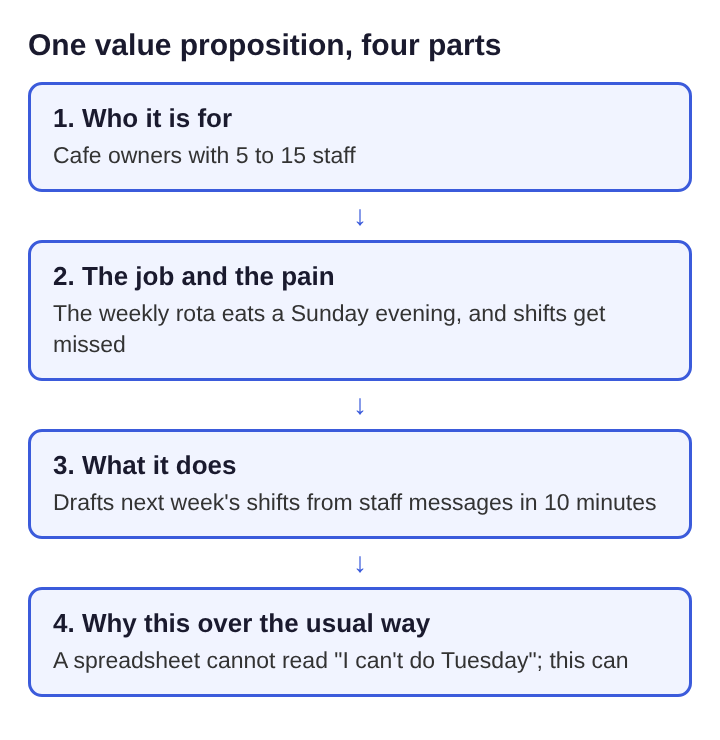
1. Who it is for. Cafe owners with 5 to 15 staff. Fewer than 5 and the rota fits in their head. More than 15 and they probably already have a manager or a scheduling system.
2. The job and the pain. The job is a fair rota that covers every shift. The pain, from talking to owners, is that it eats about three hours on a Sunday evening, because availability arrives as scattered text messages, and a missed message means a shift nobody turns up for.
3. What it does. It reads the staff messages for the week, drafts next week's shifts in about ten minutes, and flags any shift with nobody available so the owner can sort it before Monday.
4. Why this over the usual way. The usual way is a spreadsheet. A spreadsheet cannot read "I can't do Tuesday, but Thursday evening is fine". This tool can.
Put together, the statement reads: "For cafe owners with 5 to 15 staff who lose Sunday evenings to the rota, a tool that drafts next week's shifts from your staff's messages in ten minutes, and flags gaps before Monday. Unlike a spreadsheet, it reads the messages for you."
Notice what the statement leaves out. It never mentions the model behind the tool, the app's design, or anything else the owner does not care about on a Sunday evening. Every word ties back to the job and the pain. It also gives you something to check. If owners who try it still spend two hours fixing the draft, the third part is not yet true, and the statement has to change or the product does.
A value proposition also sets up the later choices of a launch. Once you know who it is for and why they would switch, deciding how to reach them follows, which is the subject of a go-to-market strategy.
How it differs from a unique selling proposition
The two phrases are often mixed up. The unique selling proposition, a term from the advertising man Rosser Reeves and used in campaigns of the early 1940s, is about telling customers how one brand is better than its rivals. It looks outward at competitors.
A value proposition is wider. It covers the customer, their job, their pain and the outcome, and the point of difference is only its last part. In the rota example, the unique selling proposition would be the single line "it reads your staff's messages for you". The value proposition is the whole statement around it, and it would still hold even in a market with no direct rival, where the only competitor is the owner's own spreadsheet.
Comparing offers can also be done on two lines at once, quality and cost. A product can offer more for less, more for the same, or more for more. Offering lower quality at the same or a higher cost is what writers on the subject call a negative value proposition: a reason not to switch.
Common mistakes when writing one
- Too wide a customer. "Anyone who works" describes no one you can find, so you cannot check the claim.
- Features in place of outcomes. "Powered by AI" says nothing about the customer's week.
- No current alternative. If you cannot name what the customer does today, you do not yet know why they would change.
- Words nobody uses. If customers describe the pain as "the Sunday rota", write that, not "workforce scheduling friction".
- Writing it once. A first statement is a guess. It gets sharper each time a real customer tells you what they actually value.
Frequently asked questions
How long should a value proposition be?
Short enough to say in one breath: one or two sentences for the statement itself. A longer version can list the pains and gains, but the core should fit on a single line.
Is a value proposition the same as a mission statement?
No. A mission statement says what the company is for over the long run. A value proposition is about one group of customers and one product, and it changes as you learn about them.
Can one business have more than one value proposition?
Yes. A business that serves two different groups usually needs a separate statement for each, because their jobs, pains and current alternatives differ.
When should a founder write the first one?
Before building much, as soon as there is a guess about who has the problem. Writing it early shows what is still unknown, and talking to customers fills those gaps.
Why a value proposition keeps changing
A value proposition is less a sentence you write than a claim you keep checking. The first version comes from a guess about a customer and a pain. Each conversation, each person who keeps using the product and each person who stops tells you something about which part of the claim holds. The customer who stays may value something you never wrote down, and the customer who leaves may show that the point of difference was smaller than you thought.
That is why the four parts are worth keeping separate. When something is not working, you can see which part is wrong: the group may be too wide, the pain too mild, the outcome not yet true, or the usual way good enough. Changing one part at a time turns a vague sense that the product is not landing into a specific question you can answer.
AI Entrepreneur
Building a business in the age of AI, from a first project to a company. Visit aientrepreneur.vlvd.net