What is a pivot in a startup? It is a deliberate change to one core part of the plan, such as who the customer is, which problem gets solved or how the business makes money, made because the evidence says the current plan is not working. The founders, the skills and much of the product usually stay. What changes is the bet at the center of it.
A pivot is one of the hardest calls a new founder makes, because it means admitting a plan has failed while still believing the business can work. AI Entrepreneur covers this ground in the part of its courses called "Your first business", alongside finding customers and building a first version.
What Is a Pivot in a Startup, and Where the Word Comes From
The term spread through the lean startup method, which treats a new company as a set of guesses to check against what customers actually do. In that method a pivot is a structured course correction: you replace one basic guess about the product, the strategy or the way the company grows with a new one, and then check the new guess.
The method runs on a loop of build, measure and learn. You build a small version, measure how people use it, and learn whether the guess behind it holds. At the end of each loop you make one of two choices: persevere with the current plan, or pivot to a new one. The loop repeats as many times as needed.
Steve Blank, one of the people behind the customer development side of the method, put the idea in plain terms, as the lean startup page records it: when results are poor, change the plan instead of firing the people. The plan was the weak part, not necessarily the team.
A Pivot Is Not a Tweak and Not Quitting
Most changes in a young company are not pivots. Fixing a confusing sign-in screen, rewriting an email or adding a missing feature are tweaks. They improve the current plan without changing the guess at its center.
Quitting is the other end. You close the company, return what is left, and move on. A pivot sits between the two. It keeps whatever the evidence says is working and changes the part that is not.
A useful way to tell them apart: after a tweak, your one-line description of the business stays the same. After a pivot, that line changes. "An AI tool that writes product descriptions for online shops" becoming "an AI tool that translates shop listings" is a pivot. Adding a tone setting to the description writer is a tweak.
Common Kinds of Startup Pivot
Pivots tend to change one of a small number of things. Naming them helps you see which part of the plan the evidence is pointing at.
- One feature becomes the product. Users ignore most of what you built but rely on one part. You cut the rest and make that part the whole product.
- A new customer. The product works, but for a different group than you aimed at. A tool built for students might find its real users among teachers.
- A new problem for the same customer. You know your customers well, and talking to them shows a bigger, more urgent problem than the one you chose.
- A new way to make money. People use the product but the revenue model does not fit how they spend, so you change who pays or how.
- A new channel. The product is right but the way you reach customers costs too much, so you change how you find them.
Good pivots change one of these at a time. Change all of them at once and you have started a new company, which is sometimes right, but then you lose the learning that the old one gave you.
Signs That a Pivot May Be Needed
No single number says it is time. A pivot usually follows a pattern that holds over several loops of building and measuring, not one bad week.
- People try it and leave. Sign-ups come, but few people return after the first week, even after you fix the obvious problems.
- Interest without commitment. People say the idea sounds useful, yet almost nobody pays, pre-orders or gives you their time.
- Usage in a place you did not expect. A small group uses the product heavily for something you never designed it to do.
- Each customer costs more than they bring in, and no change to the product or the channel moves that.
- Growth only comes from your own effort, with no word of mouth and no customer asking for more.
The third sign deserves the most attention. Unexpected usage is often the clearest pointer to where a pivot should go, because it is a real customer telling you, through what they do, what they value. Steady use by a small group, even for the wrong reason, is the early sign that a product is starting to fit its market.
Two Well Known Startup Pivots
Groupon started as an online activism site called The Point, where people could gather around a cause. It got very little traction. The founders then ran a single coupon offer for a pizzeria in the lobby of their own building and got 20 redemptions. That small number told them that the useful part of their idea was getting people to act together, and group deals were where it worked. Three years later Groupon was a billion dollar business, according to the lean startup page on Wikipedia.
Slack began inside a company called Tiny Speck, whose first product was an online game called Glitch. Glitch launched in September 2011 and closed in December 2012. While building the game, the team had made a chat tool for its own use. After the game closed, the company launched that tool as Slack, and in August 2014 renamed itself Slack Technologies.
Both stories share a shape. The first plan failed, but it produced something real: a working offer, a working internal tool, a group of people who used it. The pivot kept that and dropped the rest.
A Worked Startup Pivot for a Small AI Tool
Here is an invented example you can follow step by step. A founder builds an AI tool that writes product descriptions for small online shops. It is a minimum viable product, a version with just enough features for early customers to use and react to: a text box, a few settings and a button. The first version of a product exists to produce exactly this kind of evidence.
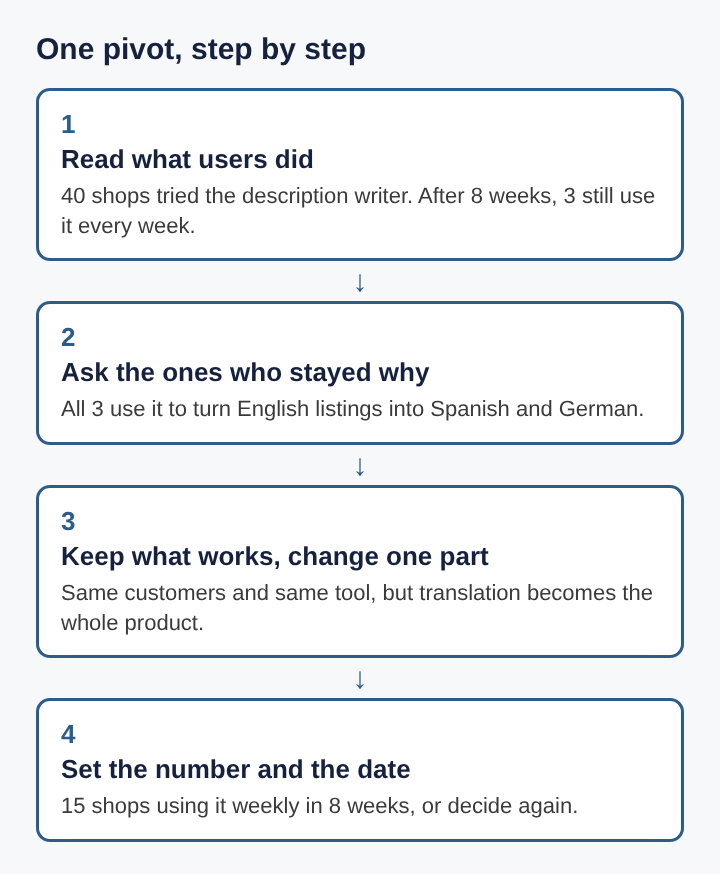
- Read what users did. Over 8 weeks, 40 shops try the tool. Only 3 still use it every week. Small fixes to the writing quality did not change that number.
- Ask the ones who stayed why. The founder calls all 3. Each one says the same thing: they paste in their English listings and ask the tool to rewrite them in Spanish and German, so they can sell abroad. None of them cares much about the original descriptions.
- Keep what works, change one part. The customers stay the same: small online shops. The core technology stays the same. What changes is the problem: the product becomes a listing translator, with the description writer removed. This is a pivot where one use becomes the whole product.
- Set the number and the date. Before building anything new, the founder writes down a goal: 15 shops using the translator every week within 8 weeks. If that happens, persevere. If not, decide again with the new evidence.
Step 4 matters most. A pivot without a written goal and a date tends to drift into a series of small changes that never get judged. The goal turns the new plan into a clear question with a clear answer.
Frequently asked questions
How many times can a startup pivot?
There is no fixed limit. Each pivot uses time and money, so the practical limit is how long the company can keep going, which is why each one should come with a goal and a date.
Is a pivot a sign of failure?
It is a sign that one plan failed, not that the company did. In the lean startup method, deciding to persevere or pivot is a normal part of every loop of building and measuring.
How long should you wait before pivoting?
Long enough to see a pattern across several rounds of real use, after the obvious problems are fixed. One slow week is not evidence; weeks of people trying the product and leaving are.
Should you tell customers about a pivot?
Yes, especially the ones who use the product. They are often the reason for the change, and they are the first people the new plan has to serve.
What a Good Startup Pivot Keeps
A good pivot is easy to describe after the fact and hard to see while it is happening. What makes it work is not boldness but evidence: a small group of people doing something real with what you built, and the discipline to follow them instead of the original plan. Keep the customers who stayed, the skills the team built and whatever part of the product people actually use. Change the one guess that the evidence has ruled out, write down the number that will show whether the new guess is right, and set the date when you will look again.
AI Entrepreneur
Building a business in the age of AI, from a first project to a company. Visit aientrepreneur.vlvd.net