The pretesting effect is a simple and slightly strange finding about learning: if you try to answer questions about a page before you study it, and then find out the right answers, you tend to learn that page better than if you had only read it. Most of your first answers will be wrong or guessed. That is expected, and the misses are part of what makes it work.
You need a set of questions about a page you have not studied yet. Study Shot makes one from a photo: it turns a page from a textbook, notes or a worksheet into multiple-choice practice questions, from the basics to advanced, and explains every answer. The method itself works with any questions you can get before reading, such as the questions at the end of a chapter, read before the chapter itself, or questions a classmate writes for you.
What the pretesting effect means
The Wikipedia page on retrieval practice describes the pretesting effect, also known as errorful generation or pre-questioning, as quizzing on material before it has been learned. Doing that appears to lead to better later learning than no pretest at all, with one condition: you get feedback on the correct answers once the quiz is over, or you go on to study the material.
That condition matters. A pretest on its own teaches nothing, because you mostly do not know the answers yet. The gain comes from the pair: the attempt first, then the answer. Without the second half, you would only be guessing.
The same page notes that the effect has shown up both in laboratory studies and in real classrooms, in language learning, in science classes in general, and with lower ability learners in chemistry.
Why guessing before you read helps
A wrong guess sounds useless. Three things happen during it that plain reading skips.
- You find out what you do not know. Before the quiz, the page looks familiar and easy. After five questions you could not answer, you know exactly which parts are new to you.
- You read with a target. When you then study the page, the questions you missed are still in your head. Each answer stands out when you reach it, instead of blending into the rest of the text.
- You produce something. Even a wrong answer is an attempt from your own mind. The generation effect is the finding that information is better remembered when it is generated from your own mind rather than simply read, and a pretest pushes you to generate before you read.
The retrieval practice page adds a detail worth knowing: the pretesting effect appears to be specific to the material the questions ask about, and is not driven by a general state of curiosity. So the questions need to point at the parts of the page you most need to learn. A vague question gets you a vague gain.
A worked example with one textbook page
Say you have a biology page on photosynthesis that you have not read yet. Here is one way to run a pretest on it, step by step.
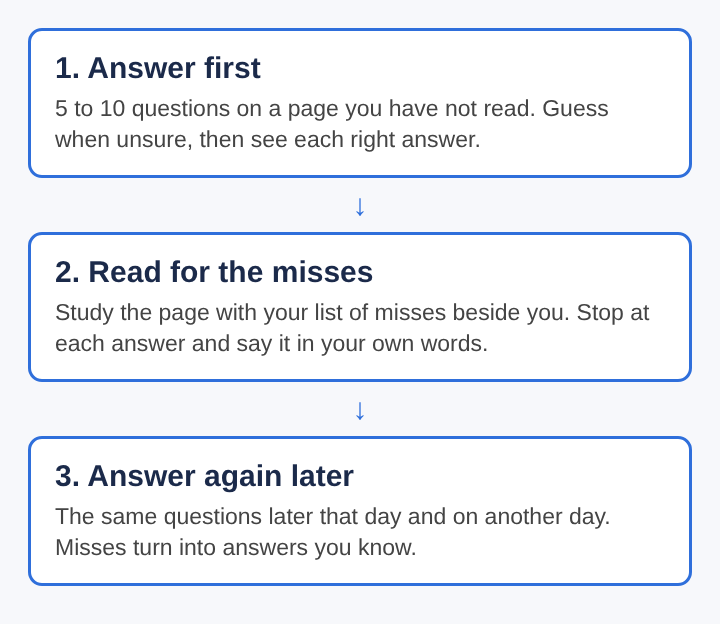
- Get the questions before reading. Take a photo of the page and ask for a short quiz. For a new subject, the project's own guide suggests the Tiered level with 5 or 10 questions, a ladder that climbs from Basic through Intermediate to Advanced. Each question has four choices.
- Answer without looking. Do not skim the page first. One question might read: "Where in a plant cell does photosynthesis take place?", with the mitochondria, the chloroplasts, the nucleus and the cell wall as choices. If you are not sure, pick the one that seems most likely and move on.
- Read every explanation. Each answer is checked right away and explained, one question at a time. Here the answer is the chloroplasts. Note each miss on a scrap of paper in a few words.
- Now study the page. Read it once, slowly, with your list of misses beside you. When you reach the part that answers one, stop and say the answer out loud in your own words.
- Answer the same set again. The quiz is kept in a library with its page photo, ready to take again. Do it later the same day, then again on another day, and watch which misses have turned into answers you know.
The whole first pass of 10 questions takes a few minutes. Most of the value sits in step 4, because that reading is aimed at the gaps the quiz showed you.
How pretesting compares with quizzing after study
Quizzing after study, recalling what you have already read, is the better known form of retrieval practice. The research on how the two compare is mixed. The retrieval practice page reports that some studies find pretesting less effective than quizzing after study overall, while others find it at least as effective.
You do not have to choose. The photosynthesis example uses both: the first round is a pretest, and the second and third rounds are quizzes after study on the same questions. The pretest shapes how you read, and the later rounds make you pull the answers back up after a delay.
For more on why the second half of that plan works, see the article on desirable difficulty in learning, the idea that some kinds of struggle during practice help memory later.
When the pretesting effect works best
According to the same page, pretesting has shown benefits across age groups and subjects, but it seems better suited to concrete material such as facts and concepts. It can be used with reading passages, videos and live lectures. The page also notes that a pretest seems to be a good way to open a lecture series and that it reduces mind-wandering during lectures.
In practice, that points to a few good uses:
- A chapter full of terms, dates, parts or definitions, where each question has one clear answer.
- A lecture or video you will watch tomorrow: a short quiz on the slides or notes the night before gives you things to listen for.
- A new language, where a pretest on a page of vocabulary shows which words you already half know.
It fits less well with long arguments or open essays, where the main thing to learn is a chain of reasoning rather than a set of facts.
Mistakes that undo the effect
A few habits turn a pretest into wasted time.
- Skipping the answers. The effect depends on feedback or further study. A pretest with no follow-up leaves your guesses as they were, wrong ones included.
- Peeking at the page first. Skimming before the quiz turns it into a quick recall check. That has its own value, but it is not a pretest, and it hides which parts are new to you.
- Treating the result as a grade. A low first round is normal and says nothing about how well you will know the page later. The point is to map the gaps.
- Never coming back. One pretest and one reading still fade. The later rounds on the same questions are where the answers settle in. The article on learning from the questions you get wrong covers what to do with each miss.
Frequently asked questions
Does it matter if most pretest answers are wrong?
No. A pretest is taken before you have studied, so most answers are expected to be wrong or guessed. What matters is that you see the right answers afterwards and then study the material.
Is the pretesting effect the same as the generation effect?
They are close but not the same. The generation effect is about remembering what you produce better than what you read; a pretest is one way to make you produce an answer before the material is in front of you.
How many questions should a pretest have?
There is no fixed number. A short set of 5 to 10 questions per page keeps the first pass quick and leaves enough misses to guide your reading.
Does pretesting work before a lecture?
Yes. Pretesting can be used with live lectures and videos, and it has been found to reduce mind-wandering during lectures.
Using the pretesting effect on your next page
The pretesting effect turns the usual order of study around: questions first, reading second, the same questions again later. The first round is not about knowing the answers. It is about finding out which parts of the page are new, so that your reading goes straight to them. Keep the questions tied to the page, always read the answers after the guess, and come back to the same set on a later day. Done that way, a wrong guess at the start is one of the most useful things a study session can produce.
Study Shot
Turn any page into a practice quiz. Visit studyshot.vlvd.net