How many practice questions before an exam is the wrong count
Most students who ask how many practice questions before an exam they should do want one number: 50, 100, 300. The research on recall points somewhere else. What matters is how many separate rounds you answer, how far apart those rounds sit, and whether you read why each answer is right. A pile of questions answered in one evening does less than a smaller set answered across several days.
A rounds plan works with questions from any source, including Study Shot, which turns a photo of a page from a textbook, notes or a worksheet into multiple-choice practice questions, from the basics to advanced, and explains every answer. The count you end up with comes from your own wrong answers, not from a target set in advance.
Why answering questions beats rereading the page
Answering a question forces you to pull the idea out of memory. Psychologists call this retrieval practice, also known as active recall. The idea is old. In 1890 William James wrote that "things are impressed better by active than by passive repetition", and that when you almost know a piece, it pays to recollect it by an effort from within rather than look at the book again.
Modern work adds a detail that changes how you should count. Right after a session, material you simply restudied is often recalled about as well as, or better than, material you answered questions on. As time passes, the material you answered questions on comes out ahead. So a session can feel productive and still fade, while answering questions pays off later, at the exam.
Two more findings from the same body of research shape the plan. Feedback matters: answering and then seeing the right answer helps more than answering alone. And spacing the rounds apart makes the benefit of answering questions larger. Those two points decide most of what follows.
What the research says about doing more in one sitting
The obvious fix for a hard exam is to do more questions in one long session. The research on overlearning, which means practising past the point where you first get everything right, says this helps less than it seems.
A 1992 meta-analysis of 15 studies found that overlearning does improve recall, and that more of it gives more retention. Later studies looked at how long that gain lasts and found it tends to be short-lived. In one study, people who overlearned geography facts and word definitions recalled more after one week, but the advantage faded over time until they were no better off than people who had stopped earlier.
A mathematics study gives the sharpest answer to the counting question. People did either three or nine practice problems of the same kind in one sitting. One week later and four weeks later, the two groups did no differently. Six extra problems in the same session bought nothing that lasted. In a second comparison, people did ten problems either all at once or split across two sessions. After one week the groups were level, but after four weeks the split group did better.
Read together, these results say the number of questions in one sitting has a ceiling. Past the point where you can answer a set correctly, extra questions that day mostly cost time. The next useful question is on a different day.
Count rounds instead of questions
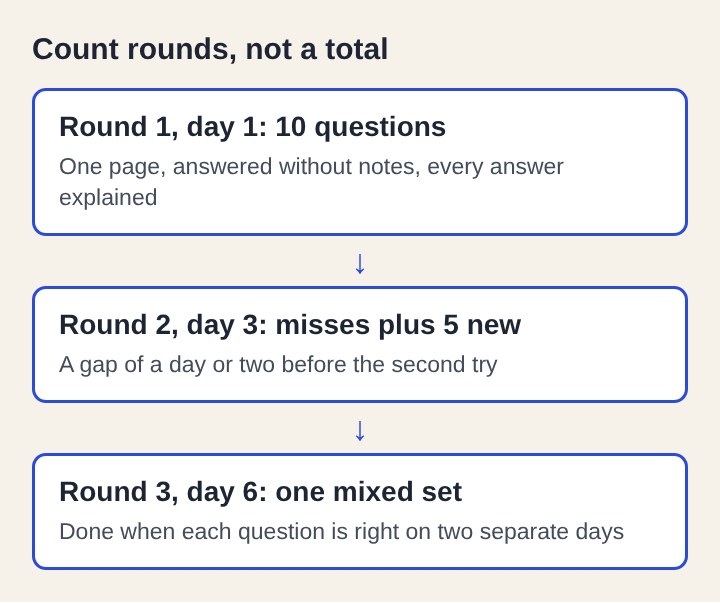
A round is one pass through a set of questions without notes, followed by reading every explanation. A sensible plan for most exams has three rounds per chapter:
- Round 1: answer about 10 questions per page, without looking at the page, then read why each answer is right.
- Round 2: a day or two later, answer your misses from round 1 again, plus about 5 new questions on the same pages.
- Round 3: a few days after that, answer one mixed set drawn from the whole chapter.
The stopping rule replaces the target number. A question is done when you have answered it right on two separate days. A question you get right in round 1 and again in round 2 drops out. A question you miss keeps coming back until it passes that rule, and the explanation for it tells you what to learn from the miss. This way the total depends on what you actually know, which is the only honest way to set it.
A worked example with one chapter and ten days
Say your biology exam is in ten days and one chapter, photosynthesis, covers four textbook pages. Here is how the rounds play out.
- Day 1, round 1. Make 10 questions for each page and answer them cold: 40 questions. One of them asks where in a plant cell photosynthesis takes place, with the mitochondria, the chloroplasts, the nucleus and the cell wall as the four choices. You pick the mitochondria, read the explanation, and learn the right answer is the chloroplasts. You miss 14 of the 40 and write each one down.
- Day 3, round 2. Answer the 14 misses again, plus 5 new questions per page: 34 questions. You miss 6. The 26 questions you answered right on day 1 are not touched yet; they get their second check in round 3.
- Day 6, round 3. Answer one mixed set from the whole chapter, with the hardest questions in it: about 20 questions, including the 6 misses and a sample of the day 1 questions you got right. You miss 2.
- Day 8. Answer only those 2 again, plus a short mixed set of 10.
Total: about 100 answers for four pages, spread over four days, with every miss answered right again on a later day. No day took more than about 40 questions. The guides for Study Shot suggest a similar shape: revising a chapter page by page at 10 questions per page, and in the week before an exam, 10 or 15 harder questions, then retaking the quiz until you get them right.
How to tell when a chapter is ready
The stopping rule gives you a clear signal, but a few other signs help you decide whether to add a round.
- The misses are getting rarer. If round 3 still produces as many misses as round 2, the chapter needs another round, not a longer one.
- You can say why, not only what. If you get a question right but could not explain the reason, count it as a miss. Reading the explanation for every answer, right or wrong, catches these.
- Harder questions hold up. Basic recall questions come first, but exams also ask you to use an idea. A chapter is ready when questions at the harder level stay right too.
- Old chapters still pass. Add a few questions from earlier chapters to each later round. If they slip, they come back into the rotation.
Frequently asked questions
Is 100 practice questions enough before an exam?
It depends on how they are spread. One hundred questions over four or five days, with misses repeated, usually does more than two hundred in one night. Count rounds and misses, not the total.
How many practice questions should you do in one day?
Enough to answer each question in the set once and read every explanation, often 20 to 40. Studies on overlearning found that extra problems in the same sitting gave no lasting gain, so stop and come back another day.
Should you repeat the same practice questions?
Yes, for the ones you missed, but on a later day rather than straight away. Mix in new questions on the same material so you recall the idea instead of remembering the wording of one question.
What if there is only one day left before the exam?
Do one round in the morning and answer your misses again in the evening. A gap of a few hours is shorter than ideal, but it is still a gap, and a second pass at your misses is worth more than new material.
The right number of practice questions comes from your misses
The number of practice questions before an exam is an output, not an input. Three or four rounds per chapter, a day or more apart, with every explanation read and every miss carried forward, gives you a count that matches what you know. Some chapters will take 40 answers and some will take 150. The rule that a question is done only after two right answers on two different days keeps the effort where the gaps are, and ends it where they close.
Study Shot
Turn any page into a practice quiz. Visit studyshot.vlvd.net