If you have ever closed a book feeling that nothing stuck, only to find the material came back a week later, you have met the idea behind the question what is a desirable difficulty in learning. A desirable difficulty is effort during study that slows you down now but leaves a memory you can use later. The psychologist Robert Bjork, who studies human learning and memory at UCLA, gave the idea its name. You can build these difficulties by hand from a textbook, notes or a worksheet, or with Study Shot, which turns a photo of a page into multiple-choice practice questions, from the basics to advanced, with every answer explained.
What is a desirable difficulty in learning
A desirable difficulty is a condition of learning that asks for more effort but improves performance over the long term. Bjork coined the term in 1994. The key word is "desirable." Not every difficulty helps. A blurry photocopy or a noisy room makes study harder without making memory stronger. A desirable difficulty is one that makes your mind do the work that the later use of the material will ask for: pulling an answer out, choosing between two close ideas, rebuilding something you half forgot.
The idea rests on a split between two things. One is how well you do during practice, with the page still fresh. The other is what you can still do days later, with the page closed. Easy methods lift the first quickly, and that quick gain is easy to mistake for the second. Desirable difficulties often make practice look worse while the lasting part grows.
Why the harder way feels slow and still pays off
When you reread a page, every sentence looks familiar. That familiarity is easy to confuse with knowing. You recognise the words, so you assume you could produce them. Often you cannot. The gap between recognising and recalling is why rereading is a weak way to study on its own.
A desirable difficulty takes that comfort away. When you answer a question with the page closed, you find out at once what you actually hold. The search for the answer is part of the learning, and a failed search shows you exactly where the gap is.
This is also why these methods feel worse. You get more wrong. You go slower. Many people drop them for that reason and go back to rereading, which feels smooth. The smooth feeling is the trap.
Retrieval practice as a desirable difficulty
The best known desirable difficulty is retrieval practice: answering from memory instead of looking at the material again. Flashcards are the classic case. The desirable difficulty page also notes that feedback is key, so you should learn the right answer after each try. The basics of active recall and how to use it cover the habit in detail.
Here is a worked example you can copy. Say you just read a textbook page on photosynthesis. You close the book and answer this question:
Where in a plant cell does photosynthesis take place? The four choices are the mitochondria, the chloroplasts, the nucleus and the cell wall.
The right answer is the chloroplasts. If you hesitate between the chloroplasts and the mitochondria, that pause is the difficulty doing its job. Both are parts of the cell tied to energy, and both show up on the same diagrams. Choosing between them makes you sort out which one does what: chloroplasts capture light to make sugar, and mitochondria release energy from it. That sorting is the learning.
Multiple-choice questions work as a desirable difficulty when the wrong choices are plausible, as they are here. When the wrong choices are silly, the question turns into a reading exercise. The case for and against the format is in when multiple-choice questions help with studying.
Spacing and interleaving as desirable difficulties
Two more desirable difficulties change when you study, not what you do.
Spacing means spreading practice over several sessions instead of packing it into one. The spacing effect was first described by Hermann Ebbinghaus in a book published in 1885. When you come back after a gap, you have forgotten some of the material, and pulling it back takes more effort than it would after five minutes. A simple plan: answer questions on a page today, again in two or three days, and again a week later. More on this is in how the spacing effect shapes study.
Interleaving is spacing where the gap is filled with another subject. You work on chemistry, switch to history, then come back to chemistry. The switch gives the first subject time to fade a little, so the return asks for real recall instead of a quick echo of what you just saw.
Wrong answers as a desirable difficulty
Getting a question wrong is uncomfortable, and many people treat it as failure. Seen as a desirable difficulty, a wrong answer followed by a clear explanation is one of the most useful moments in a session.
Go back to the photosynthesis question. Say you chose the mitochondria. If you only see "wrong, the answer is chloroplasts," you get a correction but no reason. If you also read why the mitochondria are wrong and why the chloroplasts are right, you now hold the contrast between them. Next time, the mix-up that tripped you is the very thing you remember.
Two habits make wrong answers pay off:
- Commit before you check. Pick an answer and stick with it before you see the feedback, so the correction has something to push against.
- Read the explanation even when you were right. A right answer can be a lucky guess. The explanation tells you whether your reason was sound.
A longer method is in how to learn from the questions you get wrong.
Building desirable difficulties from your own pages
The slow part of using desirable difficulties is often making the questions. Good questions with plausible wrong choices take time to write, and that time can crowd out the practice itself. Writing a few yourself has its own value, covered in the generation effect in learning, but you also need a steady supply to answer.
With a photo-based quiz, the steps are short. You snap a page, or pick a photo you already took, choose a level, and practise one question at a time. Each answer is checked right away and explained. The levels are Basic, Intermediate or Advanced, plus Tiered, a ladder that climbs through all three. A quiz has 5 to 20 questions, each with four choices, sorted from the basics to the hardest, so you start where success is likely and climb.
Every quiz is kept in a library with its page photo, ready to take again, which makes spacing practical: answer the set today and take it again in a few days. If you are working through a whole chapter, ways of studying a textbook chapter without rereading it fit well beside the questions.
Frequently asked questions
Is struggling while studying a sign that learning is working?
Often, yes, as long as the struggle ends in finding the answer or understanding the explanation. Struggle with no way to succeed is a sign the material is too far ahead of you.
How hard should practice questions be to count as a desirable difficulty?
Hard enough that you have to think and sometimes get them wrong, but easy enough that you can reason toward an answer. Starting with basic questions and moving up once you get most of them right keeps you in that range.
Is reading a page, reciting it and checking it a desirable difficulty?
Yes. In one experiment, students who read a text, recited it without looking and then checked it against the page did better than students who simply reread it. Reciting asks for recall, and the check becomes a search for what you missed.
Who came up with the idea of desirable difficulties?
The psychologist Robert Bjork coined the term in 1994, out of his work on learning and forgetting at UCLA.
When a desirable difficulty stops being desirable
The idea has a limit, and it matters. The desirable difficulty page gives three guidelines for telling a helpful difficulty from a harmful one.
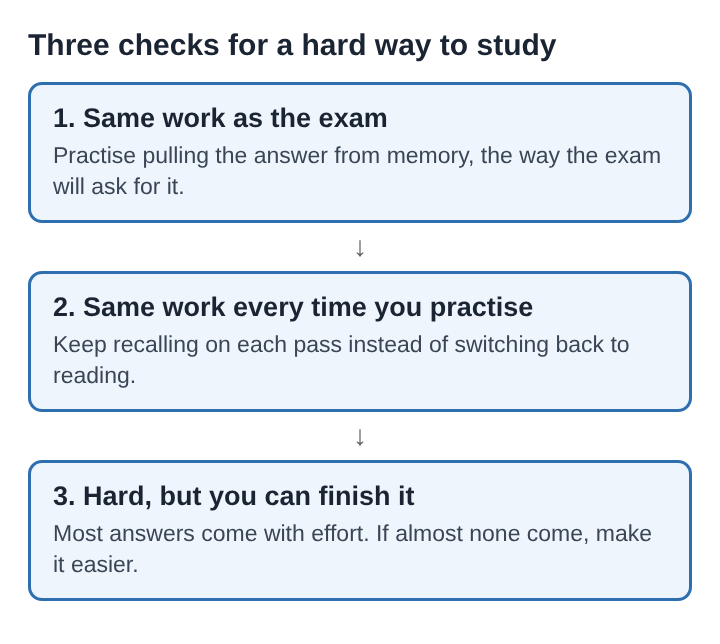
First, the work you do while learning should match the work the later recall asks for. If the exam asks you to produce an answer, practise producing it. Second, it should match the work you do each time you practise, so you keep recalling instead of drifting back to reading. Third, the task has to be possible. A task that is too hard can put you off and stop the processing that builds memory.
That third check connects to cognitive load, the effort being used in working memory. Much of what you learn reaches long-term memory only after working memory has handled it, so a task that floods working memory leaves little behind. A beginner who jumps to the hardest questions on a new chapter often hits this wall.
Some signs a difficulty has stopped helping:
- You get almost every question wrong and the explanations do not make sense yet.
- You cannot tell which part of the material a question refers to.
- You are guessing at random instead of reasoning between choices.
The fix is to step down a level, not to give up on effort. Answer basic questions on the terms and facts until most come back, then move to questions that ask you to apply or compare them. A desirable difficulty works when it sits just past what you can already do, close enough to reach.
Study Shot
Turn any page into a practice quiz. Visit studyshot.vlvd.net