Are multiple-choice questions good for studying? The short answer
Are multiple-choice questions good for studying? Yes, with conditions. They help when they make you pull an answer out of memory before you look at the choices, when the wrong options are plausible, and when you get an explanation right after each answer. They help much less when you skim the four options, spot the familiar one, and move on. The format is not the problem. How you use it decides whether you are learning or just recognizing.
The questions also have to come from somewhere. Most people study from a specific textbook chapter, a set of lecture notes, or a worksheet, so the most useful questions are the ones built from those exact pages. Study Shot is one way to get them: it turns a photo of a page into multiple-choice practice questions, sorted from the basics to advanced, and explains every answer. The format works the same way whether you write the questions yourself or not, and the habits that make it useful apply either way.
Why multiple-choice questions count as retrieval practice
Retrieval practice means trying to bring information back from memory instead of reading it again. The research on retrieval practice finds that long-term memory improves when part of the study time goes to pulling information back from memory, rather than to reading it again. That is the core of active recall, and it is why answering questions tends to beat rereading the same page.
A multiple-choice question is a retrieval attempt with some support. You still have to search memory, but the choices narrow the search. That support is useful early on, when you know little about a subject and an open question would leave you blank. It becomes a crutch later, when the choices do the remembering for you.
Robert Bjork named this trade-off a desirable difficulty in 1994. Practice that takes some effort, without being impossible, tends to produce more lasting learning than practice that feels smooth. A good multiple-choice question sits in that range: hard enough that you have to think, easy enough that you can usually get there.
Recognition versus recall in multiple-choice study
Memory researchers separate two processes. Recall) is producing an answer with no options in front of you. Recognition is judging whether something you see is familiar. Recognition is generally easier. One account, the two-stage theory, says recall needs a search through memory and then a decision, while recognition needs only the decision.
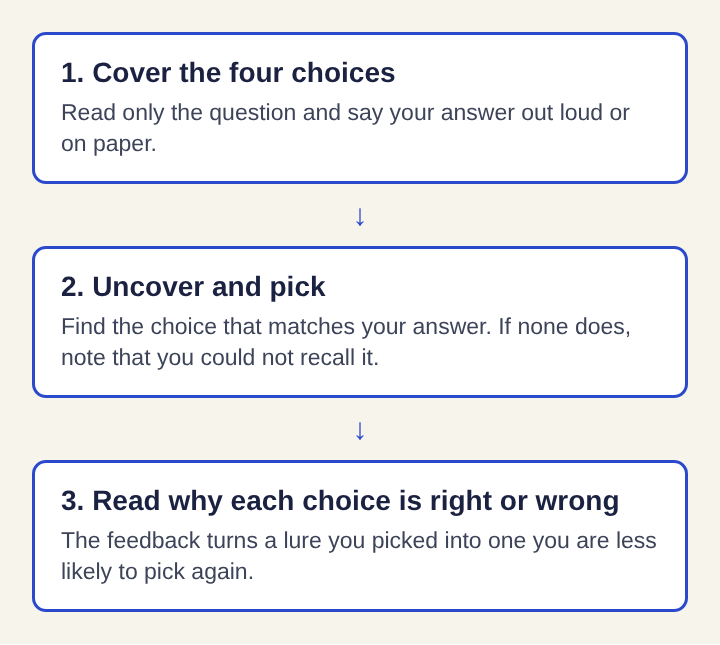
Multiple-choice questions lean on recognition by design. That gives you a choice each time you answer one. You can let the options carry you, or you can use a simple habit that turns the question back into recall:
- Read the question stem only. Cover the options with your hand or scroll so they are out of view.
- Say or write your answer in a few words.
- Now look at the four choices and find the one that matches.
- If none matches, notice that. It means your answer was off, even if you then pick correctly.
Take a question about photosynthesis: "Where in a plant cell does photosynthesis take place?" If you cover the options and say "the chloroplasts" before you see the list, you have done real recall. If you read "mitochondria, chloroplasts, nucleus, cell wall" first and decide "chloroplasts sounds right," you have done recognition. Both get the point. Only one tells you that you actually know it.
When multiple-choice questions mislead: weak distractors and false familiarity
The wrong options in a multiple-choice item are called distractors. Their quality decides how much the question teaches. The general guidance on multiple-choice item writing is that each distractor should be plausible yet clearly incorrect, so the question still makes sense when read with any of the options.
Weak distractors cause two problems.
- The answer is too easy to spot. If three options are obviously silly, you pick the fourth by elimination. You learn nothing about the content, only about the question.
- A wrong option can stick. Seeing a false statement can make it feel more familiar, and familiarity is easy to confuse with truth. This is related to the illusory truth effect, where repeated exposure makes a claim seem more believable. If you choose a wrong answer and never find out, you may walk away remembering it.
The fix for the second problem is immediate feedback. When you learn right away that "mitochondria" was wrong, and why, the wrong idea gets corrected before it settles. Feedback that arrives a week later, or never, leaves the error in place. The retrieval practice page cites a 2008 paper by Andrew Butler and Henry Roediger whose finding is in its title: feedback adds to the benefit of multiple-choice questions and reduces their harm.
There is also a quieter trap: a run of right answers on easy questions. Getting 18 of 20 right feels good, but if those questions only asked you to name terms, you may still be unable to explain how the parts connect. That is why mixing difficulty levels matters.
How to write multiple-choice questions from your own pages
Writing your own questions is study in itself, because you have to decide what matters on a page and what a reasonable mistake would look like. The full process for making practice questions from notes goes deeper, but for multiple choice specifically:
- Pick one idea per question. A stem that mixes two facts makes it unclear what you got wrong.
- Write the stem as a full question. "Where in a plant cell does photosynthesis take place?" works with the options covered. "Photosynthesis:" does not.
- Write the correct answer first, then the distractors. Base each distractor on a real confusion. Mitochondria is a strong distractor for the chloroplast question because both are organelles tied to energy, so a half-remembered page can mix them up.
- Keep options similar in length and form. If the right answer is the only long, careful one, it gives itself away.
- Add a one-line explanation for each option. Why is the right one right? Why is each wrong one wrong? This is where most of the learning happens.
- Climb in difficulty. Start with what a term means, then how two things relate, then how you would apply the idea to a new case.
Four choices is a common, workable number. It gives room for three real confusions without padding the list with filler.
Getting multiple-choice questions from a photo of a page
Study Shot covers several of the habits above without you writing the questions. Its line is "Turn any page into a practice quiz." You take a photo of a page from a textbook, your notes or a worksheet, and it writes multiple-choice questions about that page, from the basics to advanced, and explains every answer.
You pick a level: Basic, Intermediate, Advanced, or Tiered, which climbs through all three. A quiz has 5 to 20 questions. The explanation after each answer handles the feedback problem: a wrong choice gets corrected on the spot instead of lingering. Every quiz is kept in a library with its page photo, so you can take it again days later and see whether the misses have turned into hits. A question that looks wrong can be flagged.
The covering habit still applies to questions written by anyone else: read the stem, answer in your head, then look at the choices. The choices only check what you already produced.
Turning every wrong multiple-choice answer into a lesson
A wrong answer is the most useful thing that happens in a study session. It shows you exactly where your understanding breaks. The habit is to stop and look at it instead of rushing to the next question.
When you miss one, ask three things:
- Why did the chosen option look right? Name the confusion, for example: mixing up the organelle that releases energy from food with the one that captures light.
- What does the correct answer depend on? Trace it back to the line on the page.
- Could the question be answered with the options covered now? If not, you have read the explanation without absorbing it.
Then come back to the missed questions later, not just the same evening. Spreading practice over days is the spacing effect, and it applies to corrections as much as to new material. There is more on this in learning from the questions you get wrong.
Frequently asked questions
How many answer options should a multiple-choice question have?
Four is a common and workable number. What matters more is that each wrong option is believable, because one plausible distractor teaches more than three obvious ones.
Should multiple-choice practice replace short-answer questions?
No. The retrieval practice research reports greater gains from short-answer or essay questions than from multiple choice, though the act of retrieval is what helps in both. A useful mix is to answer multiple-choice stems with the options covered first, then add a few open questions that ask you to explain how ideas connect.
How often should multiple-choice questions be repeated?
Go back to them over several days rather than repeating them all in one sitting. Focus each return on the questions you missed or guessed, and check whether you can now answer them with the options hidden.
Are multiple-choice questions good for studying on their own?
They are useful, but they work better as part of a wider routine. Pair them with immediate explanations, spaced repeats, and some open recall, and they become a solid form of retrieval practice instead of a recognition exercise.
Study Shot
Turn any page into a practice quiz. Visit studyshot.vlvd.net