How to journal about a hard decision without rushing it
Learning how to journal about a hard decision starts with one plain fact: the decision will not fit into a single sitting. A hard choice is hard because each option costs something you care about, and those costs look different on a tired Tuesday than on a rested Saturday. One long entry written in a rush tends to record your mood that night. Several short entries written over a few days record the decision itself, from more than one angle.
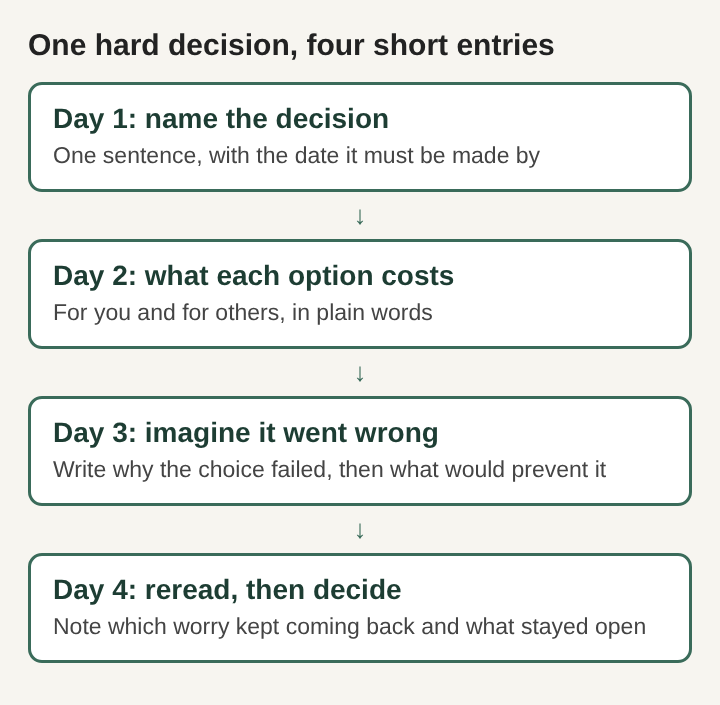
The method here uses four entries, one a day, each with a single job. None of them asks you to reach an answer early. The point is to put the choice on paper in a form you can reread, so that by the last entry you are looking at what you wrote, not at what you feared at 2 a.m.
Some journaling tools are built around this kind of slow attention. EnrichAI asks five questions a day about your own life, each drawn from what you value, what you are dealing with and what you are curious about, and its readout says plainly what you left unanswered. A decision you keep circling shows up there as a thread left open, which is a useful signal in any journal, paper or not.
Entry one: name the decision in one sentence
Most hard decisions arrive as a fog. You feel pulled in two directions, but you could not say exactly what the two directions are. The first entry turns the fog into a sentence.
Write the decision as a choice between named options, with a date. "Do I take the job in another city or stay where I am, decided by the end of the month." "Do I tell my brother what I think of his plan, before his trip on Friday." If you cannot write the sentence yet, write what you would need to know to write it. That is still progress.
Then add two short lines:
- Who else the choice touches. A partner, a team, a parent, nobody.
- What happens if you do nothing. Doing nothing is usually one of the options, and it has costs too.
Stop there. The first entry is short on purpose. Naming the choice and its deadline is often enough to lower the noise for a day.
Entry two: write what each option costs
The second entry looks at each option in turn. For each one, write what you would gain, what you would lose, and who else would gain or lose. Keep to plain words. "I would see my mother less" is more useful than "family considerations".
This is close to a tool counsellors use called the decisional balance sheet, a table that sets out the gains and losses of each choice to help someone decide. It is often used when a person feels ambivalent, wanting two things at once, and it appears in approaches such as motivational interviewing. You do not need the table. A few lines per option, in your own handwriting or on a screen, do the same work.
Two habits make this entry more honest:
- Write the costs you would rather not say out loud. If one option would hurt your pride, say so. Pride is a real cost and it often drives the choice in secret.
- Mark the guesses. Put a small question mark next to anything you do not actually know, such as how a manager will react or what a new city costs. Those marks become your list of things to find out.
Entry three: imagine the choice went wrong
By the third day you probably lean one way. This entry checks the lean without arguing with it. Pick the option you are leaning toward, imagine it is a year later and the choice turned out badly, and write the story of why.
The idea comes from the pre-mortem, a planning method in which a team imagines that a project has already failed and works backward to find what could have caused it. Turned toward one person's life, it surfaces worries that a plain list of costs tends to miss, because it asks for a story rather than a number.
Then write one more line under the story: what would make that failure less likely? Sometimes the answer is a small change to the plan, such as agreeing a trial period or having the hard conversation before the move rather than after. Sometimes the answer is that the failure story felt more likely than you expected, and the lean deserves a second look.
Entry four: reread before you decide
The last entry starts with reading, not writing. Read the first three entries in order, slowly, once. Then answer three questions in a few lines each:
- Which worry came back in more than one entry?
- Which of the question marks from day two are still open, and can any of them be answered before the deadline?
- If you had to decide in the next hour, which option would you choose, and what is the first small step?
The repeated worry is usually the real centre of the decision. People often write about salary or logistics on day two and find that the same fear of letting someone down appears in all three entries. When that happens, the decision is less about the job and more about that conversation.
Rereading also shows what you avoided. If you wrote four lines about one option and one line about the other, the short side may be the one you are afraid to look at. The patterns in your own journal entries are easier to see in writing than in memory, because memory smooths over the gaps.
A worked example: staying or moving for a job
Take Mara, a made-up example, who has been offered a role in another city and has two weeks to answer.
Day one. Her entry reads: "Do I accept the offer in the new city or stay in my current role, decided by the 15th." Who it touches: her partner, whose work is local, and her father, who lives ten minutes away. Doing nothing means the offer lapses and she stays.
Day two. Moving: more responsibility, a team she admires, a higher cost of rent (marked with a question mark, since she has not checked), and her partner would have to look for new work. Staying: a stable team, her father close, and a feeling she names plainly as "being passed over again".
Day three. She imagines it is a year after the move and it went badly. The story on the page is not about the job at all. It is about her partner, unhappy and out of work, and about the two of them not having talked about it properly before she said yes. Her line underneath: "Ask him directly what he would need, before the 10th."
Day four. Rereading, she notices that her partner appears in every entry and that she never wrote what he actually said, only what she guessed. The open question mark about rent is easy to check. Her decision is not made yet, but the next step is clear: one honest conversation, then the rent search, then the choice.
Nothing in those four entries told Mara what to do. They showed her where the decision really sat, which was a conversation she had been putting off.
Questions that help when you feel stuck
Some days the entry will not come. A single open question can restart it. These work best when they cannot be answered yes or no:
- What would you choose if nobody else ever found out which option you picked?
- Which option would you be able to explain to yourself in five years without wincing?
- What are you hoping someone will tell you, so that you do not have to decide?
- When did a choice cost you something small this week, and did you mind?
The last one is a variation on a question such as "When did honesty cost you something small this week?". Small recent costs are easier to write about than a large future one, and they often show how much a particular loss really bothers you.
It also helps to write without advice. A journal that tells you how you feel or what to do takes the decision away from you. The entries are a record of what you said, and the choice stays yours.
Frequently asked questions
How many days should you journal about a hard decision?
Four short entries over four days is a workable default. If the deadline is closer, the four steps fit into one long sitting with a break between each, though a night's sleep between them usually helps.
Should you write a list or full sentences?
Short sentences work better than single words, because "rent" says less than "rent would take half my pay". Lists are fine for the costs on day two, as long as each line is a full thought.
What if the journal makes the decision feel harder?
That often means the entries found a cost you had not admitted yet. Name it in one line, then go back to the question of what would make the hard option less likely to fail.
Is it worth rereading old entries after the decision?
Yes. Reading what you feared before a choice, once you know how it turned out, shows which of your worries tend to come true and which tend not to.
What journaling a hard decision leaves you with
Journaling about a hard decision does not produce the answer. It produces four pages you can trust more than your memory of a bad night: the choice named with a date, the real costs of each option, a story of how the favoured one could fail, and the worry that kept returning. With those in front of you, the decision is still hard, but it is now a decision about things you can see, and the first small step toward it is usually already written down.
EnrichAI
Five questions a day about your own life, each a little deeper. Visit enrich.vlvd.net