What is the five whys technique?
What is the five whys technique? It is a way to find the cause of a problem by asking "why?" about the problem, then asking "why?" again about the answer, and repeating until you reach a cause you can actually fix. The Wikipedia page on the five whys describes it as an iterative technique for exploring cause and effect, with the goal of reaching the root cause by asking why five times, each question aimed at the answer before it.
The appeal is that it needs no software, no training and no data set. You need the problem, a pen and the patience to keep going past the first answer that feels good enough. That last part is where most people stop too early.
The method also works better when each chain is written down rather than held in your head. A problem journal such as Problem Graph keeps a problem in one line with the solutions tried on it and what happened, which is the same record a five whys chain produces.
Where the five whys came from
The modern technique was developed by Sakichi Toyoda and used inside Toyota as the company built up its manufacturing methods. Taiichi Ohno, the architect of the Toyota Production System, described repeated why questions as the basis of Toyota's scientific approach: ask enough times and both the nature of the problem and its solution become clear. The method became part of the problem-solving training new staff received in that system.
From the factory floor it spread. The same Wikipedia page lists its use in Kaizen, lean manufacturing, lean construction and Six Sigma. Today it shows up just as often in software teams writing up an outage and in people trying to work out why a habit keeps slipping.
The setting changed, but the core move did not. You start from something you can observe, and you keep asking about the answer instead of jumping to a fix.
How to run the five whys, step by step
The method is short, but each step carries a rule that keeps the chain honest.
- Write the problem as a fact. One line, about what happens, not about who is to blame. "The sink is full of dirty dishes most mornings" works. "Nobody in this house cares" does not.
- Ask why the fact happens. Write the answer as another fact you could check, not a guess about someone's character.
- Ask why about that answer. Not about the original problem. Each question points at the line just above it.
- Stop when you reach something you can change. That is usually a missing step, a missing rule or a missing owner, not a person's mood.
- Pick one fix for that cause and write down how you will know it worked. Then try it for long enough to see.
Step 3 is the one people skip. If every why goes back to the original problem, you get a list of possible causes side by side, not a chain that goes deeper.
A worked example: dishes left in the sink
Take a shared home where the sink is full of dirty dishes most mornings. The quick fix is a reminder on the fridge. Here is the chain instead.
- Why is the sink full in the morning? Nobody washes up after dinner.
- Why does nobody wash up after dinner? The dishwasher is still full, so there is nowhere to put the dishes.
- Why is the dishwasher still full? Nobody empties it in the morning after it runs overnight.
- Why does nobody empty it? It is nobody's job. Each person assumes someone else will.
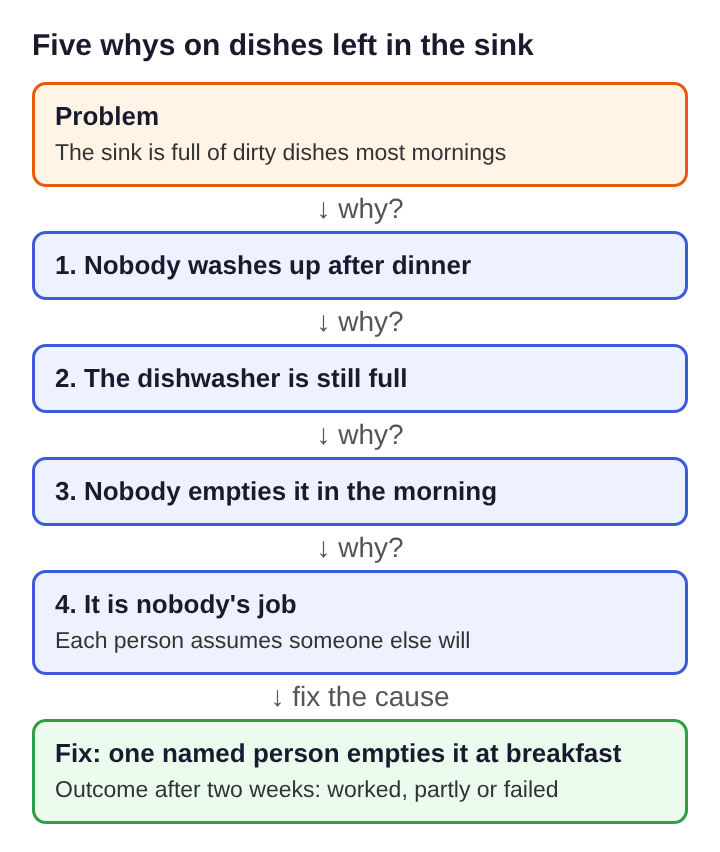
The chain stopped at four, because the fourth answer is something the household can change today: one named person empties the dishwasher at breakfast. The reminder on the fridge would have treated the first answer. The named owner treats the fourth.
This matches what the Wikipedia page says about the shape of a good final answer. The real root cause tends to point at a process that is not working well, or one that does not exist at all. Here the missing process is "who empties the dishwasher." No amount of reminders adds that.
The last step is to write the fix down with a check. After two weeks, is the sink clear most mornings? Mark the fix as worked, partly or failed, and if it failed, keep it on the record with the reason. That way the next chain starts from what is already known, not from scratch.
Why five is not a fixed number
The name says five, but the count is a rough guide. The Wikipedia page notes that the number of whys can be higher or lower depending on how complex the problem is. The dishes chain needed four. A problem at work with several moving parts might need six or seven.
A better stopping rule is this: stop when the next why would take you outside what you can change, or when the answer names a step, rule or owner you can add. If you keep asking past that point, you end up at answers like "people are busy" or "the economy," which are true and useless.
The opposite mistake is stopping at the first answer that has an obvious fix. "Nobody washes up after dinner" has an obvious fix: tell people to wash up. It fails because the dishwasher is still full. The chain exists to catch that.
Where the five whys goes wrong
The method has serious critics, including inside Toyota. Teruyuki Minoura, a former managing director of global purchasing for Toyota, called it too basic to analyze causes at the depth needed to make sure an issue stays fixed. Two of the criticisms the Wikipedia page lists are worth keeping in mind every time you use it:
- Stopping at symptoms. People tend to stop at the first answer that seems to be a cause, even when it is only another symptom.
- Only one cause. Each why can have more than one true answer, but a single chain follows only one of them.
Alan J. Card, a medical professor, went further and argued that the arbitrary depth of the fifth why is unlikely to line up with the real root cause. The number five has no special link to how deep a cause sits.
The practical answer is to let the chain branch. If "why is the dishwasher full?" has two honest answers, follow both. A drawing called an Ishikawa or fishbone diagram, created by Kaoru Ishikawa, does this on paper: the problem sits at the head and possible causes branch off a spine, with sub-causes on each branch. A five whys chain is then one path through that drawing, not the whole of it.
Keeping a record of each chain
A five whys chain on a scrap of paper helps once. Kept, it helps again. The record that pays off has four parts: the problem line, the chain of answers, the fix chosen, and its outcome.
The outcome is the part people leave off. Without it, a month later you cannot tell whether the named owner for the dishwasher worked or quietly stopped after a week. Marking each fix as worked, partly or failed turns the chain into evidence you can use the next time the same problem appears.
Problems that share a cause also become visible this way. If the dishes chain ends in "nobody's job" and so does a chain about unpaid bills, the shared cause is the pattern, and Problem Graph lets related problems be linked so that pattern shows. The fix for one may be the fix for both. For more on reading that kind of link, see how to link related problems to find a pattern, and for a fuller walk through the method on a personal problem, see how to do a root cause analysis on a personal problem.
Frequently asked questions
Do you always have to ask why exactly five times?
No. Five is a rough guide. Stop when you reach a cause you can change, which may take three questions or seven.
What is the difference between the five whys and root cause analysis?
Root cause analysis is the wider goal of finding the cause behind a problem. The five whys is one short method for doing it, and a fishbone diagram is another that shows several causes at once.
Can the five whys be used on personal problems?
Yes. It works on habits, chores and money as well as on machines, as long as each answer is a fact about what happens rather than a judgment about a person.
What should you do when a why has more than one answer?
Follow each answer as its own branch. A single chain that ignores the other answers can miss the real cause.
What the five whys technique is good for
The five whys technique is good at one thing: stopping you from fixing the first answer. It pushes past the symptom you can see toward a missing step, rule or owner you can add. It is weak when a problem has many causes at once, and it gives no guarantee that the fifth answer is the true one. Used with branches where a why has more than one answer, and with each fix marked by how it turned out, it becomes a quick and honest way to move from "this keeps happening" to "this is what changed."
Problem Graph
Every problem you carry, on one map. Solved together. Visit problemgraph.vlvd.net