Most advice on how to keep a journal when you are busy assumes you have a quiet half hour, a good pen, and a clear head. A full week rarely gives you any of those. What it does give you is small gaps: two minutes before a meeting, the walk to the car, the time the kettle takes to boil. A journal can live in those gaps if you stop asking each entry to be long. One approach, at enrich.vlvd.net, is built on that: it asks five questions a day about your own life at an hour you pick, then gives a plain readout of what you said, set beside your week and month. The habits that follow work with or without a tool like that.
Why Journaling Slips Away When You Are Busy
Journaling rarely stops because people decide to stop. It stops because the entry gets pushed to "later," and later is when you are tired. Then a missed day turns into a missed week.
Three things usually cause it:
- The entry is too big. If you expect a full page, any day without a full page of time becomes a day without an entry.
- There is no fixed moment. "Sometime today" loses to everything that has a fixed moment.
- The blank page asks you to decide what matters. On a busy day, choosing what to write about takes more effort than the writing.
Each of these has a direct fix. Make the entry small, tie it to a moment, and start from a question instead of a blank page.
How Short a Journal Entry Can Be on a Busy Day
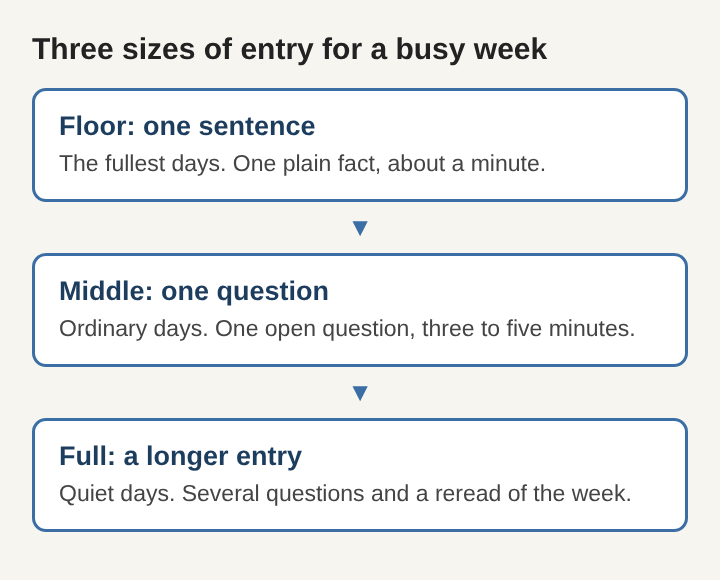
An entry can be one sentence. A single specific sentence often holds more than a page of general summary.
Compare these two entries from the same Tuesday:
- "Busy day. Lots of meetings. Tired."
- "In the third meeting I stopped arguing about the deadline and just agreed, and I am still annoyed at myself for it."
The second names one moment, one action, and one reaction. Six months from now, the first entry tells you nothing. The second tells you what you gave up and how it felt.
A useful floor: one concrete thing that happened, and one thing you thought or felt about it. If you have more time, add a second moment. If you have less, write only the moment. The rule is specific over complete.
If you are new to the practice and want more on first entries, how to start journaling covers the early weeks in more detail.
Attaching Journaling to Moments Already in Your Day
A habit starts from a context cue, such as a prior action, a time of day or a place, and grows more automatic with each repetition. It is slow: in one study by Phillippa Lally and colleagues, people took 66 days on average to reach that point, with a range of 18 to 254 days. A journal entry with no cue depends on memory and willpower, which are both low on busy days.
A related idea from the psychologist Peter Gollwitzer is the implementation intention: a plan written in the form "when X happens, I will do Y." Studies of this kind of plan found a higher chance of reaching a goal, because the situation itself becomes the reminder.
For a journal, that means choosing a moment that already happens every day. Some that work for people with full schedules:
- "When I sit down on the train home, I will write one sentence about the day."
- "When I pour my first coffee, I will answer one question."
- "When I plug my phone in at night, I will write before I put it down."
Pick a moment that happens on your worst days, not only your good ones. A plan tied to "after my evening run" fails every day you skip the run.
Reflection Questions That Fit Into Two Minutes
A question removes the hardest part of a short entry, which is deciding what to write about. The best short questions are specific and cannot be answered with yes or no. "Was today good?" ends in one word. "What surprised you today?" needs a sentence.
Some questions that fit into two minutes:
- What did you notice on the way out this morning?
- What took more energy today than you expected?
- Who did you talk to today that you would talk to again?
- What did you put off, and why?
- What do you do now that you once had to learn?
Each points at a real moment instead of asking for a judgment of the whole day. Easy questions also work as a way in. Once you have written one plain sentence about the morning, a harder question about what you are avoiding feels less steep. If a question does feel too heavy for the time you have, what to do when a reflection question feels too hard has ways to approach it from the side.
Using EnrichAI Questions When Time for Journaling Is Short
Two of those questions come from the EnrichAI home page, whose sample questions include "What did you notice on the way out this morning?", "What do you do now that you once had to learn?" and "When did honesty cost you something small this week?" Several of its design choices line up with the problems busy people face.
A fixed hour. The questions arrive at a time the person chooses, which gives the entry its cue without having to remember it.
An order from easy to deep. Claude asks five questions drawn from what the person values, what they are dealing with and what they are curious about, ordered from the easiest to step into to the deepest. Each question says what it draws on, such as the season, a stage of life, a value the person named, or a thread from yesterday. None can be answered yes or no.
Typed or spoken answers that save as they go. On a day with only four minutes, you can speak two answers on a walk and come back to the rest. Nothing is lost if you are interrupted.
A readout that names what was left open. When the fifth answer is in, the day's readout arrives, which the site calls the enrichment. It catalogs the person's own words, says plainly what was left unanswered, and sets the day beside the week and the month. The next day's questions follow what was left open, so a skipped thread is not dropped. The readout does not tell a person how they feel, flatter them, grade their answers, give advice they did not ask for, or claim progress their answers do not show. It is a plain record of what was said.
Answers stay private. Accounts are by invitation, answers are kept in the site's own database and sent to Claude only to write the questions, readouts and progress, and a person can download everything they wrote or delete it all.
Returning to a Journal After Missed Days Without Catching Up
The fastest way to stop journaling for good is to try to fill in every missed day. Reconstructing last Wednesday from memory takes longer than writing about today, and it produces weaker entries, because the details are gone.
Instead, when you come back:
- Write today's entry first, at its normal small size.
- If you want, add one line about the gap: "Missed four days. The project launch took everything." That line is a real entry about your week.
- Move on. Do not list what you missed.
Gaps are part of the record. A journal with a hole every time work spikes shows you something true about how you live. Noticing patterns in your own journal entries goes further into reading that kind of signal.
If you have ten minutes at the end of a week, a short look back can stand in for missed days. Reflecting on your week in ten minutes offers a structure for that.
Frequently asked questions
How often should a busy person write in a journal?
Daily works well if each entry is small enough to finish in a few minutes, because a daily cue is easier to keep than an occasional one. If daily is not possible, a fixed few days a week tied to the same moment is steadier than writing whenever there is time.
Is a journal entry typed on a phone as useful as one written by hand?
For keeping the habit, the format that gets used is the useful one. Typing or speaking on a phone fits into gaps where a notebook does not, and a specific sentence typed on a train holds the same information as one written at a desk.
What should a journal entry include on a very full day?
One concrete moment and one reaction to it is enough. "The client called back and I felt relieved, then irritated that I had worried all morning" is a complete entry.
How to Keep a Journal When You Are Busy Over the Long Term
Over months, short entries add up to something long entries often do not: a record with few gaps. The aim is not to write well. It is to write something true and specific often enough that, looking back, you can see what your weeks were actually made of.
Three habits carry most of the weight. Keep the entry small, so a hard day still produces one. Tie it to a moment that happens even on hard days. Start from a question that points at something real, so you never face an empty page with no idea where to begin. When the page still feels empty, what to write when you have nothing to say has more ways in.
When you miss days, write today and leave the gap. A journal that bends around a busy life lasts longer than one that waits for a calm week, because a calm week may not come, and the busy ones are worth remembering too.
EnrichAI
Five questions a day about your own life, each a little deeper. Visit enrich.vlvd.net