What is an ad impression?
If you have asked what is an ad impression, the short answer is this: an impression is one time an ad is fetched and shown on a page. It is a count of deliveries, not of people and not of attention. One reader who opens three pages with the same ad on each adds three impressions, and an ad that loads at the bottom of a page nobody scrolls to can still add one.
The word matters because almost every other number in online advertising is built on it. Click rates divide by it, reach and frequency are worked out from it, and the size of a campaign is usually described in thousands of it. Knowing what the count includes, and what it leaves out, tells you how much any of those numbers can say.
The question also has a privacy side. An impression can be counted with nothing about the person who saw it. vlvd ads, a small service that places one ad at a time on a family of game and learning websites, counts views and clicks per ad, per site, per day, as numbers only, and gives the people who see its ads no cookies and no visitor id.
One fetch, one count
The plain definition on Wikipedia's impression page) is that an impression happens when an ad is fetched from its source and can be counted. Each fetch is one impression. Whether the ad is clicked plays no part.
That simple rule leaves room for noise, so the count is usually cleaned. Traffic from bots is filtered out, and so are requests that end in an error. The definition from the IAB, an advertising industry group, adds one more condition: the count should be recorded as close as possible to the moment the reader has a chance to see the page. A request that never turns into a page in front of a person should not count.
Three things follow from this:
- An impression is not a visitor. The same person can produce many.
- An impression is not a view in the human sense. The ad was delivered; nobody promises it was read.
- An impression is not a click. Clicks are counted on their own and compared with impressions afterwards.
Served impressions and viewable impressions
The gap between "delivered" and "seen" led to a second kind of count. The same Wikipedia page describes both.
Served impressions are recorded by the ad server when it sends the ad. They count whether or not the ad fully loads, and whether or not it lands in a part of the page the reader can see.
Viewable impressions are narrower. A display ad counts as viewable when at least half of it is on screen for at least one second. Advertising groups in the United States have pushed to move from served counts to viewable ones, because a served count can include ads below the fold that no one ever scrolled to.
Neither count is wrong. They answer different questions. A served count says how often the ad left the server. A viewable count says how often it had a fair chance of being noticed. When two reports disagree, the first thing to ask is which of the two each one uses.
Impressions, clicks and the rate between them
Impressions become most useful when something else is divided by them. The best known result is the click-through rate: clicks on an ad divided by the number of times it was shown. Wikipedia notes that the first online display ad, for AT&T on the site HotWired in 1994, had a click-through rate of 44%, and that clicks on banner ads have fallen a long way since.
Impressions also set the unit for comparing campaigns. Cost per mille, or CPM, expresses a campaign in thousands of impressions, which is why "per thousand" turns up so often in advertising. Counting impressions is how most web advertising is accounted for.
Clicks carry their own noise. Click fraud is a person or an automated script clicking an ad with no real interest in where it leads, so clicks are filtered in the same spirit as impressions are.
A worked example: one ad on one day
The numbers here are invented to show the arithmetic. Say one small ad runs on one site for one day.
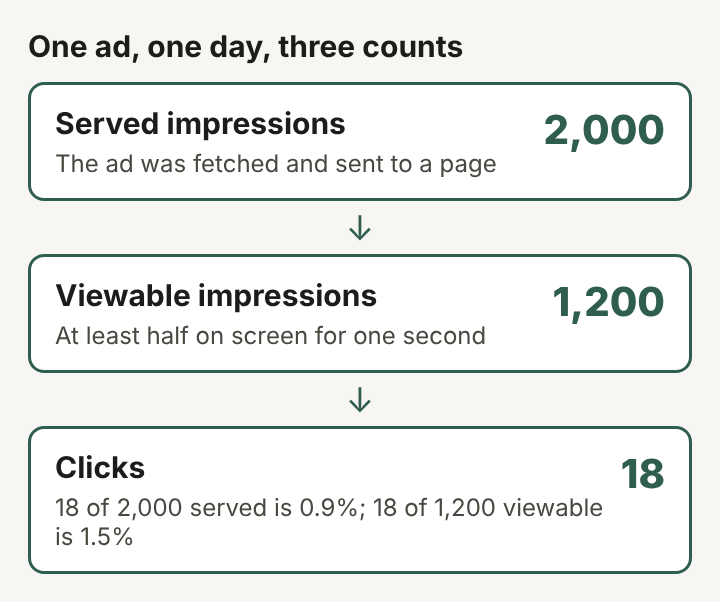
- Served. The ad server sends the ad 2,000 times. That is 2,000 served impressions.
- Viewable. Of those, 1,200 were at least half on screen for at least one second. That is 1,200 viewable impressions. The other 800 loaded somewhere the reader never looked, or left before the second passed.
- Clicks. 18 readers clicked. Divided by the served count, the click-through rate is 18 / 2,000, or 0.9%. Divided by the viewable count, it is 18 / 1,200, or 1.5%.
Same ad, same day, same clicks, two rates. Neither is a trick; they just divide by different things. A rate that does not say what it divides by cannot be compared with another one.
Notice what the example never needed: who the readers were. Every number in it is a count of events for one ad on one site on one day. That is the shape vlvd ads keeps, views and clicks per ad, per site, per day. Its privacy page says each site tells it only the site's name, the kind of ad and which ads were already shown in that visit, kept in the browser until the tab closes, so the same ad is not shown twice.
What the count cannot tell you
Because an impression is a delivery, it says little about people unless something else is added. Working out reach, the number of different people who saw an ad, needs a way to tell one person from another. That is where cookies and visitor ids usually come in, as the article on frequency capping shows: frequency is impressions divided by reach, and reach needs an identity.
So there is a real trade. Counting events only is simpler and keeps nothing about the reader, but it cannot answer "how many different people saw this?" across days or across sites. Counting people answers that, at the cost of following them. A service that chooses event counts gives up that answer on purpose.
An impression count also says nothing about whether the ad was any good. A high count with almost no clicks may mean the ad was seen and ignored, or that it was served where nobody looked. That is why served and viewable counts are best read side by side, with clicks next to both.
Frequently asked questions
Is an impression the same as a view?
Not exactly. A served impression only means the ad was delivered to a page. A viewable impression is closer to a view: at least half of the ad on screen for at least one second.
Does reloading a page create a new impression?
Usually yes, because each fetch of the ad is one impression. Filters remove bots and errors, not repeat visits from a real reader.
How is click-through rate worked out from impressions?
Divide the clicks by the impressions and multiply by 100. Always check whether the impressions were served or viewable, since the same clicks give a higher rate over the smaller viewable count.
Can impressions be counted without tracking people?
Yes. An impression is an event, so it can be added to a tally per ad, per site and per day with nothing stored about the reader. What that tally cannot give is the number of different people reached.
Ad impressions as a count of events
An ad impression is the smallest unit in online advertising: one fetch, one count. Served impressions count what left the server, viewable impressions count what had a fair chance of being seen, and clicks only mean something once you know which of the two they were divided by. Read that way, an impression report is a record of what happened to an ad, not a record of who the readers were, and the second never has to follow from the first.
vlvd ads
Show your project to people who are already exploring. Visit ads.vlvd.net