What is data minimization in advertising? It is the practice of collecting only the data an ad system needs to show and count an ad, using that data only for that job, and keeping it no longer than the job requires. An ad does not need to know who you are to appear on a page. It needs a place to appear, a format, and a way to avoid showing you the same thing twice. Data minimization treats everything beyond that as a cost to the reader rather than an asset to the ad system.
What is data minimization in advertising?
Most online ads depend on information about the person seeing them: a browser id, a history of visited pages, a guess at age or interests. Data minimization reverses that habit. Instead of asking what extra data could improve targeting, it asks what the smallest set of facts is that still lets the ad work. One small ad service shows one ad at a time on a family of game and learning websites, and it is built around that question. Its ads run with no cookies, no visitor tracking, and a person checking every ad.
The general principle has its own name in data protection. Data minimization means collecting, processing and storing only the personal information a specific purpose requires, because data with no current use still carries risk for the person it describes. The same principle appears in almost every data protection text, and the OECD Privacy Guidelines call it the Collection Limitation Principle.
It also sits close to privacy by design, an approach that acts before a privacy problem happens instead of repairing it afterwards, and makes privacy the default setting. In advertising, the practical result is simple. When the data is never collected, it cannot leak, cannot be sold, and cannot be matched with other data later.
The three limits of data minimization: collection, use and retention
Data minimization works through three separate limits. Each one closes a different gap.
- Collection. Gather only what the stated job needs. If the job is "show an ad and count it," a full browsing history is outside that job.
- Use. Use the data only for the reason it was collected. A count of clicks gathered to report results should not become input for a profile.
- Retention. Delete or reduce the data once the job is done. A record of which ads a reader saw during one visit has no purpose after that visit ends.
These three limits match principles in the European Union's General Data Protection Regulation, whose Article 5 lists data minimisation among its principles, next to purpose limitation and storage limitation. A system can meet the first limit and still fail the other two. Data collected narrowly but kept for years is still a risk.
How tracking based advertising works against data minimization
Tracking based advertising works the opposite way. Its value grows with the amount of data it holds, so each part of the system pushes toward collecting more.
A third-party cookie gives a browser an id that follows it from site to site. A tracking pixel reports a page visit back to a server that may have no visible part on the page at all. Put together, these produce a profile: a list of pages, times and actions tied to one id. That profile is what makes retargeting possible, where an ad for a product you looked at appears on unrelated sites days later.
Each step breaks one of the three limits. Collection goes far past what one ad needs. Use spreads from showing an ad to building a long record of behavior. Retention stretches across weeks or months, because an old profile is still useful for matching. The reader rarely sees any of this happen.
What data minimization in advertising looks like on a page
Take a concrete situation. A student opens a page about fractions on a learning website. There is an ad slot in the text. What has to happen for an ad to fill it?
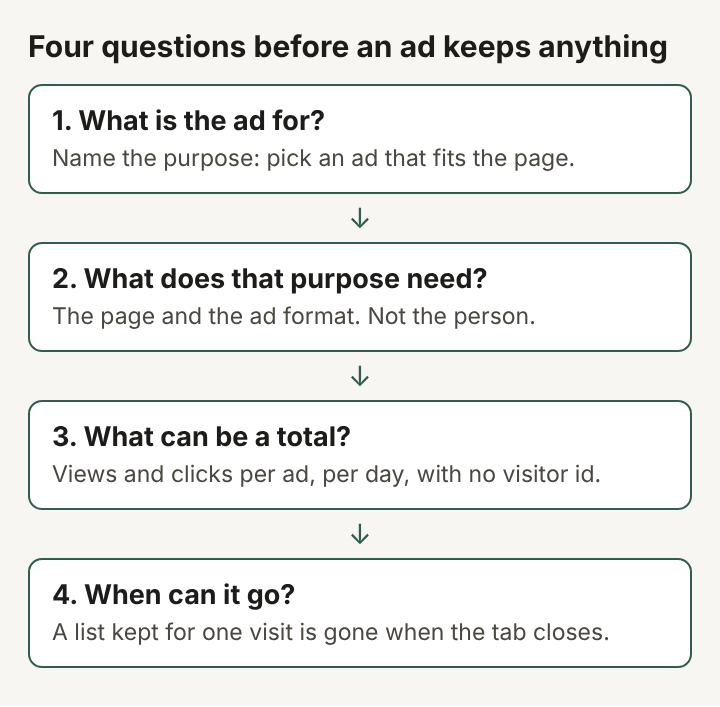
The ad system needs to know three things: which site is asking, which kind of ad fits the slot, and which ads this reader has already seen during the visit, so it does not repeat one. That is enough to choose an ad. To count results, it needs to record that the ad was viewed and, if it happens, clicked.
Now check what a minimized setup leaves out. The request carries no visitor id. No cookie is set in the browser. The list of ads already shown lives in the browser and disappears when the tab closes. The count of views and clicks is a set of totals, not a list of people. The ad and its picture come from the ad service's own address, so the advertiser never learns that this student was there.
Those are the questions a reader, publisher or advertiser can ask of any ad setup. Is there an id? Is anything stored after the visit? Which servers learn that the page was opened? Are the reported results totals or records of individuals?
Contextual ads as data minimization in practice
Contextual advertising chooses an ad from the words on the page and what the reader is looking at, rather than from the person reading it. A page about fractions on a learning site gets an ad suited to people learning things. The match comes from where the ad appears, which is information the publisher already has.
This makes contextual ads a direct way to apply data minimization. The reader's history never enters the decision, so there is no reason to collect it. The answer to whether websites can show ads without cookies is mostly an answer about context: the page itself carries enough signal.
Context has limits. It cannot follow a person to another site, and it cannot target an individual. Under data minimization, those limits are the intended outcome.
Data minimization in one small ad service
The service described in the first section shows how the three limits can be applied in a working ad system. Its privacy page sets out the details.
Collection. People who see its ads get no cookies and no visitor id. A site tells the service only its own name, the kind of ad it wants, and which ads were already shown in that visit. That last list is kept by the browser until the tab closes, and its only job is to stop the same ad from appearing twice.
Use. It counts views and clicks per ad, per site, per day, and the record is numbers only. An advertiser sees those daily views and clicks for each ad. A click goes straight to the advertised page.
Which servers learn about the visit. Every ad, its picture included, is loaded from ads.vlvd.net, so an advertiser never sees who views their ad.
The ads are small by design. Each one is a headline of up to 40 characters, one sentence of up to 90, and a button of up to 18. The picture is the advertised page's own preview image, the one set in its og:image tag. There are three formats: a banner inside the text, a small tab in the corner, and a full-screen ad shown when a reader finishes a lesson.
Data minimization covers what a system takes from readers. The other half of a privacy-friendly ad is what it shows them. A person checks every ad before it runs, usually within two working days. Ads for gambling, adult content, weapons, crypto and trading, politics, health or medical claims, and get-rich or money-making claims are not accepted, and an ad must describe the page it links to truthfully. Both halves come up again in what makes an ad privacy friendly.
Return to the student on the fractions page. At the end of the lesson, a full-screen ad appears. The site has said its own name, that it wants a full-screen ad, and which ads the student already saw in this tab. The view adds one to a daily total. If the student closes the tab, the list of seen ads is gone. What remains on the server is one more view in a daily total, with nothing that points back to the student.
Frequently asked questions
Does data minimization in advertising mean using no data at all?
No. It means using only the data needed for the job, such as which site is asking, which ad format fits, and which ads were already shown in a visit. Personal ids, browsing histories and profiles fall outside that need.
Can ad results be measured under data minimization?
Yes. Views and clicks can be counted as totals per ad, per site and per day. That shows how an ad performed without recording who saw it or clicked it.
Is data minimization in advertising required by privacy law?
The European Union's General Data Protection Regulation includes data minimisation as one of its core principles for personal data. How it applies to a given ad setup depends on what data that setup collects and where it operates.
What is data minimization in advertising?
It is the practice of collecting only the data an ad needs, using it only for that purpose, and deleting it once the purpose is met. Contextual ads that choose an ad from the page rather than the person are a common way to apply it.
What data minimization in advertising changes for readers and publishers
For readers, the main change is that an ad stops being a source of information about them. They do not have to trust that a profile is stored safely, because no profile exists. They also see fewer ads that follow them around, since nothing connects one visit to the next.
For publishers, minimized ads reduce what they must explain and defend. Many cookie notices exist because of tracking scripts, and the rule behind them is covered in why websites ask about cookies. Fewer tracking tools means fewer third parties to account for, and a simpler answer when a reader asks what happens to their data.
For advertisers, the trade is clear. They give up individual targeting and follow-up across sites. In return, they get placement next to relevant content, daily totals of views and clicks, and an audience that has not been asked to give anything up. Results are measured in aggregate, which answers the useful question: did this ad, on this site, on this day, get attention?
Data minimization does not make advertising disappear. It makes advertising smaller, more visible, and easier to explain in a few sentences.
vlvd ads
Show your project to people who are already exploring. Visit ads.vlvd.net