What is frequency capping in advertising?
What is frequency capping in advertising? It is a limit on how many times one person sees the same ad. The rule might say "three times a day" or "once a week". When you reach the limit, the ad stops showing to you, and another ad takes its place. The idea is simple. The hard part is how the system remembers what you have already seen.
Most ad systems remember with a cookie or an id tied to you. Some do it with far less. The small ad service vlvd ads, which places one small ad at a time on a family of game and learning websites, keeps a cap that lasts only as long as your visit. That gives you two clear cases to compare: a cap that follows you, and a cap that forgets you when you leave.
Frequency, reach and the number behind a cap
A cap only makes sense once you know what it limits. In marketing, frequency) is the number of times a target audience is exposed to one message in a set period. On television it is worked out by dividing the total impressions by the number of people reached. If an ad was seen 300 times by 100 people, the average frequency is 3.
An average hides a lot. Those 300 views might be spread evenly, three per person. Or 10 people might have seen the ad 21 times each while 90 people saw it once. Both cases give the same average. A frequency cap deals with the second case. It does not raise the average for people who saw the ad once. It stops the same few people from seeing it again and again.
So a cap has three parts:
- The unit: one person, one device or one visit.
- The limit: how many showings are allowed.
- The window: the period the limit covers, such as an hour, a day or a visit.
The same Wikipedia page gives a plain example: "three views per visitor per 24 hours" means a visitor who has seen an ad three times will not see it again for a day.
Why advertisers cap repeats
Repetition helps an ad up to a point. The mere-exposure effect, studied by Robert Zajonc in the 1960s, describes how people tend to like things more simply because they are familiar. Seeing a name a few times can make it feel known.
Past that point, repeats stop working. The frequency page describes capping as a common way to avoid "banner burnout", the point where visitors are overexposed and response drops. It also notes that some research suggests spreading repeats out, about once a week, instead of showing them many times in one day.
How many showings are enough? Nobody agrees. The same page calls effective frequency "quite controversial" and lists several definitions. One well-known view comes from Herbert E. Krugman, who wrote "Why Three Exposures May Be Enough" while working at General Electric. He named three levels of exposure: curiosity, recognition and decision. In his view, a fourth showing is just a repeat of the third.
There is also a cost to the person on the other side of the screen. The same ad, over and over, turns a page into noise. A cap protects your attention as much as it protects an advertiser's budget. The page also points out one trade-off: capping fits campaigns judged by clicks, and may work against campaigns built only for brand awareness.
How a cap is usually remembered
To count how many times you saw an ad, a system has to recognize you each time. The usual tool is a cookie. According to the frequency page, capping is applied across every site that serves ads from the same network, and it uses cookies to remember the count.
That is where a cap starts to look like tracking. An HTTP cookie that persists is sometimes called a tracking cookie, and third-party tracking cookies are used to build long-term records of browsing histories. A counter that says "this person saw ad 42 twice today" lives next to a record of where that person was when they saw it. The cap needs the count. The network ends up holding the history too.
If you want to know more about how that cross-site record is built, the earlier piece on how a third-party cookie works walks through it step by step.
The question then is narrow and practical. Can a system stop showing you the same ad without knowing who you are?
A cap kept for one visit, step by step
One answer is to move the memory off the server and into the page you have open. The privacy page for the service linked at the start says that people who see its ads get no cookies and no visitor ids. Each site tells the service only three things: its own name, the kind of ad, and which ads were already shown in this visit. That list is kept in the browser until the tab closes, so the same ad is not shown twice.
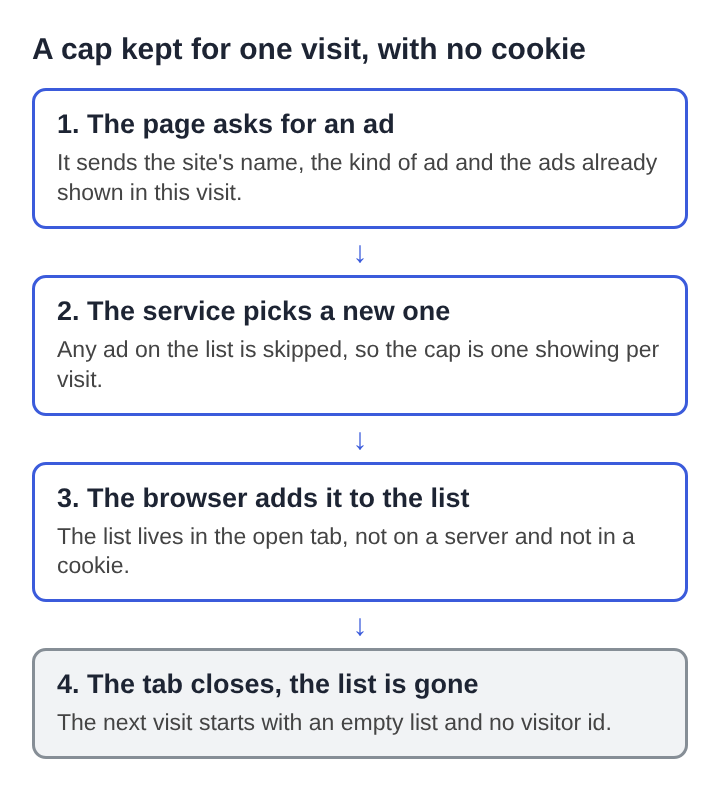
Follow one visit to see how that works. Say you open a lesson page on a learning site.
- First ad. The page asks for a banner. The list of ads shown in this visit is empty, so any approved ad can be picked. Call it ad A. The browser writes "A" on the list.
- Second page. You move to the next lesson. The page asks again and sends the list: "A". The service skips A and picks ad B. The list now reads "A, B".
- Third page. The page sends "A, B". Neither can be shown, so you see ad C.
- Close the tab. The list is gone. Nothing on a server says you saw A, B or C.
- Come back tomorrow. A new visit starts with an empty list. Ad A can show again, because nothing remembers that you saw it.
The cap here is one showing per ad, per visit. The unit is the visit, not the person. The window ends when the tab closes.
The counting that does happen is kept apart from you. The same privacy page says views and clicks are counted per ad, per site, per day, as numbers only. Every ad, its picture included, loads from the ad service itself, so an advertiser never sees who views their ad. The totals tell an advertiser how an ad is doing. They do not tell anyone who you are.
What a per-visit cap gives up
A cap that forgets you has limits, and they are worth seeing clearly.
- No weekly limit. If you visit five days in a row, you can see the same ad once each day. A cookie-based cap could stop that. A per-visit cap cannot, because it keeps nothing between visits.
- No limit across tabs. Each open tab has its own list. Two tabs side by side can each show ad A once.
- No limit across sites by person. A network cap follows you from site to site. A per-visit list knows only the visit it belongs to.
What you get in return is just as concrete. There is no id to leak, no history to match, and no record to delete later. The cap does one job, stopping a repeat within a visit, and holds nothing else.
Whether that trade is right depends on what you value more: tight control of repeats over weeks, or not being recognized at all. For a site where people read a lesson or play a short game, one visit is often the window that matters most.
Frequently asked questions
What is a typical frequency cap?
There is no single number. A common written example is three views per visitor per 24 hours, but the right limit depends on the window, the format and what the campaign is for.
Does frequency capping need cookies?
Not always. A cap that follows one person across days and sites usually relies on cookies or an id. A cap that lasts only one visit can be kept as a list of ads shown in the open tab, with no cookie at all.
What is the difference between frequency and reach?
Reach is how many different people saw an ad. Frequency is how many times, on average, each of them saw it, which is the total impressions divided by the reach.
What happens when an ad hits its cap?
The ad stops showing to that person, device or visit until the window ends. The ad server picks a different ad for the same space instead.
Frequency capping and the cost of repetition
Frequency capping starts from a fair point: an ad seen once may be noticed, and an ad seen twenty times is mostly in the way. Every cap answers two questions. How many times is enough? And what must be remembered to count that?
The first question has no settled answer, from Krugman's three exposures to the advice to spread repeats over a week. The second question has a wider range of answers than it first seems. A count can be tied to a person and kept for months, or it can be a short list that lives in one tab and vanishes when the tab closes. The smaller the memory, the less a cap knows about you, and the more it is just a rule about not saying the same thing twice.
vlvd ads
Show your project to people who are already exploring. Visit ads.vlvd.net