If you want to know how to write a worked example, the short answer is this: take one real case, with real numbers or real names, and walk it from the starting point to the finished result. Show every step, give the reason for each one in a single sentence, state the result, and show how the reader can check it. Then give a second case where the reader does one step alone.
A worked example is the part of a guide where the advice stops being general. Rules tell a reader what to do; the example shows it being done, once, with nothing skipped. A writing site whose guides open with the answer and then work through an example builds every guide around that order, and the order holds for any how-to: answer first, then one case the reader can follow line by line.
What a worked example is and why it helps
A worked example is a step-by-step demonstration of how to do a task or solve a problem. In the research on learning, it has three parts: a stated problem, the steps of the solution, and the final answer. The worked-example effect is the name for a finding that has held across many studies: people new to a skill learn more from studying a solved case than from solving the same kind of problem on their own.
The classic study came from John Sweller and Graham Cooper, who had learners of algebra study worked examples in place of solving problems. The group that studied the examples did significantly better. The examples were paired with practice problems, one solved case followed by one the learner tried, rather than examples alone.
The reason is effort. Cognitive load is the effort being used in working memory, the small space where a person holds what they are thinking about right now. Sweller developed the theory in the late 1980s out of a study of problem solving. A beginner who has to search for a method, hold the numbers and watch for mistakes all at once has little room left to notice how the method works. A worked example takes the search away, so the effort goes into understanding the steps.
How to write a worked example in five steps
Every good worked example in a guide follows the same order. Each step is a decision the writer makes before the first sentence.
- Pick one case. Choose a single, ordinary situation the reader is likely to face. One case, not three.
- Use real values. Put in actual numbers, names, settings or file names. "An amount" teaches nothing; "200 grams" does.
- Write every step. Include the steps that feel too obvious to write. Those are the ones a beginner misses.
- Give the reason for each step. One short sentence on why the step comes next.
- End on a result the reader can check. State the answer, then show one quick way to confirm it is right.
Those five decisions are what separate a worked example from a paragraph that says "for example" and moves on.
Choose one case with real numbers
The case is the foundation. Pick the situation most readers of the guide are in, not the most interesting one and not the hardest one. A guide on resizing images should resize one photo from one size to another, with both sizes written out. A guide on writing a cover letter should work through one letter for one job.
Real values matter because they let the reader copy each move. A reader who sees "multiply by the factor" has to work out what the factor is. A reader who sees "multiply by 1.5" can do it on the spot, and can then swap in their own number with confidence.
Keep the case small. If the full task has twenty steps, choose a case that shows the five steps that carry the method, and say plainly which parts were left out. A short example that a reader finishes beats a long one they abandon halfway.
Show every step and the reason behind it
Writers who know a skill well skip steps without noticing. To a beginner, each skipped step is a gap they have to fill alone, and that is where they get stuck. Research on worked examples backs this up: Pillay found that examples showing three intermediate stages worked better than examples showing only one, as long as the gap between stages was small enough for learners to connect them.
So write the small steps. Then add the reason. A step without a reason teaches the reader to copy; a step with a reason teaches them to do the next case alone. The reason does not need to be long. "Divide the new number of servings by the old one, because that gives the amount every ingredient grows by" is enough.
Format helps here. Number the steps, put one action in each, and keep the reason in the same sentence or the next one. Bold the values that change from step to step so the reader can follow them down the page.
A worked example, from start to finish
The method, applied to one case: a guide that shows how to scale a recipe. The reader has a recipe for 4 servings and needs 6.
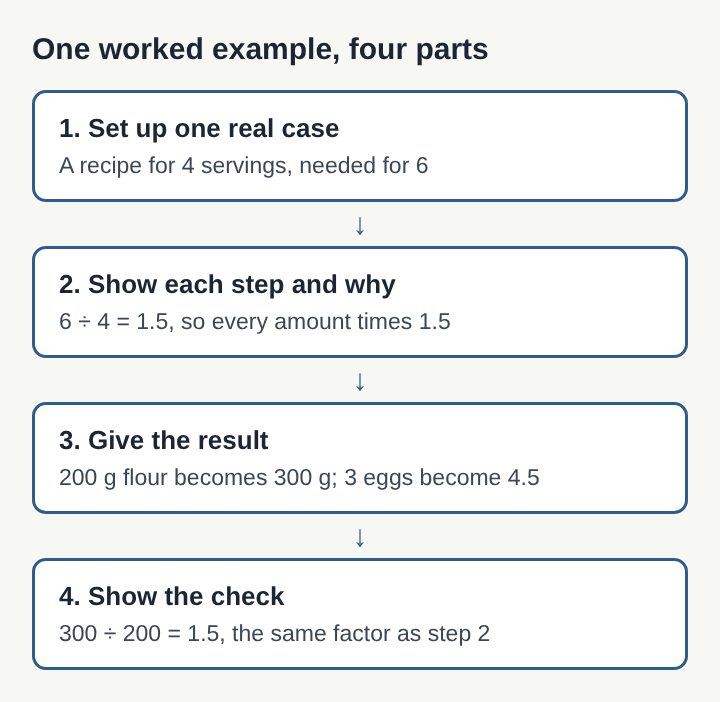
Set up the case. The recipe makes 4 servings and lists 200 grams of flour and 3 eggs. The reader needs 6 servings.
Step one: find the factor. Divide 6 by 4. The answer is 1.5. This number is the amount every ingredient grows by, so it is worked out once, before touching the list.
Step two: apply it to each amount. 200 grams of flour times 1.5 is 300 grams. 3 eggs times 1.5 is 4.5 eggs.
Step three: deal with the awkward result. Nobody can crack half an egg cleanly, so the guide says what to do: use 4 eggs and a little extra milk, or beat 5 eggs and leave a small amount out. This is the step a beginner would not expect, which is exactly why it belongs in the example.
Step four: check the result. Divide the new amount by the old one: 300 divided by 200 is 1.5, the same factor as step one. If any ingredient gives a different number, it was scaled wrong.
Notice what the example does. It uses real values, writes the obvious first step, gives a reason at each move, handles the one odd case, and ends with a check the reader can run in five seconds.
Fade the steps in the second case
One worked example shows the method. A second case, with some of the work left to the reader, is what makes it stick. The research calls this a faded worked example: the solved steps are taken away one at a time, so the reader moves from studying a solution to producing one.
Fading also gets the reader explaining the steps to themselves, which the same research ties to better learning. Most learners, it notes, explain examples to themselves only on the surface unless something prompts them. A faded step is that prompt.
In a guide, fading is simple. After the full example, give a second case, say scaling the same recipe down to 2 servings, and write only the first step. Ask the reader to finish it, then give the answer: a factor of 0.5, 100 grams of flour, and 1.5 eggs, rounded to 1 or 2 with the same advice as before. The reader now has proof they can do it without help.
Frequently asked questions
How long should a worked example be?
Long enough to show every step of one case, and no longer. For most how-to guides that is three to seven steps, each one or two sentences.
Where should the worked example go in a guide?
After the short answer and before the details. The reader gets the method in one paragraph, then sees it done once, then reads the finer points.
Should a guide have more than one worked example?
One full example and one faded case is usually enough. More full examples help only when the cases differ in a way that changes the method.
What makes a worked example confusing?
Skipped steps, made-up placeholders in place of real values, and no way to check the result. Each one leaves the reader guessing whether they did it right.
When worked examples stop helping readers
Worked examples are built for beginners, and their value drops as a reader gains skill. The research calls this the expertise reversal effect: once learners know the method, a fully solved case adds little and can slow them down, because they have to read through steps they already do without thinking.
That has a plain consequence for writers. Match the example to the reader the guide is for. A guide for newcomers should show every step with its reason. A guide for people who already know the basics can give a shorter example, or go straight to a faded case and let the reader fill in the rest. The goal of a worked example is a reader who no longer needs one.
Electrified