Learning how to write clear instructions for beginners comes down to one habit: write for the person who has never done the task, not for the person you are now. A beginner reads every word, takes each one literally, and has no way to fill a gap you leave. If a step skips something, they do not guess. They stop, or they guess wrong and break something.
Good practical guides of every kind depend on that habit. On a site where anyone can write notes and articles, most of what is there is practical guides on AI safety, security, study skills, history and games. Those guides open with the answer, then work through an example. They also end with 3 to 5 follow-up questions, each answered. That shape suits instructions well, because a beginner needs to know where they are going before they take the first step.
How to write clear instructions for beginners: start with the result
Before step one, tell the reader three things: what they will have at the end, roughly how long it takes, and what they need in front of them. This is the answer-first order from the inverted pyramid, applied to a task.
Take one worked example and carry it through every step. You are writing instructions for turning on two-step verification for an email account. A weak opening says: "Two-step verification is an important security feature. Here is how to set it up." The reader still does not know what will change or what to have ready.
A clear opening says: "When you finish, your email account will ask for a six-digit code from your phone each time you sign in on a new device. This takes about ten minutes. You need your phone, your email password, and a pen and paper."
Now the reader can decide whether to start now or later. They can gather the pen before step four asks for it. And they know what done looks like, so they can tell when they have arrived.
Write one action per step in beginner instructions
Each numbered step should ask for one thing. Experts bundle actions because the actions feel like one motion to them. A beginner has to hold each action in mind while hunting for the button, and every extra action adds to what psychologists call cognitive load: the amount of new information working memory has to handle at once.
Here is a bundled step: "Go to settings, open the security section, turn on two-step verification and scan the code with your authenticator app."
That is four actions. If the reader fails at the third, they have to read the whole sentence again to find their place. Split it:
- Open your account settings.
- Choose the security section.
- Turn on two-step verification.
- Open the authenticator app on your phone and scan the square code on your screen.
Step four still has two verbs, but they belong together: the reader cannot scan without opening the app. Use that as your rule. Keep two actions in one step only when the second cannot happen without the first, and only when both are simple.
Put the verb first, too. "Choose the security section" works better than "The security section is where you go next." The reader scans for what to do, so put what to do at the front.
Define every term a beginner meets in the instructions
The hardest words to spot are the ones you stopped noticing years ago. Researchers call this the curse of knowledge: once you know something, it is hard to recall what it was like not to know it. In a 1990 study by Elizabeth Newton at Stanford, people who tapped out well-known songs with their fingers kept overestimating how many tunes their listeners would name, because the tappers could hear the melody in their heads. You write "authenticator app" without a second thought. A beginner reads it and stops.
Go through your draft and mark every term a newcomer might not know. For each one, choose one of three fixes:
- Replace it with a plain word if the plain word is just as exact. "The square code" can replace "QR code" if the reader only needs to find it on screen.
- Define it in the same sentence the first time it appears. "Install an authenticator app, a phone app that makes a new six-digit code every 30 seconds."
- Name it once, then keep the name. If you call them "backup codes" in step five, do not call them "recovery codes" in step seven. A beginner will think they are two different things.
Paul Graham makes a related point in Write Simply: simple words are easier for every reader, and a lot of readers of English are not native speakers. For instructions, simple words also mean fewer places where a reader can get stuck.
Show what success looks like after each instruction
A beginner does not know whether a step worked. An expert sees the screen change and moves on. A newcomer sees the screen change and wonders whether it changed the right way.
End each step with a checkpoint: one sentence that says what the reader should see now.
- Turn on two-step verification. A page opens with a square code and a line of letters under it.
- Scan the square code with your authenticator app. Your app now shows your email address with a six-digit number next to it.
- Type that six-digit number into the box on your computer. You see a message that says two-step verification is on.
Checkpoints do two jobs. They tell the reader to keep going when things are right. And they tell the reader to stop when things are wrong, at the step where the problem started, not three steps later when nothing matches.
Warn beginners about likely mistakes before each step
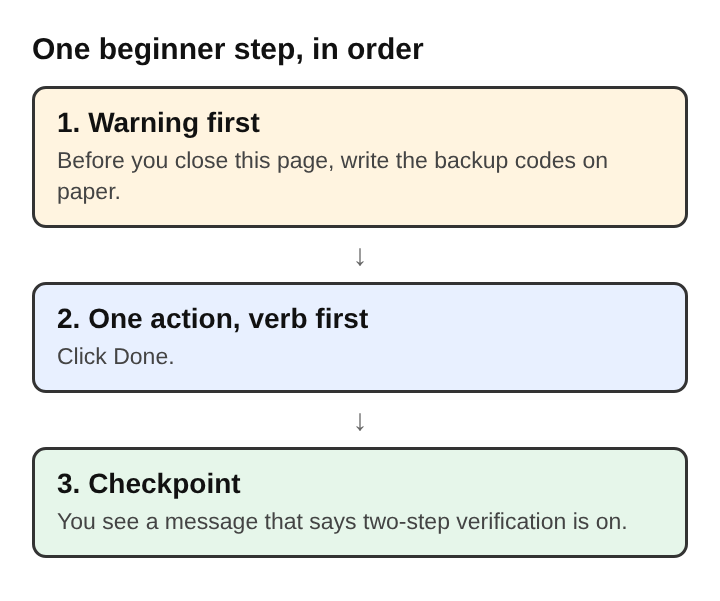
Put warnings before the step they apply to, not after. A reader follows instructions in order. A warning that comes after the action arrives too late.
In the two-step example, the most costly mistake is closing the page without saving the backup codes. If the reader loses their phone later, those codes are the only way back into the account. A weak version says: "Click Done. Note: make sure you saved your backup codes first." By the time the reader sees the note, they have clicked Done.
A clear version puts the warning first and makes it a step of its own:
- Before you close this page: write the backup codes on paper and keep the paper somewhere safe. You cannot see these codes again after you leave.
- Click Done.
You will not know every likely mistake from your own head. You find most of them in the next step.
Check beginner instructions with a real newcomer
Rereading your own instructions does not catch their gaps, because you fill each gap from memory without noticing. Self-editing still helps, and the habits in editing your own writing before publishing will tidy the sentences. But only a real beginner can show you where a beginner gets stuck.
Find someone who has never done the task. Give them your instructions and the tools they need. Then follow these rules:
- Do not explain anything. If you have to explain, your instructions need that explanation.
- Watch silently and write down every pause, every reread, and every question they ask out loud.
- Note where they look on the screen when they cannot find something. That tells you which words to use.
- Ask afterwards which step felt unclear, but trust what you saw more than what they say.
Fix each problem, then give the new version to a different newcomer. The first person has already learned the task and cannot be a beginner again. Repeat until a newcomer gets from the first step to the result without stopping.
Frequently asked questions
How long should a step in beginner instructions be?
Most steps should be one or two short sentences: the action, then what the reader should see. If a step needs a paragraph, it usually holds more than one action and should be split.
Should instructions for beginners use numbered lists?
Yes, when the order matters. Numbers let a reader keep their place, come back after a break, and tell someone exactly where they got stuck.
How many screenshots do beginner instructions need?
Add one where the screen changes in a way words cannot easily describe, or where the reader must find something small. Write each step so it still works without the image, because screens change and images fall out of date.
What makes instructions for beginners clear?
Clear instructions state the result first, ask for one action per step, define every unfamiliar term, show what success looks like, and warn about mistakes before they happen. They have also been checked by at least one person who had never done the task.
Writing clear instructions for beginners in public
Publishing instructions where anyone can read them puts the same check in front of a much larger group of newcomers. Every reader who follows your steps is checking them. When readers can comment, the person who got stuck at step four can tell you so, and that comment is worth more than any reread you do alone.
Treat those comments as changes to make. When a reader reports that a button has moved or a word confused them, fix the step and keep the rest steady, so people already partway through do not lose their place. Updating an old post without losing its readers follows the same idea. When several readers ask the same question, answer it in the instructions, either in the step itself or in a short set of follow-up questions at the end, written with the habits from writing an FAQ section.
Instructions written in public get clearer each time a beginner gets stuck and says where. Start with the result, one action per step, every term defined, a checkpoint after each action and a warning before each risk. Then let real newcomers show you what you missed.
Electrified