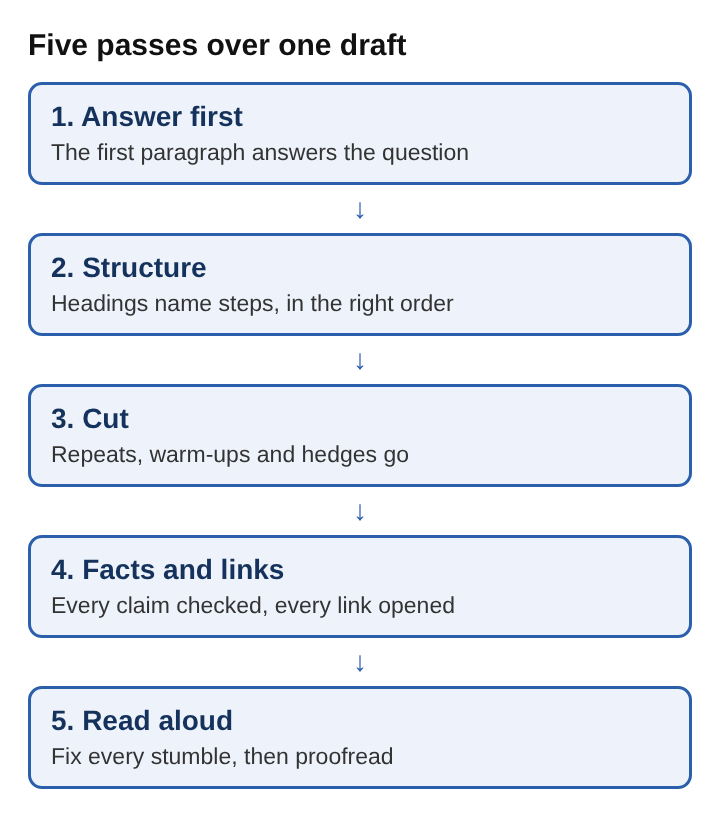
If you want to know how to edit your own writing before publishing, the short answer is this: let the draft rest, then read it several times, looking for one kind of problem each time. First check that the answer comes first. Then fix the structure, cut what does not earn its place, verify every fact and link, and finish by reading the whole thing aloud. Trying to catch everything in one read rarely works, because each read is best at finding one kind of problem.
This matters most when you write in public. On an open site of practical guides on AI safety, security, study skills, history and games, where anyone can make an account and write notes and articles, your name sits on every post and links to your page. A careful edit keeps the comments on your post about your ideas, not your mistakes.
The example used throughout is a draft guide that answers one question: "How do I back up the photos on my phone?" The draft was finished last night.
Why editing your own writing needs distance from the draft
Right after you finish a draft, you cannot see it. You read what you meant to say, not what is on the page. Your memory fills the gaps.
Distance breaks that. The simple version is time. Leave the draft overnight if you can. If you cannot, do something unrelated for an hour, then come back. A second trick is to change how the text looks: read it on your phone, print it, or switch the font.
Paul Graham puts the whole process in one line in Writing, Briefly: write a bad first version fast, then rewrite it over and over. Editing is the rewriting part. It is not a final polish. It is most of the work.
First editing pass: check that the draft answers the question first
Start with the biggest question, because if this one fails, polishing sentences is wasted effort. Read only the title and the first paragraph. Then ask: if the reader stopped here, would they have what they came for?
In the photo backup draft, the first paragraph talks about how many photos people take and how sad it is to lose them. The actual method, turning on automatic backup and checking it ran, shows up in paragraph four. That is backwards. The reader came with a question, and the answer is hiding.
The fix is to move the answer to the top. News writers call this the inverted pyramid): the most important information goes first, and detail follows in order of importance. There is a longer explanation in what the inverted pyramid is in writing. For a practical guide, it means your opening paragraph gives the short answer in two or three sentences, and the rest of the guide shows how to do it.
Second editing pass: fix the structure and headings of the draft
Now read only the headings, top to bottom, and nothing else. They should tell the story of the guide on their own. If a heading says "Some background" or "Other things," it tells the reader nothing about whether to read that section.
Rewrite each heading so it names a step or answers a question. "Other things" becomes "What to do if the backup stops." "Background" either becomes a real step or gets cut. Writing headings this way is its own skill, covered in how to write headings that answer a question.
Then check the order. Steps should appear in the order a reader would do them. In the example draft, the section on freeing up storage comes before the section on turning on backup. But a reader who deletes photos before the backup has run could lose them. Swap the two.
Last, give each paragraph one job. If a paragraph explains a setting and also warns about storage limits, split it.
Third editing pass: cut words, sentences and whole paragraphs
The best-known advice on cutting comes from William Strunk's The Elements of Style: omit needless words. Every sentence should do something for the reader. If it does not, it goes.
Work from large to small. First look for whole paragraphs that repeat a point already made. The photo draft explains why backups matter twice, once in the opening and again before the conclusion. Keep one. Then look for warm-up sentences at the start of sections, such as "Now that you understand the basics, it is time to move on." Delete them. The heading already did that job.
Then go sentence by sentence. Common things to cut:
- Hedges such as "basically," "kind of" and "it could be said that."
- Doubled words such as "each and every" or "first and foremost."
- Phrases that announce instead of saying, such as "It is important to note that." Just note it.
- Paragraphs you enjoyed writing but that do not help the reader do the task.
That last one is the hardest. Save cut paragraphs in a separate file if it helps you let go.
Fourth editing pass: verify facts, sources and links before publishing
This pass is slow, and it protects you most. Go through the draft and mark every statement that could be wrong: every number, every name, every claim about what an app or setting does, every menu path such as "Settings, then Photos."
For each one, find where it came from. If it came from a source, link that source in the same paragraph. If a menu path came from memory, open the app and follow it yourself. Menus change, and a wrong step stops a reader cold. A full method for this is in how to fact-check your own blog post before it goes out.
Then click every link. Check that it loads and that the page says what you claim it says.
Final editing pass: read the draft aloud for rhythm and errors
Read the whole draft out loud, slowly. Your ear catches what your eye skips: a sentence that runs out of breath, a word used three times in a row, a missing "not" that flips the meaning.
Paul Graham argues in Write Like You Talk that more people will read what you write if you write in spoken language. Reading aloud is the quickest way to hear where your draft is not. If you would never say a sentence out loud, rewrite it until you would.
This is also the right moment for proofreading: spelling, punctuation, doubled words, broken formatting. It comes last on purpose. Earlier passes rewrite and delete sentences, so any typo you fixed before them might be gone anyway.
Editing your own writing when you publish in public
On an open site, strangers read the guide without hearing you explain it. Guides on that open site of practical guides follow a shape that maps onto the editing passes. Each opens with the answer, then works through an example. Every claim a guide makes about a product is matched to a source page before the guide is saved. Each guide ends with 3 to 5 follow-up questions, every one answered.
That shape gives you a useful editing frame for your own posts, wherever you publish. The answer-first opening is the first pass. Matching each product claim to a source is the fourth. The follow-up questions are a final check: if you cannot write three questions a reader would still ask, and answer each in a sentence or two, the guide may have gaps. There is more on writing those in how to write an FAQ section for an article.
Publishing in public also means the edit does not end when you press publish. On that site, if something in a post is wrong, readers say so in its comments, and each post shows who wrote it. Treat those comments as one more editing pass, done by people who came with the question you set out to answer.
Frequently asked questions
How long should a draft rest before self-editing?
Overnight is a good default, because a night away makes the text feel less familiar. If you are short on time, even an hour on unrelated work helps more than editing straight away.
Should spelling and grammar be fixed first or last?
Last. The earlier passes move, rewrite and delete whole sentences, so fixing small errors first wastes effort on text that may not survive.
How many editing passes does a practical guide need?
Five focused passes cover most needs: answer first, structure, cutting, facts and links, then reading aloud. A short note may need fewer, and a long guide may need the cutting pass twice.
How do you know a piece of writing is ready to publish?
It is ready when the first paragraph answers the question, every heading names a step or question, every fact has a source or has been checked by hand, and you can read it aloud without stumbling. It will never feel perfect, so use that list instead of a feeling.
How to edit your own writing before publishing: the short checklist
- Let the draft rest, ideally overnight, and change how it looks before you read it again.
- Read the title and first paragraph alone. Move the answer to the top if it is not there.
- Read only the headings. Make each one name a step or answer a question, and put the steps in the order a reader would do them.
- Cut repeated paragraphs, warm-up sentences, hedges and anything that does not help the reader do the task.
- Mark every fact, number and claim. Link its source or check it yourself, then open every link.
- Read the whole draft aloud, slowly, and fix every place you stumble.
- Proofread spelling and punctuation last, once nothing else is going to change.
Each pass asks one question. Asked one at a time, they catch what a single careful read would miss.