Knowing how to fact-check your own blog post comes down to one careful pass: go through the draft sentence by sentence, mark every statement a reader could prove wrong, and trace each one back to the page where it first appeared. Compare your words with that page, then fix the sentence, cut it, or put a link on it. The whole pass takes a short while for most posts, and it is the step that keeps a small slip from becoming the thing readers remember.
Some places that publish practical guides build this step in. On a site where anyone can write notes and articles and be read, every claim a guide makes about a product is matched to a source page before the guide is saved, and readers who find something wrong say so in the comments. You can run the same check on your own, on any blog, before you press publish.
Why checking comes before publishing
Newsrooms call this internal fact-checking: the publisher verifies the claims in a piece before it goes out, so errors never reach readers. Checking after publication is still possible, but by then the mistake has been read, shared and sometimes copied into other posts.
A blog post has no editor standing between you and the reader. That makes you the fact-checker as well as the writer. The good news is that a solo check does not need special tools. It needs a list of claims, the original pages, and a willingness to delete a sentence you liked.
How to fact-check your own blog post, claim by claim
Work in four steps, in this order. Doing them in order matters, because each step depends on the one before it.
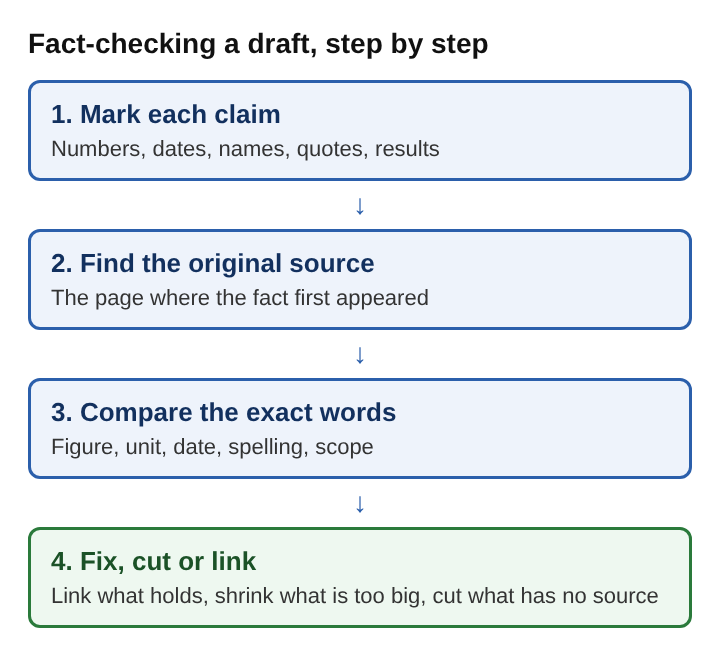
- Mark each claim. Read the draft slowly and highlight every sentence that states a fact: a number, a date, a name, a quote, a rule, a result. Opinions and advice can stay unmarked. A sentence that says "most people" or "studies show" is a claim and gets marked.
- Find the original source. For each marked sentence, find the page where the fact first appeared, not the page where you happened to read it.
- Compare the exact words. Put your sentence next to the source. Check the number, the unit, the date, the spelling of names and the scope of the claim.
- Fix, cut or link. If the source supports the sentence, put a link on the words that make the claim. If it supports a smaller version, shrink the sentence. If you cannot find support, cut it.
Finding the original, not a copy of it
Most facts on the web are repeated from somewhere else, and each repetition can drift. A figure gets rounded, a "may" becomes "does", a study of one group becomes a rule about everyone. The fix is to keep following the trail until you reach a primary source: the original document, data or first-hand account. In journalism that can be a person with direct knowledge of the event, or a document they wrote.
For a product, the primary source is the product's own page. For research, it is the paper or the institution that ran the study. For a quote, it is the speech, interview or text where the words were said. A news article or another blog post is a pointer that helps you find the original, not the original itself.
When two sources disagree, say so in the post, or pick the one closer to the event and link it. Never average them or quietly choose the one that suits your point.
A worked example: three sentences in one draft
Say your draft about sleep and study contains these three sentences:
- "Students who sleep eight hours get 40% higher exam marks."
- "The spacing effect was first described in the 1880s."
- "Most study apps track how long you spend on each card."
Step 1, mark. All three state facts, so all three are marked.
Step 2, find. You search for the first one and find it on a lifestyle blog with no link. You keep looking and find no study with that number. The second you trace to an encyclopedia entry that names the researcher and the year of the original work. The third came from your own memory of two apps.
Step 3, compare. The first sentence has no source at all. The second matches the entry, and the entry names the original work, so you open that too. The third rests on two examples, which cannot support "most".
Step 4, decide. Cut the first sentence. Keep the second and put a link on "first described". Shrink the third to "Some study apps track how long you spend on each card", which your two examples do support. The post is shorter by one sentence and every remaining fact now points somewhere a reader can open.
Numbers, quotes and dates need the closest look
Three kinds of claim go wrong more often than the rest, so give them a second pass.
Numbers. Check the figure, the unit and what it counts. "10,000 users" and "10,000 visits" are different claims. Check the year the number belongs to, because a figure that was right three years ago may be wrong now.
Quotes. Copy quotes from the source, never from memory, and never from a page that does not link the original. Famous lines are often attributed to the wrong person. If you cannot find where the words were first said or written, describe the idea in your own words instead of quoting.
Dates and names. Check spellings letter by letter, and check that the date is the event's date and not the date a page about it was published.
Wikipedia's rule on verifiability is a useful rule for a blog too: readers should be able to check that a claim matches a reliable published source, and quotes or claims likely to be challenged should carry a citation right where they appear.
Keeping a record of what you checked
A short list kept next to the draft saves time later. For each claim, write the sentence, the source page and the date you opened it. When a reader questions a fact, you can answer in a minute. When you update the post a year later, you know which facts to check again.
Links also decay. Pages move or disappear, and a link that once proved your point can turn into a dead end, a problem known as link rot. Recording the source's title next to its address, and saving a copy in a web archive for anything important, lets you find the page again if its address changes.
Finally, leave a way for readers to tell you about mistakes, such as comments or a contact address, and correct the post openly when they do. A note saying what changed and when keeps the trust that a silent edit would lose.
Frequently asked questions
How long does it take to fact-check a blog post?
It depends on how many claims the post makes. A post with ten checkable facts usually takes a few minutes per fact, and most of that time goes into finding the original source.
Do opinions need fact-checking?
The opinion itself does not, but the facts it rests on do. If an argument depends on a number or an event, check that number or event.
Is a Wikipedia link good enough as a source?
It is a good place to start and often fine for general background. For a specific number or quote, follow its references to the original and link that when you can.
What should you do if you find a mistake after publishing?
Correct it in the post and add a short note saying what changed and when. Readers who saw the first version can then see that it was fixed.
Fact-checking as part of writing well
Fact-checking your own work is less about catching lies than about catching drift: the rounded number, the remembered quote, the "most" that should have been "some". Each check is small. Together they turn a draft into something a reader can rely on and verify for themselves.
The habit also changes how you write. Once you know every claim will be traced, you start making fewer claims you cannot support, and you write the ones you keep with more care. The result is a post that says a little less and means all of it.