When you work out how to write an article people can skim, start with one rule: put the answer first. Most readers land on a page with a question, look at the opening lines and the headings, and decide in a few seconds whether to stay. If the answer sits in the first paragraph and every heading names a real question, the skimmer gets what they came for. The careful reader still gets the full explanation. You can see the habit at work on a site of practical guides that anyone can write for, covering AI safety, security, study skills, history and games, where each guide opens with its answer.
Why readers skim an article before reading it
Skimming is a reading method in its own right. The Wikipedia entry on speed reading describes it as searching a page for clues to the main idea: reading the beginning and the end for a summary, then the first sentence of each paragraph to decide whether to look for more detail. The same entry notes that scanning leans on the headings and other highlighting the writer provides.
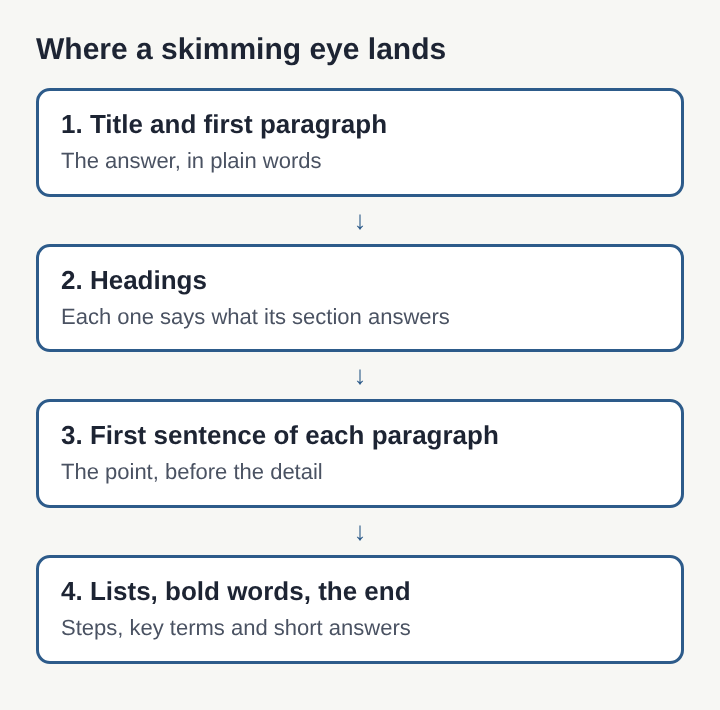
A skimmer is not a lazy reader. They are checking fit. They want to know three things:
- Does this page answer the question that brought them here?
- Where on the page is the part they need?
- Is the rest worth the time?
If your page answers those three quickly, the skimmer often turns into a full reader. If it hides the answer under three paragraphs of background, they leave. So writing for skimmers does not mean writing less. It means arranging what you write so the useful part shows first.
Answer the question in the first lines of the article
Writers who lead with background are telling the story in the order they learned it. Readers want it in the order they need it. Newsrooms solved this long ago with the inverted pyramid): the most important facts at the top, details after, background last. There is a longer explanation of how the inverted pyramid works in writing if you want the full shape.
In emails and reports the same rule goes by another name, bottom line up front): begin the message with its key information, so the reader gets the most important part first, then the reasons.
Here is a worked example. A reader searches for how to turn on two-factor authentication for an email account. A background-first opening explains what passwords are, why accounts get taken over, and how login codes came about. The answer arrives in paragraph five. An answer-first opening says: turn it on in the account's security settings, pick how you want to receive login codes, and save the backup codes somewhere you can find them. Then the guide walks through each step.
The second version serves both readers. The skimmer is done after two sentences. The careful reader now knows where the guide is going and can follow the steps with that in mind.
A quick way to write this opening: finish the draft, then ask what you would say if the reader gave you one breath to answer. Put that sentence first.
Headings that let readers skim an article by question
After the opening, headings do most of the work for a skimmer. A reader jumps from heading to heading, looking for the one that matches their question. Vague headings break that search.
Compare these two sets for the same security guide:
- Vague: "Background", "Setup", "Other things", "Wrapping up".
- Specific: "Where the security settings are", "Choosing how to get login codes", "Where to keep backup codes", "What to do if you lose your phone".
A reader can act on the second set. Someone who already turned the feature on and then lost their phone jumps straight to the last heading.
Some rules that keep headings useful:
- Name the subject in every heading. A heading should make sense if it is the only line the reader sees.
- Phrase headings as questions or tasks when the reader arrives with a question or a task.
- Keep one idea per heading. If a section covers two things, split it.
- Match the reader's words. If people search for "backup codes", do not call them "recovery tokens" in the heading.
Short paragraphs, lists and bold text for skimming
Inside each section, the first sentence carries the most weight. Skimmers read it and move on. So write each paragraph so its first sentence states the point, and the rest supports it.
Keep paragraphs short. Two to four sentences is enough for most points on a screen. A long block of text hides its key line in the middle, where a skimmer will not find it.
Use lists when the content is a list: steps in order, options to choose between, items to gather before starting. Do not turn every paragraph into bullets, though. An argument with "because" and "so" in it reads better as prose, since the links between ideas matter.
Bold text works when it is rare. Bold the one phrase in a section a reader must not miss, such as a warning or the key setting name. If half the page is bold, nothing stands out.
Plain words help too. Paul Graham argues in Write Simply that ordinary words and simple sentences are easier to read, that readers go further when reading costs them less effort, and that many readers of English are not native speakers. A skimmer moving fast gains the most from short, common words.
Skimmable practical guides written in public
Writing in public adds pressure that helps here. When anyone can read a guide and comment on it, a buried answer gets noticed quickly. The guide site linked in the opening is built around this kind of writing: anyone can make an account, get their own page, and post short notes or longer articles, and each post shows who wrote it.
The guides there follow a shape that fits everything said so far about openings and headings:
- They open with the answer, then work through an example.
- Every claim about a product is matched to a source page before a guide is saved.
- They end with 3 to 5 follow-up questions, each answered.
- Each guide is filed under its subjects, such as AI alignment, study tips or castles, so the next guide a reader needs is a click away.
The follow-up questions at the end serve skimmers in a second way. A reader who scrolls to the bottom finds short answers to the questions that come up next. There is more on how to write an FAQ section for an article if you want to add one to your own guides.
Public writing also gives you feedback. If something in a post is wrong, readers say so in its comments. That feedback often shows exactly where a skimmer got lost: the question they asked is the heading you were missing.
Checking whether an article can be skimmed
Before you publish, go over the draft the way a skimmer will. These checks take a few minutes.
- Read only the first two sentences. Do they answer the question in the title? If not, move the answer up.
- Read only the headings. Could a reader find the section they need from these alone? Rewrite any heading that would not make sense on its own.
- Read only the first sentence of each paragraph. Does the article still make its case? If a first sentence is a warm-up, cut it or swap it with the real point.
- Look at the shape on a phone screen. Any paragraph that fills the screen is too long.
- Count the bold phrases. If there are more than one or two per section, trim them.
- Ask someone else to find one fact. Give a friend a question the article answers and watch how long it takes them to find it.
The last check is the most honest. Writers know where everything is in their own draft, so they cannot see what a stranger cannot find.
Frequently asked questions
Does writing for skimmers make an article shallow?
No. The full explanation stays on the page. Answering first and using clear headings only changes the order, so readers who want depth still get it and readers who want the short answer get that too.
How long should the opening answer be?
One to three sentences is usually enough. It should answer the question in the title directly, then the rest of the article explains and supports it.
Should every heading be a question?
Not every one. Question headings suit pages where readers arrive with questions, but task headings such as "Choosing how to get login codes" work just as well. What matters is that each heading names something specific.
Are bullet lists always easier to skim than paragraphs?
Lists are easier to skim for steps, options and checklists. Reasoning that depends on "because" and "so" reads better as short paragraphs, since bullets drop the connections between ideas.
How to write an article people can skim, from first line to last heading
Put the pieces together and the method is short. Write the answer in the first lines. Give every section a heading that names its question or task. Open each paragraph with its point, keep paragraphs short, and use lists only for real lists. Bold the rare line that must not be missed. End with the questions a reader will ask next, each answered briefly.
Then read your own draft three ways: first lines only, headings only, first sentences only. If each pass still tells the reader what they need, the article works for skimmers and full readers alike. The careful reader loses nothing, and the hurried one leaves with an answer instead of a back button.