What is the inverted pyramid in writing? It is a way of ordering a text so that the most important information comes first, and each later paragraph carries less essential detail than the one before it. A reader who stops after the first paragraph still has the main point. A reader who keeps going gets more depth, not a new story.
The name describes the shape of the information: wide at the top, where the key facts sit, and narrowing toward the bottom, where background and side details end up. Electrified, a place to write and be read with practical guides on AI safety, security, study skills, history and games, builds its guides in the same order: the answer first, then an example.
Where the inverted pyramid structure came from
The structure comes from news writing. The Wikipedia entry on the inverted pyramid in journalism) describes it as the usual shape of a news report, with the who, what, when, where and why placed at the start.
Historians disagree on when it began. It is often linked to the telegraph, which may have pushed reporters to condense their copy and to guard against unreliable lines: a writer who put the key facts first lost the least if a message broke off. Studies of nineteenth-century American newspapers suggest it spread decades later, as reporting turned toward plain fact. Treat the telegraph as one explanation, not a settled one.
Whatever the origin, the reason it lasted is practical. Readers can stop at any point and still have the core of the story, and editors can cut from the bottom without losing the essentials. The same Wikipedia entry on news style calls the first sentence of a news story its lead, a brief statement of the essential facts, ideally about 20 to 25 words. Its warning to writers is short: do not bury the lead.
What is the inverted pyramid in writing? Three layers
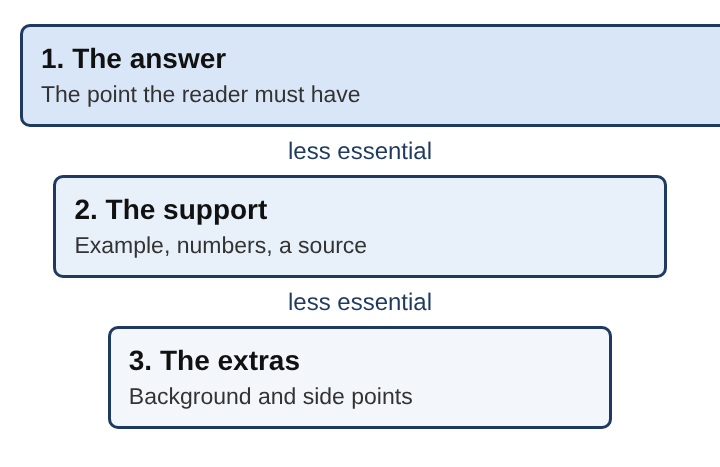
Most pyramids have three layers. You do not need to label them, but you should know which paragraph belongs to which.
- The top: the answer. The one or two sentences a reader must have. If the text is a news report, this is what happened. If it is a guide, this is the answer to the question in the title.
- The middle: the support. The details that make the answer usable or believable: conditions, numbers, an example, a source, an exception.
- The bottom: the extras. Background, history, related points, and anything a reader could miss without being misled.
A quick check: cover the last third of the text. If the reader would still act correctly, the bottom is doing its job. Now cover the last two thirds. If the reader still knows the main point, the top is doing its job.
Writing the opening lines of an inverted pyramid
The opening is where most pyramids succeed or fail. A good opening answers the question the reader arrived with, in plain words, before any setup.
Here is an invented news example. A weak opening reads: "After weeks of discussion among local officials, a decision was reached on Tuesday regarding a well-known crossing." A strong opening reads: "The river bridge on Main Street closed on Tuesday after inspectors found cracks in two support beams. Drivers are being sent through the north road." The second version names the thing, the event, the cause and the effect in two sentences. The rest of the report can then cover the inspection, the repair plan and the history of the bridge.
Some habits help:
- Write the opening last, once you know what the text actually says.
- Put the subject and the verb early in the first sentence.
- Cut any sentence that only announces what is coming.
- Keep the opening short enough to read in one breath, usually two sentences.
The inverted pyramid in practical guides
A practical guide is written for someone who has a question and wants to act. That makes the pyramid a natural fit, because the reader's first need is the answer, and the second need is proof that it works.
Take an invented question: "How do I renew a library book online?" The top of the pyramid is the answer: sign in to your library account, open your loans and press renew. The middle is a worked example, such as a book due on Friday that you renew on Wednesday and see a new due date. The bottom holds the extras: what happens if another reader has reserved the book, and how to renew by phone.
Now compare that with a guide that starts with the history of lending libraries. The reader with the question has to dig for the steps. The pyramid puts the answer where the eye lands first.
The same pattern shows up in how its guides are built. They open with the answer, then work through an example, and end with 3 to 5 follow-up questions, each answered. Those closing questions sit at the bottom of the pyramid, which is the right place for them: they catch the edge cases that matter to some readers but not to all. When a guide makes a claim about a product, that claim is matched to a source page before the guide is saved, which keeps the support layer honest.
The inverted pyramid when writing in public
When you write in public, people reach your text from many directions. Some arrive from a search, some from a feed, some from a friend's link. Most of them decide in a few seconds whether the text is for them. The top of the pyramid is what they see in that window.
Public writing also gets corrected in the open. Each post shows who wrote it, and if something in it is wrong, readers say so in its comments. A pyramid helps here, because a reader who disagrees can tell which claim to challenge: the answer sits in plain view at the top, and the support sits right beneath it.
Filing also follows the same logic. When a post is filed under its subjects, such as study tips or castles, a reader who finishes one text can move to the next with one click. The pyramid serves the reader who needs only the top, and the filing serves the reader who wants more.
For short notes, the pyramid collapses to a single layer: one sentence that states the point, maybe one more that supports it. For longer articles, all three layers appear. The order stays the same.
Common inverted pyramid mistakes
Burying the answer
The most common mistake is starting with context. Writers feel the reader needs setup, but the reader came for the answer. Move the setup into the middle layer, where the reader who needs it will find it.
Overloading the top
The opposite mistake is cramming every fact into the first paragraph. A top layer with seven points has no priority. Pick the one point that matters most, state it, and let the others follow in order.
Writing a teaser
An opening that hints at an answer without giving it ("There is one simple trick most people miss") is not a pyramid. It delays the answer and makes the reader work for it. State the trick.
Ending with a repeat
A pyramid does not need a wrap-up that restates the opening. The bottom layer is allowed to simply stop once the useful detail runs out. If the text has follow-up questions, those can close it instead.
Ordering by time instead of importance
Stories and tutorials often run in the order things happened. The pyramid orders by importance. In a guide, that means the result comes first and the steps follow, even if the steps happened first in real life.
Frequently asked questions
Does the inverted pyramid suit every format?
No. It fits news reports, guides, answers and short notes well. Narrative writing, such as a personal essay or a story, often depends on building toward a point, so the pyramid would remove what makes it work.
How long should the opening of an inverted pyramid be?
Usually one to three sentences. The opening should hold the single point a reader must have, with no setup. If it needs a full paragraph, the point is probably more than one point.
Can an inverted pyramid include a conclusion?
It can, but it does not need one. Because the main point is already at the top, a closing paragraph that repeats it adds little. A short list of follow-up questions or a related detail is a better ending.
What is the inverted pyramid in writing?
It is a structure in which the most important information comes first and the supporting detail follows in order of decreasing importance. It comes from news writing and suits any text where the reader wants the answer quickly.