An FAQ section is a short run of questions and answers placed after the main body of an article. If you want to know how to write an FAQ section for an article, the method is short: collect the questions readers really ask, put the answer in the first sentence of each entry, and keep the list small. Each of those moves has details that decide whether the section helps readers or only pads the page.
What an FAQ section for an article does
The body of an article follows one main question. Readers often arrive with that question plus two or three neighbours: a limit, an edge case, a "what if". Those neighbours rarely fit in the main flow without slowing it down. The FAQ section is where they go.
The name is short for frequently asked questions. The Wikipedia entry on FAQ points out that the questions are generally not asked often: the format is a question-answer list, and each question may combine several real ones. In an article, the same idea applies at a smaller scale. A reader who finished the body gets the loose ends tied. A reader who skims jumps straight to the questions and may get what they came for in under a minute.
Some sites already work this way. Electrified is a place to write and be read, with practical guides on AI safety, security, study skills, history and games, and its guides end with 3 to 5 follow-up questions, each answered. The format is plain: the guide answers the main question, then the closing questions cover what a reader is likely to ask next.
Find the real questions for an FAQ section
Do not invent questions to fill space. Collect them from places where readers have already asked.
- Comments and messages. Any question a reader asked after a similar post is a candidate.
- Questions people ask you in person. If you explain the same thing twice, a third person will want it too.
- Your own early confusion. The question you had when you first learned the subject is often the one beginners have now.
- Search suggestions. Type the start of a question about your subject into a search box and note what it completes.
Say you wrote a guide to setting up a home printer. This is an invented example. The real questions might be: can a phone print to it, why does the printer say it is offline, and what happens when the ink is not the right model? Those are specific and a reader could act on each one.
Then filter. Cut any question the body already answers in full. Cut any question that exists only to repeat a keyword. Keep the ones that need a different angle from the main text, such as a condition, an exception or a next step.
Answer first: how to write an FAQ section for an article one entry at a time
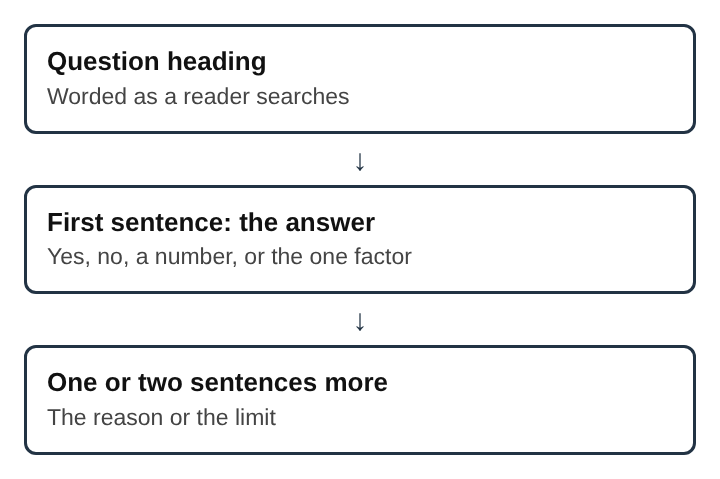
Each entry should have the same structure as the whole article: the most important point first, then the detail. Journalists call this shape the inverted pyramid), a way of ordering information so the basics come in the opening sentences. Wikipedia notes it has been adapted to other writing, such as blogs. There is a longer look at it in the article on the inverted pyramid in writing.
For an FAQ entry, that means the first sentence is the answer. Not a warm-up, not a restatement of the question, not "it depends" with nothing after it.
Here is a weak opening for the question "Can a phone print to the printer?":
Many people wonder about this, and there are different ways to set a printer up.
Here is a stronger one:
Yes, if the printer has wireless printing. Check the model name on the box.
The second version gives the reader the answer in the first word and then adds the one condition that matters. That is the whole pattern: answer, then the reason or the limit, in one to three sentences. If an answer needs more than that, the question belongs in the body of the article as its own section.
When the answer is yes or no, say yes or no. When it is a number, give the number. When it truly depends, name the one factor it depends on in that first sentence.
Word FAQ questions the way readers search
Readers type plain words. Write the question in the form they would use, with the subject named in full.
- Name the subject. Write "How long should each FAQ answer be?" instead of "How long should it be?" Each question has to make sense alone, because a reader may land on one entry without reading the rest.
- Use the reader's words. If readers say "exam", do not write "assessment". Insider terms belong in the answer, where you can explain them.
- Ask one thing. A question with an "and" in it usually hides two entries.
- Keep it short. A question that runs past one line is probably two thoughts.
Read each question aloud as if a stranger asked it. If you would need to know the article to understand it, reword it.
How many questions an FAQ section for an article needs
Three to five is enough. That range keeps every entry worth reading and the section short enough to scan in a glance.
If you have eight candidate questions, do not publish eight. Ask of each one: could this be a sentence in the body instead? Often three of them can. The body gets more complete, and the FAQ keeps only the questions that need their own entry.
If you have only one question, that is also a fact worth noting. Your article may have covered the subject well. A single stray question can go into the body, and the FAQ section can be left out.
Writing an FAQ section in public
Publishing under your name changes where the questions come from. On that site, anyone can make an account, get their own page, and write short notes and longer articles. Each post shows who wrote it and links to that writer's page. Readers can comment, and if something in a post is wrong, readers say so in its comments.
That loop is useful for an FAQ section. A comment that asks "what about this case?" is a ready-made question. When the same doubt shows up twice, it has earned an entry. You can also read the corrections: a comment that points out a mistake tells you which claim needed a clearer answer.
Writing in public also keeps you honest about claims. Electrified matches every claim a guide makes about a product to a source page before the guide is saved. FAQ answers are the easiest place for loose claims to slip in, because they are short and feel casual. Hold them to the same rule as the body: if you cannot point to where a fact came from, leave it out.
Headings and markup for an FAQ section
Keep the structure plain and predictable.
- Put the section after the body, as the last part of the article.
- Give it one heading at the second level, titled "Frequently asked questions".
- Write each question as its own heading at the third level, ending with a question mark.
- Put the answer in a paragraph directly under its question. Do not split an answer across lists and sub-sections.
Question headings do two jobs. Readers scan them to find the entry they need, and each heading marks where its answer starts. That only works if the answer really follows the question with nothing in between, so avoid intro lines like "Here is the answer".
Use the same order in every article you write. When the section always sits in the same place with the same heading, regular readers learn to look for it.
Frequently asked questions
Should every article have an FAQ section?
No. Add one only when readers have real follow-up questions that the body does not already answer. A short note with no loose ends does not need one.
Where does the FAQ section go in an article?
At the end, after the main body, under its own second-level heading titled "Frequently asked questions". Each question is a third-level heading with its answer directly beneath.
How long should each FAQ answer be?
One to three sentences. The first sentence is the answer itself, and any further sentences give the reason or the limit.
How do you write an FAQ section for an article?
Gather real questions from comments, messages and your own early confusion, and pick three to five. Word each as a reader would search, answer it in the first sentence, and add a sentence or two of detail. Place them under one heading, each question as its own subheading.