Who were the greatest empire builders in history? Four names come up in almost every answer: Cyrus the Great of Persia, Alexander the Great of Macedon, Augustus of Rome and Genghis Khan of the Mongols. Each one ruled the largest state of his age. Yet their empires had very different fates. One broke apart within months of its founder's death. Another lasted for centuries.
The difference was rarely the fighting. Winning battles was the part these men shared. What set them apart was what they built after the battles: governors, roads, couriers, armies on a payroll and written law. The short lessons of Learn 100 Influential People give these rulers a course of their own, Empire Builders, in the part on the best-known names.
Who were the greatest empire builders in history, and why these four
Size is the first measure most people reach for, and all four pass it. Cyrus created the largest empire the world had seen up to his time. Alexander's realm ran from Greece to northwestern India. Augustus ruled the whole Mediterranean. The Mongol state that Genghis Khan founded became the largest contiguous empire ever.
But size alone hides the real question. An empire is a promise that distant people will keep paying taxes, obeying orders and staying at peace with each other, long after the army has marched on. The four men answered that question in four ways. Read their stories side by side and a pattern appears.
Cyrus the Great and rule through governors
Cyrus the Great came from Persis, in what is now southern Iran. He defeated the Median Empire and then took in the older states of the Near East one after another. His Achaemenid Empire, founded in 550 BC, grew to roughly 5.5 million square kilometres at its peak.
Two habits made it hold. First, Cyrus was known, even among Greek writers, for tolerating the customs and religions of the peoples he conquered. A city that kept its gods and its local ways had less reason to rebel. Second, he built a central administration that ruled the provinces through governors called satraps.
His successor Darius the Great pushed the borders furthest, from southeast Europe and northeast Africa to the Indus Valley. The empire was tied together by the Royal Road and an organized postal system, so orders and reports could cross it far faster than any single traveller.
Alexander the Great and the cost of speed
Alexander the Great became king of Macedon in 336 BC, at the age of 20, after his father Philip II was murdered. By 30 he had built one of the largest empires in history, stretching from Greece to northwestern India. He never lost a battle.
Then he died, and the empire did not survive him as one state. Civil wars broke out among his generals, the Diadochi, and roughly 40 years of war followed before the Greek world settled into three blocs, including Ptolemaic Egypt and the Seleucid Empire.
Still, Alexander changed the world in a way that outlasted his empire. The Greek cities he founded, such as Alexandria in Egypt, spread Greek language and culture. Hellenistic civilization became a major force in the ancient world, reaching as far east as the Indian subcontinent. His state fell apart; his culture did not.
Augustus and an empire built on roads
Augustus, born Octavian, was not the greatest general on this list. He became the first Roman emperor in 27 BC and ruled until AD 14. His strength was in what he set up behind the lines.
He reformed taxes and the currency. He developed networks of roads with an official courier system. He created a standing professional army, fixed at 28 legions of about 170,000 soldiers, funded by the state instead of by ambitious generals. These changes ended a century of civil war.
The result was the Pax Romana, a period of about two centuries in which the Roman world was largely free of armed conflict. Of the four, Augustus is the clearest case of a builder whose system mattered more than his conquests.
Genghis Khan and the largest unbroken empire
Genghis Khan, born Temüjin, spent most of his life uniting the Mongol tribes. In 1206 a great assembly, the kurultai, met at the source of the Onon River and gave him the title Genghis Khan. At that meeting he expanded his personal guard from 1,150 to 10,000 men. He then conquered large parts of China and Central Asia.
He also gave his people a law code, the Yassa, which later grew to cover much of the everyday life of the nomads. His heirs kept expanding. At its height the Mongol Empire was twice the size of the Roman Empire at its height and the largest contiguous state in history.
Four questions for weighing any empire builder
Rankings of rulers often stop at size or at battles won. A fairer way to weigh any of them is to ask four questions in order.
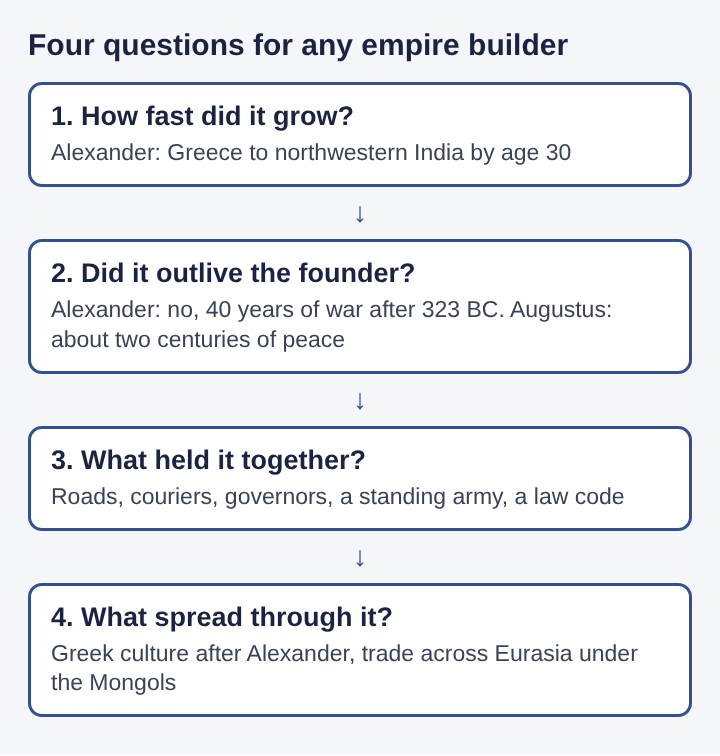
Take Alexander and Augustus through them.
- How fast did it grow? Alexander wins easily: Greece to northwestern India in about a decade. Augustus mostly kept what Rome already held.
- Did it outlive the founder? Alexander's empire split among his generals and 40 years of war followed. The system of Augustus brought about two centuries of peace.
- What held it together? Alexander's empire rested on Alexander. Rome after Augustus rested on roads, couriers, taxes and a salaried army that did not depend on one man.
- What spread through it? Here Alexander comes back. Greek culture spread across his old lands long after his state was gone.
The questions do not crown one winner. They show that "greatest" means different things. Alexander was the greater conqueror. Augustus was the greater builder. Cyrus and Genghis Khan each did well on both, with a system of governors in one case and a law code and a vast unbroken territory in the other.
The questions also touch an older debate. The great man theory of history credits such rulers with shaping events, while its critics say they were products of their times. The second and third questions lean toward the critics: what lasted was usually the system, not the man.
Frequently asked questions
Who built the largest empire in history?
Among empires that formed one unbroken stretch of land, the Mongol Empire founded by Genghis Khan is the largest contiguous state in history. At its height it was twice the size of the Roman Empire at its height.
Why did Alexander's empire fall apart so fast?
It depended on Alexander himself. When he died, his generals fought each other for about 40 years before the lands settled into separate kingdoms such as Ptolemaic Egypt and the Seleucid Empire.
What made the Persian Empire under Cyrus last?
Cyrus tolerated local customs and religions and ruled through provincial governors called satraps. Later rulers linked the empire with the Royal Road and a postal system.
Was Augustus a conqueror or an administrator?
Mostly an administrator. He reformed taxes and currency, built roads with a courier system and created a salaried standing army, which helped begin about two centuries of relative peace.
What the great empire builders left behind
Every one of these empires is gone. What remains is less about borders than about tools. Provincial governors, long roads with relay stations, a professional army and a written law code all show up again in later states, long after the founders died.
That is the quiet lesson of the four. A conquest can be won in a season. An empire that lasts is built in the dull years after it: in the courier who rides on time, the tax that is fair enough to pay and the law that a herder at the far edge of the realm can still name.
Learn 100 Influential People
100 people who shaped history, from Moses to the web. Visit influentialpeople.vlvd.net