Why the hour changes how to journal at night
Learning how to journal at night before bed comes down to one choice: write an entry that closes the day, not one that opens new problems. A morning page can start things. A night page has a different job. It takes what happened, asks one honest question about it, puts the unfinished parts somewhere safe, and then stops.
The hour is yours to pick. EnrichAI, for example, asks its five questions at the time a person chooses, from the easiest to step into to the deepest, and none of them can be answered yes or no. An evening hour suits that kind of question well, as long as the deepest one does not arrive while you are already lying down.
The rest of the work is about keeping the entry short, keeping it honest, and keeping a firm line between reflecting on the day and planning tomorrow.
What the sleep research says about the last hour
The guidance on sleep hygiene is direct about the hour before bed. Activities that lower physical arousal and mental effort help people fall asleep, so relaxing activities are the advice for that time. Continuing important work or planning shortly before bedtime, or once in bed, has been shown to delay falling asleep. The same guidance advises keeping time spent on worries, or on anything emotionally upsetting, to a minimum shortly before bed.
Two points follow for a night journal. First, an entry that turns into a to-do list for tomorrow is planning, and planning is the activity the research links to a later sleep. Second, an entry that digs into the worst part of the day can become the worry the guidance asks you to limit.
The same page adds a caution worth keeping in mind. A 2021 analysis by the American Academy of Sleep Medicine did not favor sleep hygiene as a stand-alone treatment for chronic insomnia. So a calmer evening routine is a reasonable habit, not a cure, and long-running trouble sleeping is a matter for a clinician.
Keep worry from turning into rumination
Rumination) is the sustained focus on, and repetition of, negative thoughts and emotions. It is closely related to worry. A journal can feed it without you noticing: you write about the argument, then write about it again in different words, then reread it, and an hour later you are still turning it over.
The fix is structure. A night entry gives each hard thing one line, in plain words, and then moves on. If the line keeps pulling you back, that is a sign the thing belongs in a daytime entry, when you have the energy to think it through and the time to act on what you find.
Writing about painful events has a real history in research. Expressive writing, developed mainly by James Pennebaker in the late 1980s, asked people to write their deepest thoughts and feelings about a past trauma. Many participants reported being upset by the writing, even though they also found it valuable. That is a good reason to give deep, emotional writing an earlier hour of its own, rather than the minutes before sleep.
A night entry in four short steps
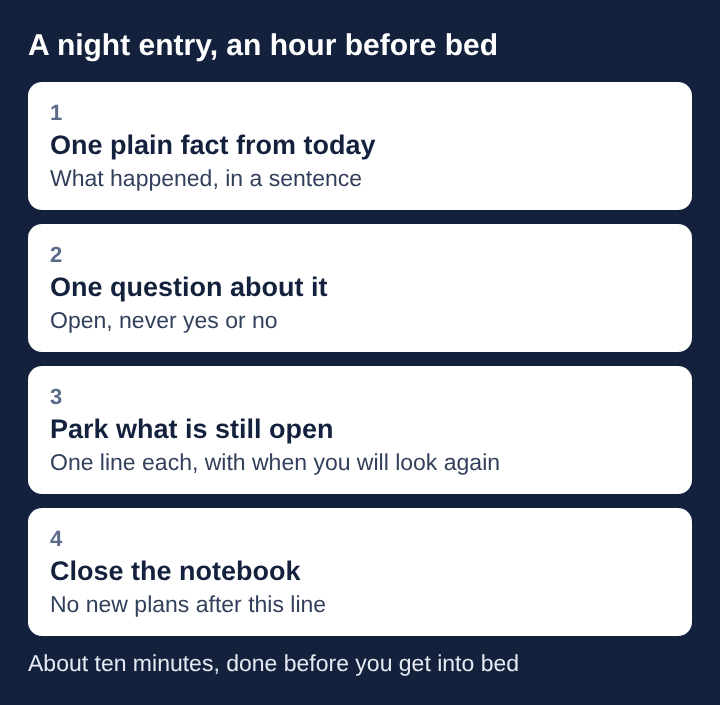
Each step has one job, and the order matters.
- One plain fact from today. Write what happened, in a sentence, with no judgment attached. "The meeting ran an hour over" is a fact. "The meeting was a disaster" is a judgment.
- One question about it. Ask something open, never a question with a yes or no answer. "What was I waiting for when it ran over?" leaves room to notice something. "Was it my fault?" closes the door.
- Park what is still open. List each unfinished thing on its own line, with when you will look at it again. The list is a holding place, not a plan. You are writing it down so you do not have to keep it in your head overnight.
- Close the notebook. Write a last line that marks the end, such as the time, and put the journal away. Nothing new gets added after it.
Done this way, the entry takes about ten minutes. Finish it at a desk or a table, before you get into bed, so the bed stays a place for sleep.
A worked example from one invented evening
Here is how one evening might look. The person and the details are made up for illustration.
It is 9:40 p.m. Dana has had a long day. A client moved a deadline forward, a friend did not reply to a message, and the kitchen tap is still dripping. She sits at the kitchen table with a notebook.
Fact: "The client asked for the report on Wednesday instead of Friday."
Question: "What did I feel first when the email came in, before I started planning?" Two sentences answer it. The first feeling was relief that the project would end sooner, then worry about the time. That is something she would not have noticed if she had gone straight to the plan.
Parked:
- Report outline: tomorrow, 9 a.m.
- Message to the friend: Thursday lunch.
- Plumber for the tap: Saturday.
Last line: "9:52. Done for today."
Notice what the entry does not contain. There is no breakdown of the report into tasks, no draft of the message to the friend, no list of plumbers. Each of those is planning, and each has a time when it will happen. The entry took twelve minutes and ended with a line that says it ended.
What to write when the day was hard
Some evenings, the one plain fact is heavy. A loss, a fight, bad news. The four steps still work, with two changes.
Keep the fact short, even if it hurts to leave it short. "An argument about money" is enough for tonight. Then make the question a gentle one, such as "What do I want to remember about this when I come back to it?" That question sets up a later entry instead of opening the whole subject now.
Then put the hard thing on the parked list with a real time, in daylight, when you will write about it properly. A night journal is not the place to work through a hard day in full. It is the place to set it down carefully so you can pick it up again.
If you find the same hard thing on the parked list night after night, that repetition is information in itself, the kind of thing noticing patterns in your own journal entries brings to light. It may be the thing to bring to a friend, a counselor or a doctor, rather than to the notebook alone.
Frequently asked questions
How long should a night journal entry be?
About ten minutes is enough for a fact, a question and a parked list. Longer entries tend to drift into planning or into going over the same worry again.
Should you journal in bed?
It is better to write at a desk or table and finish before you get into bed. The sleep hygiene advice is to keep the bed for sleep and to avoid planning once you are in it.
What if writing at night makes you more anxious?
Shorten the entry to one fact and the parked list, and move the deeper question to the morning or the afternoon. If the anxiety continues, talk to a doctor or a counselor.
Is a to-do list the same as a night journal?
No. A to-do list plans tomorrow, while a night journal reflects on today. The parked list in a night entry only records what is open and when you will return to it, without planning how.
A night journal is a way to end the day on purpose
The point of writing at night is not to solve anything. It is to notice one thing that happened, ask one honest question about it, and put down what is unfinished so it can wait until morning. When the entry has a clear last line, the day has one too.
Over weeks, the facts and questions add up to a record of what your days actually held, and the parked lists show which things keep coming back. That record is worth more than any single long entry written at midnight, and it costs only the few minutes before you turn out the light.
EnrichAI
Five questions a day about your own life, each a little deeper. Visit enrich.vlvd.net