What is a five-minute journal?
A five-minute journal is a short daily entry built from the same few prompts, answered in about five minutes. So what is a five-minute journal in practice? The plain answer is this: it is a diary with a fixed shape. Instead of a blank page, you meet the same handful of questions each day, write a line or two for each, and close the notebook.
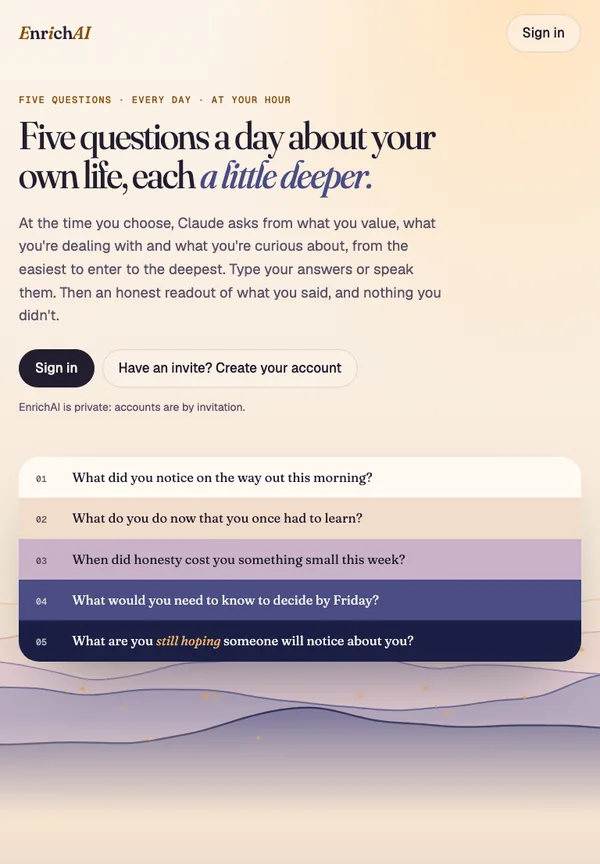
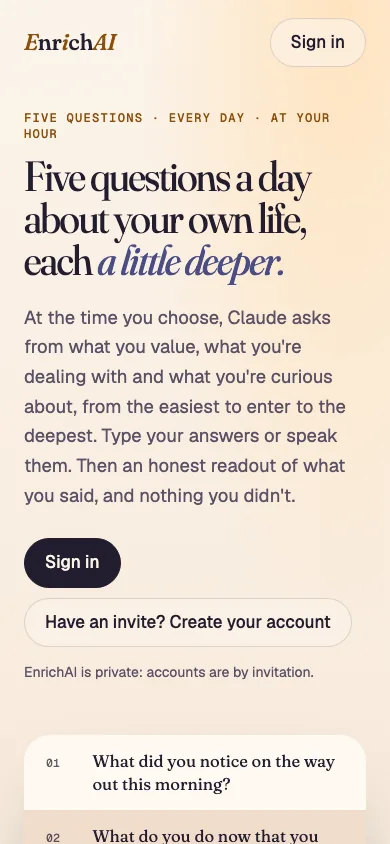
The time limit is the part people notice, but the prompts do the real work. Five minutes spent on "what went well" produces a very different page from five minutes spent on "what did you avoid today". Some daily question sets, such as EnrichAI, ask five questions about your own life at an hour you choose, going from the easiest to step into to the deepest, and none of them can be answered yes or no. That shape, a few prompts that climb from light to heavy, is a good model for any short journal you build yourself.
Why a few fixed prompts are enough
A blank page asks you to decide what matters before you write anything. On a tired evening that decision is the hard part, and it is where most journals stop. A fixed set of prompts removes it. You already know the first question, so you start writing before you have time to talk yourself out of it.
Fixed prompts also make your entries comparable. When every page answers the same questions, you can lay a week of them side by side and see what repeats. An open-ended diary can hold more, but it is harder to read back, because each day is shaped by whatever mood you were in when you opened it.
The trade is depth. Five minutes will not hold a long argument with yourself. It holds a record: a few true lines a day, kept long enough that patterns start to show.
What research on short lists suggests
The best studied short journal is the gratitude journal, a diary of things a person is grateful for, also called "counting one's blessings" or "three good things". A few findings from that research help when you design your own prompts.
- Add the reason. In the "three good things" exercise run by Martin Seligman and colleagues, people wrote three good things at the end of each day along with a causal explanation for each one. The reason is what turns a list into reflection.
- Keep the list short. Most studies found that between 3 and 10 items per entry worked best, and researchers suggest that going past 10 items does not give the usual benefits.
- Daily is not settled. Researchers still disagree about weekly versus daily entries. Some argue that people get used to a daily list too quickly, so the same three prompts can go stale.
The last point matters most for a five-minute journal. If the prompts never change, your answers may start to repeat themselves. One way around it is to keep most prompts fixed and let one of them change each day.
One five-minute entry, minute by minute
Here is a shape you can copy. It uses five short parts, one for each minute, and it ends with a plan rather than a feeling.
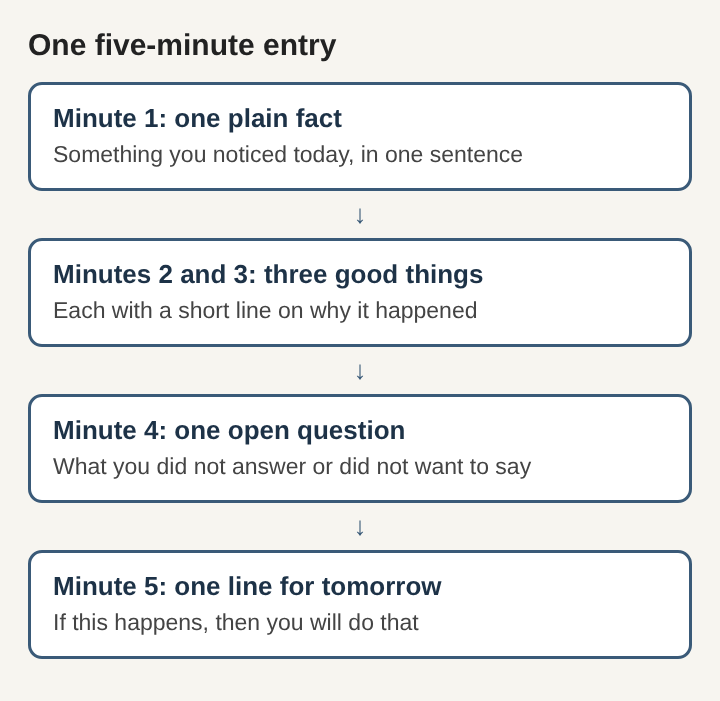
- Minute 1: one plain fact. Write one thing you noticed today, in a single sentence. A good opening question is the easy kind: "What did you notice on the way out this morning?"
- Minutes 2 and 3: three good things. List three, and after each write a few words on why it happened. The reason is the part that takes thought.
- Minute 4: one open question. Write the thing you did not answer today, or did not want to say. This keeps the journal from becoming a list of only good news.
- Minute 5: one line for tomorrow. Write it as an if-then plan. This form is called an implementation intention, a term the psychologist Peter Gollwitzer introduced in 1999 for a plan that names the when, where and how of what you mean to do.
None of these needs more than two sentences. If one part runs long, let it, and cut another part short that day.
A worked example: a Tuesday evening
Say it is Tuesday, a little after nine, and you have five minutes before bed. Your entry might read like this.
- Plain fact: "The bus was late and the driver apologised to everyone who got on."
- Three good things: "Finished the report early, because I started it before checking messages. My sister called, because I texted her on Sunday. The rain stopped at lunch, which was luck."
- Open question: "I still have not replied to Dana about the weekend, and I am not sure why."
- Line for tomorrow: "If I sit down for coffee at ten, then I reply to Dana before anything else."
Read it back and notice what each part did. The plain fact is small and true. Two of the three good things have reasons you caused, which tells you something about what to repeat. The open question names an avoidance you would have skipped in a gratitude-only list. The last line turns that avoidance into one small act with a time attached.
Over a week, the open questions are often the most revealing lines. If the same unanswered reply or the same postponed call appears four nights running, the journal has shown you something a single entry never could.
Where a five-minute journal falls short
A short entry is easy to keep, and that is also its weakness. It is easy to answer in a hurry, with the same safe lines each night, and to feel finished without having noticed anything. Three risks are worth watching.
- Answers that repeat. If "coffee, sunshine, my dog" shows up every day, change one prompt or ask for something specific to today.
- Questions that close. A prompt such as "Was today good?" invites a one-word answer. Rewrite it so it cannot be answered yes or no: "What made today different from yesterday?"
- Nothing carried forward. An entry that never looks back stays a pile of separate days. Read yesterday's open question before you start today's entry.
Some reflection tools build that last step in. EnrichAI, for instance, writes a readout after the fifth answer that catalogs what you said, says plainly what you left unanswered, and sets the day beside your week and month, and its next questions follow what was left open. On paper you can do the same by hand: underline yesterday's open question and let it be today's first prompt.
For days when even five minutes is too much, a shorter entry still counts; short entries for busy days covers how to shrink an entry to a single sentence. For ready-made prompts that climb from easy to deep, see these five daily self-reflection questions.
Frequently asked questions
Does a five-minute journal have to be about gratitude?
No. Gratitude lists are the best studied short format, but any small fixed set of prompts works. Many people mix one gratitude prompt with a plain fact and an open question.
Is morning or evening better for a five-minute journal?
Either works if it happens at the same time each day. Evening suits looking back on what happened, and morning suits planning, so some people split the five minutes between the two.
Can you speak a five-minute journal instead of writing it?
Yes. A spoken or typed entry keeps the same shape; what matters is answering the same prompts and being able to read or hear them again later.
How many prompts should a five-minute journal have?
Three to five is enough for five minutes. Research on gratitude journals found that very long lists, above ten items, did not give the usual benefits, so short is not a compromise.
What a five-minute journal leaves on the page
A five-minute journal will not settle a hard question in one sitting. What it leaves is a dated stack of short, comparable answers: one plain fact, a few good things with their reasons, the question you did not answer, and a plan for the next day. Read a week of those together and the repeated open question, the reason that keeps coming back, or the plan you never kept becomes visible. That is the value of a fixed shape kept for a few minutes a day: it turns ordinary days into something you can read.
EnrichAI
Five questions a day about your own life, each a little deeper. Visit enrich.vlvd.net