What is a Korat cat? It is a short haired breed from Thailand with a silver tipped blue coat, large green eyes and a head shaped like a heart when seen from the front. It comes in one colour only, and it is one of the oldest stable cat breeds in the world. People who walk past gardens and doorsteps meet a lot of grey cats, and very few of them are Korats. Cat Go, a walking game where players photograph real cats and keep each catch with its breed and the place it was found, puts the Korat among its eight very rare breeds, which fits what most people see on their streets.
What is a Korat cat: a natural breed from Thailand
The Wikipedia page on the Korat describes it as a natural breed, one that has barely changed its appearance over centuries. It comes from Phimai in Thailand and takes its English name from Nakhon Ratchasima Province, which Thai people usually call Korat. In Thailand the breed is called Si sawat, which means the colour of the sawat seed.
The cat has long carried a meaning beyond its looks. It is known as the good luck cat, and Korats were traditionally given in pairs to newlyweds or to people held in high regard. Until recently they were not sold at all, only given as gifts.
The breed's written record may reach back centuries. Its probable first mention is in the Tamra Maew, the Cat-Book Poems, written somewhere between 1350 and 1767 and now kept in the National Library of Thailand. The drawing there is not detailed enough to prove which breed it shows, so the claim stays probable. Korats reached Britain in 1889 and 1896 under the name Blue Siamese, but judges did not accept them as Siamese and they had vanished from shows by 1901. A Siamese has dark points on a pale body, while a Korat is one even colour all over. The first breeding pair reached the United States in 1959, and the breed won championship status there in 1966.
The Korat coat: silver tips on a blue base
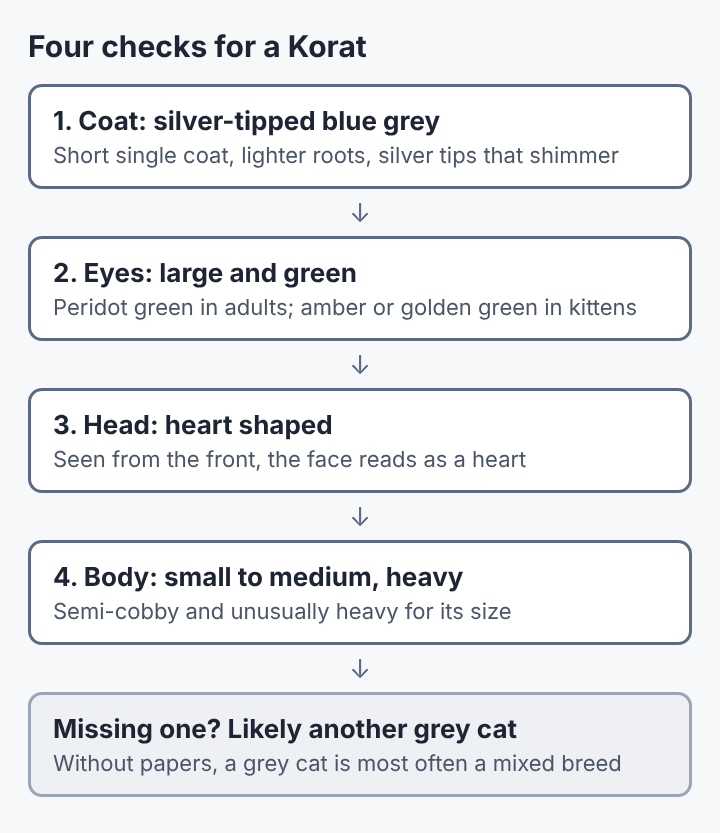
The coat is the first thing to check. A Korat has a single coat, short, with roots of a lighter silver blue. Along each hair the colour deepens to blue, and the tip turns silver. The silver shows most on the muzzle and the toes. In good light the whole cat seems to shimmer. Thai owners call the colour rain-cloud grey and the shimmer sea foam.
Blue is the only colour accepted for a Korat. Now and then a Korat has white spots or very faint grey stripes, and these marks can grow with age. They do not change the cat's health or personality, but they count as flaws and keep the cat out of shows. For someone looking at a cat on a wall, that rule is useful: an adult grey cat with a white patch or clear stripes is unlikely to be a Korat.
A few cats from Korat lines come in other colours. The Governing Council of the Cat Fancy in Britain keeps an experimental register for Korat type cats that are solid lilac or show the colourpoint pattern of the Siamese, under the names Thai Lilac, Thai Blue Point and Thai Lilac Point. They are rarer still than the blue Korat.
Green Korat eyes that arrive late
An adult Korat has large eyes of a peridot green. That colour is a strong clue, but it takes years to appear. Kittens have muddy, amber or golden green eyes, and the green comes in slowly between two and four years of age. A young grey cat with amber eyes and a silver tipped coat could still be a Korat.
A heart shaped head on a small, heavy body
The head is the next clue. Seen from the front, the Korat's face forms a heart. That shape, with the large green eyes set in it, is what most people remember after meeting one.
The body is small to medium, with a low share of body fat. Breeders call its build semi-cobby: compact rather than long. It is also unusually heavy for its size, so a Korat feels more solid than it looks. One more detail is easy to miss: its front legs are shorter than its back legs.
The breed is described as intelligent, playful and active, and it forms strong bonds with people. Korats are also very vocal, with a voice that sounds different from other breeds.
How to tell a Korat from a Russian Blue, a Chartreux or a grey moggy
Three kinds of grey cat get mixed up with the Korat more than any others. Each differs in coat, eyes or shape, so checking those in order sorts most cats out.
Korat and Russian Blue
Both are blue with a silver sheen and both can have green eyes, which is why people confuse them. The coat settles it. The Russian Blue has a dense, plush double coat, while the Korat has a short single coat. The signs of a Russian Blue on a street start from that thicker coat.
Korat and Chartreux
The eyes settle this pair fast. The Chartreux is a rare French breed with orange or copper eyes, a water-resistant double coat and a large, muscular body on short, fine boned legs. Its tapered muzzle seems to smile. A grey cat with copper eyes points to a Chartreux, never a Korat.
Korat and a grey moggy
Most grey cats are mixed breed, a moggy or domestic shorthair with no papers. A grey moggy can have green eyes too. What it usually lacks is the full set: the silver tips on the muzzle and toes, the heart shaped face, and the small, heavy build. One missing check is a reason to doubt, and two missing checks make mixed breed the honest answer.
A worked example: the grey cat on the doorstep
A grey cat sits on a doorstep in the evening light. Run the four checks from a distance.
- Coat: short and close, with a silver shine on the nose and paws. That fits a Korat or a Russian Blue.
- Eyes: a clear green. That rules out a Chartreux.
- Head: from the front, a heart shape rather than a broad round face. That leans to a Korat.
- Body: small and compact, with no white and no stripes. That keeps the Korat in play.
All four fit, so Korat is a fair guess, though only papers can prove a breed. In the game the choice works the same way. It checks the photo for a cat and reads its coat, and with no cat it says "No catch this time". It never names the breed itself: it asks "Which breed is it?" and the player picks from a list of 34. It also warns, "Most cats you meet are mixed breed. Rarer breeds are warier." If any check fails, its advice holds: "Mixed breed is always a safe pick." Tuna from the treat stops works much better on wary cats, and a startled cat leaves quickly, so calm tosses matter.
On a real street the same calm applies. Cats speak with their eyes, ears and tails, and the Wikipedia page on cat communication notes that a cat lowers its eyelids or blinks slowly to show trust, in contrast to a direct stare, and walks with its tail up when it feels confident. A photo taken from where you stand is enough to read the coat and the eyes.
Frequently asked questions
Why is the Korat called the good luck cat?
In Thailand Korats were traditionally given in pairs to newlyweds or to people held in high regard, for good luck. Until recently they were only given as gifts, never sold.
When do Korat kittens get green eyes?
Korat kittens have muddy, amber or golden green eyes. The full peridot green appears slowly, between two and four years of age.
Can a Korat have white markings?
Now and then a Korat has white spots or faint grey stripes. They do not affect health or personality, but they count as flaws in the show ring.
Are Korats prone to any inherited conditions?
The Korat is one of the breeds more often affected by gangliosidosis 1 and 2, inherited conditions caused by recessive genes. Breeding rules in Britain call for genetic screening to keep the breed free of them.
Why the Korat stays rare among grey cats
The Korat's rarity comes from its history. For centuries it was a gift, not a trade good, and the first breeding pair reached the United States only in 1959. The breed's own rules also keep it narrow: one colour, silver tipped blue, with no white and no stripes. Every grey cat on a street can be measured against those same points, coat, green eyes, heart shaped face and a small heavy body, and most of them will fall short of at least one point. That is what makes a real Korat worth a second look.
Cat Go
Walk anywhere, find a real cat, and catch it. Visit catgo.vlvd.net