Stand at the foot of an old castle tower, look straight up, and you may see a row of stone brackets holding a ledge that sticks out from the top of the wall. That ledge answers the question of what is a machicolation on a castle wall: a projecting gallery with openings in its floor, through which defenders dropped stones and other heavy or hot material on anyone standing at the base. The Wikipedia entry on machicolation describes it as floor openings between the supporting corbels of a battlement. The same problem the builders solved, covering the ground right in front of a gate, sits at the center of tower defense play. One example is Two Towers, a castle defense game in the browser where you hold a city gate stage after stage.
What is a machicolation on a castle wall?
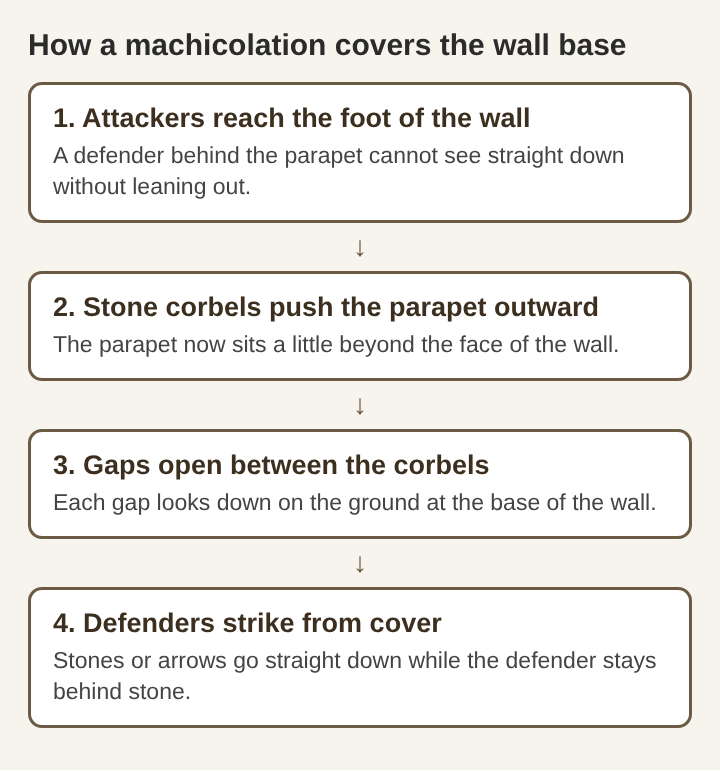
A machicolation is a defensive opening, not a decoration. The word comes from Old French machecol, probably from words meaning to crush and neck. It sits at the very top of a wall or tower. The parapet is pushed outward past the face of the wall, and the gap left between the wall and the outer parapet is open to the ground. A defender standing on the wall walk could look down through that gap and drop something without leaning over the battlements.
How a machicolation is built from corbels, a parapet and floor openings
The structure starts with corbels, stone brackets set into the wall that stick out from its face. A row of these brackets runs along the top of the wall.
Across the tops of the corbels, builders laid stone to carry a parapet that stands out past the wall face. Between each pair of corbels, the space behind the parapet stays open. Those slots are the floor openings.
The result has three useful parts:
- The corbels carry the weight and divide the gap into separate openings.
- The parapet shields the defender's body from arrows and bolts coming from the field.
- The openings give a clear line straight down to the base of the wall.
Before stone versions spread, castles used timber galleries called hoardings), shed-like structures put up on the outside of the wall during a siege, often slotted into putlog holes left in the masonry for their beams. They did the same work of covering the foot of the wall, but wood burns. Machicolations improved on them because masonry is fireproof, and because stone is permanent, always ready for a siege.
Where machicolations came from and where they spread
The oldest known buildings with machicolations are Roman forts on the Limes Arabicus, the desert frontier in what is now Jordan, such as Qasr Bshir and Qasr al-Hallabat, dating from the 4th century AD. The design came to Europe from the Levant after the crusades and became especially common in southern Europe.
Within that spread there were clear regional habits. Machicolations were more common in French castles than English ones, and in England they were usually limited to the gateway, as at the 13th-century Conwy Castle. Within France they appear more often on southern castles; one of the oldest surviving examples in northern France is at the Château de Farcheville, built from 1290 to 1304. A smaller version that guards only one key point, usually over a gate, is called a bretèche, a small balcony with openings in its floor.
Why machicolations covered the blind spot at the foot of a wall
A high wall has a weakness at its own base. An archer on top who wants to hit someone standing right against the stones has to lean out through a gap in the battlements, which exposes head and shoulders to every bow in the field. Shooting slits lower in the wall face outward and cannot aim straight down. So the strip of ground hugging the wall is often the safest place for an attacker to be.
That strip mattered. It is where attackers set ladders, swung picks at the stones, dug under the foundations and brought up rams.
A machicolation flips that. The ground closest to the wall becomes the ground the defenders can hit most easily, with a short drop and a clear view. The attackers lose their shelter at exactly the moment they get close enough to do harm.
Machicolations above the gate and how they helped hold an entrance
The gate was the weakest point in any wall. It had to open, so it was made of timber and iron rather than solid stone, and attackers knew it. That is why English builders, who rarely ran machicolations along a whole wall, still put them over the gateway.
Picture how this plays out. An attacking force brings a ram under a covered frame up to the gate. Archers on the towers shoot at the crew on the approach, but once the frame reaches the doors, its roof blocks most arrows coming in at an angle. The defenders in the gallery over the arch now drop heavy stones straight onto the roof. The first few weaken it. The next ones break through. Without that opening overhead, the ram could keep swinging. With it, the crew is under direct attack at the one spot they cannot avoid.
Machicolations compared with murder holes and arrow slits
These three openings are easy to mix up, but each covered a different stretch of ground.
- Arrow slits are narrow openings cut through the body of a wall or tower. They let archers shoot outward at range across the field while staying behind thick stone. The way they were shaped, narrow outside and wide inside, gave the archer room to aim while giving attackers a tiny target.
- Machicolations sit at the top of the outer face and cover the foot of the wall and the outside of the gate.
- Murder holes are openings in the ceiling of a gate passage. They cover attackers who have already broken through the outer doors and are now inside the entrance. The mechanics of murder holes follow the same logic of attacking from directly overhead.
Put together, they form layers. Arrow slits thin out attackers on the approach. Machicolations punish the ones who reach the wall or the gate. Murder holes catch the ones who get into the passage. Each opening fills the gap the others leave.
Covering the doorstep in tower defense strategy
The lesson of the machicolation carries straight into tower defense strategy: find the place enemies must stand, then make sure something covers it. In a game where you pick a pair of towers, add two more with gold and hold a city gate against knights, monks, kings and rams, the gate is the thing being defended, so it is the spot that matters most. An enemy that reaches it is the one doing harm, whatever happened before.
In tower defense generally, the ground in front of a goal often works as a chokepoint in tower defense: a spot enemies have to pass, where they tend to bunch up. Castle builders treated their gates that way. They did not only shoot at the field. They made sure the doorstep itself was the most dangerous ground around the castle.
Three questions follow from it:
- Is the approach covered? This is the arrow slit job: wear enemies down at range before they arrive.
- Is the gate itself covered? This is the machicolation job. If something only hits enemies on the road, anything that survives reaches the gate unharmed.
- Where should the extra gold go? Spend it to close a gap, not to double up on ground that is already well covered. A third tower that repeats what the first one does adds less than one that reaches the spot the first misses.
A worked situation: suppose that in a tower defense game most enemies die on the road, but one tough kind keeps making it to the gate and wearing it down. Adding more range on the approach may not help, because those enemies already survive it. The fix that fits the history is the one that hits the doorstep. Enemies clumped at a gate also make a good target for damage that spreads over an area, which is what splash damage in tower defense is about. A dropped stone at a crowded gate did much the same thing.
Frequently asked questions
Are machicolations and murder holes the same thing?
No. Machicolations project from the top of the outer wall and cover the ground outside, while murder holes are openings in the ceiling of a gate passage that cover attackers already inside the entrance. People sometimes use the terms loosely, but they sit in different places and cover different ground.
What is the difference between a hoarding and a machicolation?
A hoarding was a temporary wooden gallery put up on the outside of a wall during a siege. A machicolation does the same job in stone, so it cannot be set alight and is always in place.
When did machicolations stop being used?
They stayed common in fortifications until gunpowder weapons came into wide use and made them obsolete. Against cannon, a gallery for dropping stones on the wall base no longer decided a siege.
Why the machicolation answered the oldest weakness of a wall
A tall wall keeps attackers out only as long as it can punish them at its foot. The machicolation solved that by pushing the parapet out on corbels and leaving the gaps open, so the ground beside the stones became the most exposed ground around the castle. Hoardings had done the same job in wood until fire and upkeep showed their limits, and gunpowder later made the whole idea obsolete. For the centuries in between, a row of corbels at the top of a tower meant that standing close to the wall was no longer safe.
Two Towers
Defend the castle gate, stage after stage. Visit twotowers.vlvd.net