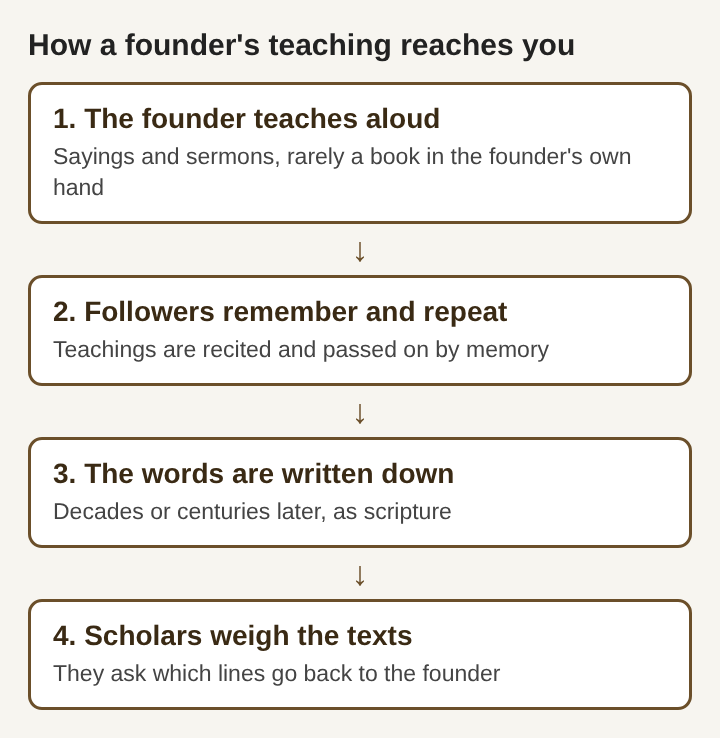
The founders of the world's major religions are a short list of names that nearly everyone has heard: Moses, Zoroaster, the Buddha, Confucius, Jesus and Muhammad among them. Ask what any one of them actually said, and when, and the answer gets harder. Most of them wrote nothing that survives in their own hand. Their followers remembered, repeated and later wrote down what they taught, and historians now work from those later texts.
That gap between a founder and the written record is the main thing to understand about them. It explains why dates for some founders swing by centuries, why scholars argue over which sayings are genuine, and why the same person can look different in a holy book and in a history book. Learn 100 Influential People opens its course Founders of Faith with Moses and Zoroaster, the lawgiver of Israel and the Persian prophet of good against evil, and with what scholars can and cannot know about them (influentialpeople.vlvd.net).
Who counts as a founder of a religion
A founder is the person a tradition traces itself back to. That sounds simple, but traditions grow over generations, and the founder's role is often clearer in hindsight than it was at the time. The religion itself took shape over generations, as followers, and the followers after them, turned a set of teachings into texts, rituals and leaders.
So when people ask who founded a religion, they are usually asking two things at once. First, who was the person at the start? Second, how much of what the religion teaches goes back to that person? The first question often has a clear name. The second rarely has a clear answer.
A cluster of teachers in a few centuries
Several founders lived within a few centuries of each other. The German philosopher Karl Jaspers named this stretch the Axial Age in 1949. He used it for broad changes in religious and philosophical thought from about the 8th to the 3rd century BCE, in Persia, India, China, the Levant and the Greco-Roman world, which appeared in parallel with no obvious contact between them.
The idea is useful as a way to see the pattern. It is also debated: historians question whether these changes really cluster in one period, or whether the label groups very different events together. Treat it as a way of grouping, not a settled fact about the past.
Zoroaster and the oldest hymns
Zoroaster, also called Zarathustra, is the spiritual founder of Zoroastrianism, the faith of ancient Persia. Tradition credits him with the Gathas, the oldest Zoroastrian scriptures, a set of hymns. Little else is known about his life; most of it comes from those same texts.
His dates show how hard the record can be. Most scholars place him in the 2nd millennium or early 1st millennium BCE, based on the language of the hymns and the society they describe. Some suggest a date as early as the 18th century BCE, others as late as the 6th. That is a spread of more than a thousand years for one person, and it comes from having almost no outside evidence to check the texts against.
The Buddha and teachings kept by memory
The Buddha, known by the family name Gautama, is identified by modern scholars as the founder of Buddhism. The Stanford Encyclopedia of Philosophy places him around 450 BCE. His teachings survive in collections known as the Nikayas or Agamas, and they concern the search for freedom from suffering.
His dates moved too. For a long time they were given as about 560 to 480 BCE, but many scholars now hold that he died around 405 BCE. Tradition says he lived to 80. His discourses were probably recited by his followers soon after his death and passed on by memory for generations before anyone wrote them down. The written texts that exist today come from that long chain of recitation.
Confucius and the Analects
Confucius, known in China as Kongzi or Master Kong, is traditionally dated 551 to 479 BCE. The tradition that bears his name traces itself to the Analects, a collection of his sayings and short scenes from his life. His teachings are mainly ethical: how a person should act, how a ruler's good example spreads to the people, and how a person improves through steady effort.
Confucius is sometimes left off lists of religious founders, because his teaching centers on conduct and order more than on gods. He still belongs in the conversation, since the tradition built on him shaped ritual, family life and government across East Asia. And the same gap applies: the sources for his life were written a few decades at least, and several centuries at most, after his traditional lifetime.
A worked example: reading a founder the way historians do
You can sort what is known about any founder with three questions. Here they are, worked through for Confucius and the Buddha using only what the sources say.
- What does the tradition say? For Confucius, he lived from 551 to 479 BCE. For the Buddha, older accounts gave about 560 to 480 BCE, and tradition says he lived to 80.
- When were the sources written? For Confucius, the texts about his life come decades to centuries after his death. For the Buddha, his discourses were kept by memory and recitation before being written.
- What do scholars accept today? For Confucius, most scholars think several ethical themes in the Analects can be safely traced to him, even when single sayings cannot. For the Buddha, many scholars now place his death around 405 BCE, later than the older dates.
Lay the answers side by side and a pattern appears. The core teaching is usually more secure than the details of the life. A date or a story may shift as evidence is weighed, while the main ideas the tradition carried forward stay recognizable. Apply the same three questions to Zoroaster and the result is stark: a body of hymns that scholars take seriously, and a life that could sit anywhere across a thousand years.
Frequently asked questions
Did the founders of major religions write their own scriptures?
Mostly not. Teachings were usually spoken, then remembered and written down by followers, sometimes generations later. Zoroaster is an exception in tradition, which credits him with the Gathas.
Why do the dates for some founders vary so much?
There is often little evidence outside the religion's own texts. Scholars date a founder from the language and setting of those texts, and different readings give different centuries.
What is the Axial Age?
It is Karl Jaspers's name for a period from about the 8th to the 3rd century BCE when new religious and philosophical thought appeared in several regions at once. Historians still debate whether the period is real or a convenient grouping.
Is Confucianism a religion?
Scholars answer differently. Confucius taught mainly about ethics and conduct, but the tradition built on his teaching shaped ritual and family life much as a religion does.
What the founders of the world's major religions left behind
The founders left teachings more than texts. What reaches a reader today passed through followers who memorized, recited, collected and finally wrote it down, and through scholars who keep weighing which parts go back to the start. Knowing that path does not shrink the founders. It shows how a few voices, carried by many people over long stretches of time, came to shape belief and daily life across much of the world.