What is churn rate? It is the share of your customers who leave during a set period, usually a month or a year. If 100 people use your product at the start of the month and 5 of them cancel before it ends, your monthly churn rate is 5%. The number is simple to work out, and it says more about the health of a young business than almost any other.
Churn matters most when customers come back every month, as they do with most AI tools billed monthly. AI Entrepreneur covers this ground in the part of its courses called "Growing a company", which deals with the economics of growing an AI company.
What Is Churn Rate, in Plain Terms
The churn rate page on Wikipedia defines it as the proportion of customers, members or items that leave a defined group during a specified period. It goes by other names too: attrition rate, customer turnover and customer defection all mean the same thing.
Three parts of that definition do the work. There is a group, such as everyone with an active account. There is a period, such as March. And there is a count of who left that group during that period. Change any one of the three and you get a different number, which is why two founders can both say "5% churn" and mean quite different things.
The measure is used widely in businesses where customers sign a contract or stay on a recurring plan: phone companies, streaming services, software sold as a service and utilities. For those businesses, the money next month depends mostly on who stays, not on who arrives.
The Churn Rate Formula
The basic formula is short. Divide the number of customers you lost during the period by the number of customers you had, then multiply by 100 to get a percentage.
Churn rate = customers lost in the period / customers at the start of the period x 100
The Wikipedia page gives its own example: a company that starts a month with 500 customers and loses 50 of them during that month has a churn rate of 10%. The same page notes an alternative some businesses use, dividing by the customers gained in the period instead, so always check which version a number uses before you compare it with yours.
A few choices make the number honest:
- Fix the period first. Monthly churn and yearly churn are different numbers. A business with 5% monthly churn loses far more than 5% of its customers in a year.
- Count only the customers who were there at the start. People who arrive during the month and leave before it ends are easy to miss or to count twice. Keep them out of the starting count and track them on their own.
- Decide what "left" means. For a monthly plan it is usually a cancellation. For a tool people use without a contract, it might be no activity for 30 days. Pick one rule and keep it.
Gross Churn, Net Churn and Revenue Churn
The plain formula gives gross churn: every customer lost, whatever else happened. The Wikipedia page separates that from net churn, the overall loss once you take into account the new customers who arrived during the same period. A business can have high gross churn and still grow, as long as new customers arrive faster than old ones leave.
That is useful, and also a trap. Strong arrivals can hide a leak. If you gain 30 customers a month and lose 25, the total still rises, but most of what you spend on finding customers only replaces the ones walking out. Watch gross churn on its own so the leak stays visible.
Some businesses also measure churn in money instead of people. The customer attrition page describes weighting the calculation by monthly recurring revenue, so a large customer who leaves counts for more than a small one. If your customers are on very different plans, revenue churn tells you more than a head count.
The same page draws one more line: voluntary churn, when a customer decides to leave, and involuntary churn, when circumstances such as a move force them out. Businesses usually focus on voluntary churn, because it comes from parts of the relationship they control, such as billing and after-sales help. For a software product, a failed card payment is a common involuntary reason worth tracking apart from people who chose to cancel.
Turning Churn Into a Customer Lifetime
Churn becomes much more useful once you turn it into time. On average, a customer stays for about one divided by the churn rate. The Wikipedia page gives yearly examples: an annual churn rate of 25% implies an average customer life of four years, and 33% implies about three years. The share who stay, one minus the churn rate, is sometimes called the survival rate.
That lifetime feeds straight into customer lifetime value, the money a customer brings in over the whole time they stay. It is why churn sits at the center of the unit economics of an AI company: halve the churn rate and you roughly double how long each customer stays, without finding a single new one.
The customer attrition page gives the reason companies care so much: keeping an existing customer costs far less than winning a new one. Every customer who stays is one you do not have to replace.
A Worked Example: One Month for a Small AI Tool
Here is one month for an invented business: a small AI tool that writes replies to customer emails, billed monthly.
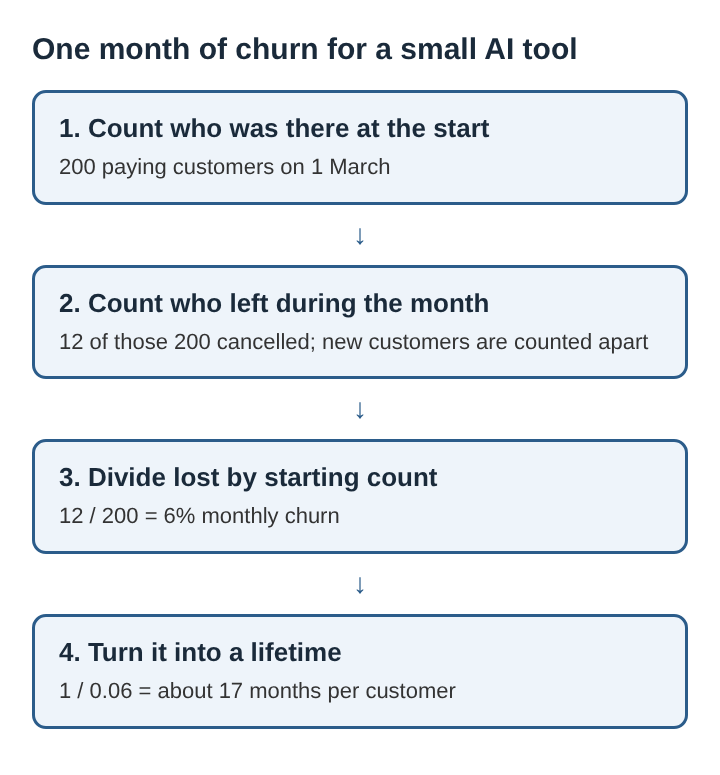
- Count who was there at the start. On 1 March the tool has 200 active customers.
- Count who left during the month. By 31 March, 12 of those 200 have cancelled. Another 30 new customers arrived during March, but they are not part of this count, because they were not in the starting group.
- Divide lost by starting count. 12 divided by 200 is 0.06, so the monthly churn rate is 6%.
- Turn it into a lifetime. One divided by 0.06 is about 17, so the average customer stays about 17 months at this rate.
Now look at what the number points to. If 9 of the 12 who left had their card fail rather than choosing to cancel, most of the churn is involuntary, and a reminder email before a card expires might fix more than any new feature. If instead most of the 12 left in their first month, the problem is likely the first experience of the product, and the fix starts there.
One month is a small sample. With 200 customers, a few people more or less changes the rate by a whole point. Track it for several months before you treat a change as real.
Why Customers Leave, and What Lowers Churn
The churn rate page lists the usual reasons: customers are unhappy, a competitor offers something better or cheaper, a competitor simply sells harder, or the customer's own needs change. The number tells you how many leave. It does not tell you why, so ask the people who cancel, in a short message, while the reason is fresh.
The same page names two broad ways to lower churn. One is making it harder to switch, through contract terms or features that are hard to copy. The other is retention work, such as rewarding people who stay. For a young business, the most reliable version is usually plainer: help each new customer get real value in their first week, and fix what makes people stop.
Be careful with introductory offers. The Wikipedia page notes that discounts for new customers can raise churn, because some people start, let the service lapse and start again to get the deal once more. It also warns that churn can be overstated when a customer leaves and comes back within the same year, so decide how you count a returning customer before the number misleads you.
Frequently asked questions
What is a good churn rate for a small software business?
There is no single good number, because it depends on who the customers are and how long their contracts run. What matters most is the trend: a rate that falls month after month is a stronger sign than any one figure.
Is churn rate the same as retention rate?
They are two sides of one number. Retention, or survival rate, is one minus the churn rate, so 6% monthly churn means 94% of the starting customers stayed.
Should new customers be counted when working out churn?
Not in the basic formula. Count only the customers present at the start of the period, and track new arrivals separately, or use net churn when you want to see both together.
How do you turn monthly churn into yearly churn?
Do not multiply by 12. Take the monthly share who stay, raise it to the power of 12, and subtract the result from one: at 6% monthly churn, 0.94 to the power of 12 is about 0.48, so about 52% of a starting group leaves within a year.
Reading Churn Rate Over Time
A single churn rate is a snapshot. Its real value comes from watching it month after month with the same rules: the same period, the same starting group, the same meaning of "left". Then a change in the number reflects a change in the business, not a change in how you counted.
Split the number when you can. Churn among customers in their first month, churn among long-time customers, voluntary and involuntary churn: each points to a different fix. A business that knows which customers leave, and when, can spend its effort keeping them rather than replacing them, and the lifetime that falls out of the formula grows with every point of churn it removes.
AI Entrepreneur
Building a business in the age of AI, from a first project to a company. Visit aientrepreneur.vlvd.net