Why a bad day needs a different kind of entry
Knowing how to journal about a bad day matters most on the evenings you least want to write. A good day is easy to record. A bad one pulls in two directions: part of you wants to forget it, and part of you wants to go over it again and again until it makes sense. The page can help with neither if you let it become a place to relive the worst hour in full colour.
A useful bad-day entry has a smaller job. It writes down what happened, gives the feeling a name, asks one question that points forward, and then ends. That takes ten minutes, not an hour. One way to see this shape in practice is EnrichAI, which asks five questions a day about your own life, from the easiest to the deepest, none of them answered with a yes or no. The order is the point. You start with something you can answer and only then go near the hard part.
How to journal about a bad day in four short moves
The method has four parts, and each one is a sentence or two, not a page.
- Write the facts. What happened, where and when, in the plainest words you have. No adjectives yet.
- Name the feeling. One or two words: angry, embarrassed, flat, scared, tired.
- Ask how, not why. One concrete question about what you could do next, not about what is wrong with you.
- Close the entry. Write what is still open and when you will look at it again, then stop.
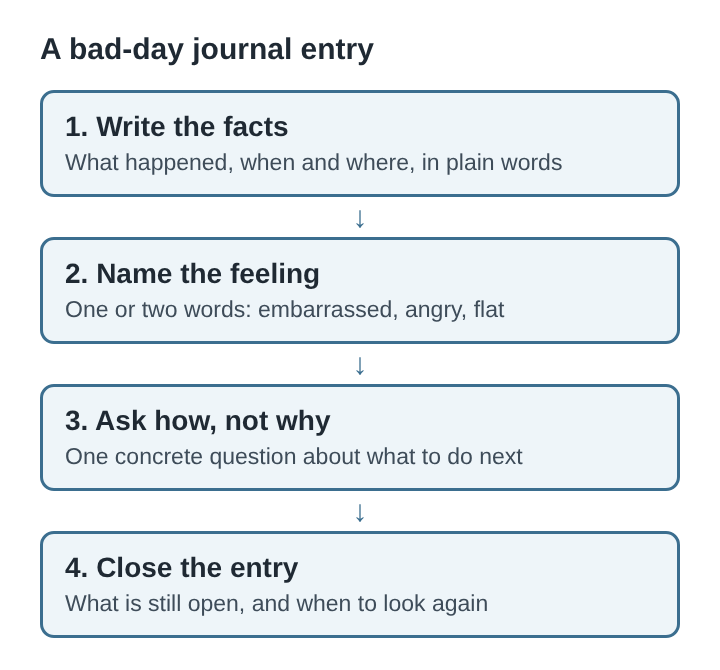
The order matters. Facts first keeps the entry from opening on the loudest feeling. Naming the feeling second gives it a place on the page instead of in every line. The how question comes third because it only works once you know what happened and how it landed. The close comes last so the entry has an end you chose.
Start with what happened, in plain words
On a bad day the story in your head is usually bigger than the events. "Everything went wrong" is how it feels. "The client meeting moved to 9, the late arrival was 20 minutes, and the manager mentioned it in front of the team" is what happened. The second version is shorter, and it is something you can look at.
Keep this part to three or four short sentences. Write times, places and the actual words people used, if you remember them. Leave out what you think they meant. If you notice yourself writing "always" or "never", cross it out and write the one time it happened today.
This is not about pretending the day was fine. It is about separating the record from the judgement, so that when you read the entry next week you can see what happened, not just how loud it was.
Put the feeling into one or two words
Once the facts are down, name what you felt. Psychologists call this affect labeling, described simply as "putting feelings into words". Research on it suggests that explicitly labeling a negative emotional state can reduce how strongly it is felt and how the body responds to it, and writing about a negative experience in a journal is one of the examples given. An odd detail is that labeling often does not register as an attempt to control the feeling at all, and it still has an effect when you are not trying to change anything. The same page is clear that the research is still at an early stage, so treat it as a reason to try, not a promise.
Keep the label short. "Embarrassed" does more work than a paragraph about how unfair it all was. If more than one word fits, write two: "embarrassed and tired". If none fits, write "something heavy, no name for it yet". That counts too.
Swap why questions for how questions
This is the move that keeps a bad-day entry from turning into a loop. Rumination) is the sustained focus on and repetition of negative thoughts and emotions. The page on it notes that people who ruminate tend to focus on their emotions rather than on solving the problem, and that therapists often help a client replace abstract "why" questions with more concrete "how" questions that are easier to examine and answer.
On paper, the difference is easy to spot:
- "Why do you always mess these things up?" becomes "How could you hear about a time change earlier next time?"
- "Why does nobody take you seriously?" becomes "How do you want to answer if it comes up tomorrow?"
- "Why are you so tired of this job?" becomes "Which one part of this week drained you most?"
The how question does not have to be answered tonight. It only has to be a question that could be answered. A why question about your whole character has no last line, which is why it keeps you writing in circles.
A worked example: one bad Tuesday
Here is how the four moves look on a real page. Suppose your Tuesday went like this: a meeting moved without notice, you arrived late, and a comment in front of others stung for the rest of the day.
Facts: "Meeting moved from 10 to 9. Saw the message at 9:05. Arrived at 9:20. Manager said 'glad you could make it' in front of five people."
Feeling: "Embarrassed, then angry."
How question: "How can a time change reach the phone before the morning?"
Close: "Still open: whether to say something about the comment. Look again Thursday, after the next meeting."
That is four lines and about five minutes. It does not solve the day. It puts the day in a form you can read later without feeling it all again, and it leaves one clear thread for the future. A good reflection practice picks that thread up the next day. On EnrichAI, for instance, the day's readout says plainly what was left unanswered, and tomorrow's questions follow what was left open, so the comment you parked on Tuesday comes back as a question on Wednesday instead of as a 2 a.m. replay.
When writing about the day starts to replay it
Some bad days are worse than a late meeting. Writing about something painful can feel worse before it feels any better. In James Pennebaker's early expressive writing study, people wrote about a past trauma for 15 minutes a day on 4 days in a row, and many reported being upset by the writing, though they also found it valuable and meaningful. Being stirred up by an entry is not a sign you did it wrong.
A replay is different. You can tell you have slipped into one when the same scene appears for the third time in one entry, or when every new sentence starts with "and then". When that happens, go back to step four. Write "still open" and a day to look again, and close the notebook. Keep a time limit if it helps, such as 15 minutes on a hard night. Coming back to it fresh beats pushing through tired.
Two things the entry should not do: grade you, and tell you how you ought to feel. A journal that passes judgement on your day adds a second bad thing to the first. Write what happened and what you felt, and leave the judging out. If a bad day keeps repeating, or the feelings are more than a page can hold, a doctor or counsellor is the right next step, not a longer entry.
For more on how entries like these add up over a few weeks, see how to notice patterns in your own journal entries.
Frequently asked questions
Is it better to journal about a bad day on the same night?
Short is better than late. A four-line entry the same night records the facts while you still remember them, and you can write more the next day once the feeling has settled.
What if writing about it feels too hard tonight?
Write one sentence of fact and one word for the feeling, then stop. That is a complete entry, and it gives you something to come back to when you are ready.
Is it bad to write only about the bad parts of the day?
Not on a bad day. If you want balance, add one plain line about something that went fine, but do not force the entry into a cheerful ending it did not have.
How do you stop a bad-day entry from going on and on?
Set a time limit before you start and end with a line that says what is still open and when you will look at it again. A how question also helps, because it has an answer and a why question often does not.
How a bad day reads a week later
What a bad-day entry is worth shows when you read it again. If it holds the facts, a word for the feeling and one how question, a week later you can see the day at its true size. The meeting was 20 minutes late, the comment was one sentence, and the question about the morning messages may already have an answer. If the entry is three pages of replay, it pulls you back into the evening you wrote it. Most bad days are smaller on paper than they felt, and a short, plain entry is what lets you see that. Over a month, those small entries also show which bad days were one-offs and which ones keep coming back, and that difference is often the most useful thing a journal can tell you.
EnrichAI
Five questions a day about your own life, each a little deeper. Visit enrich.vlvd.net