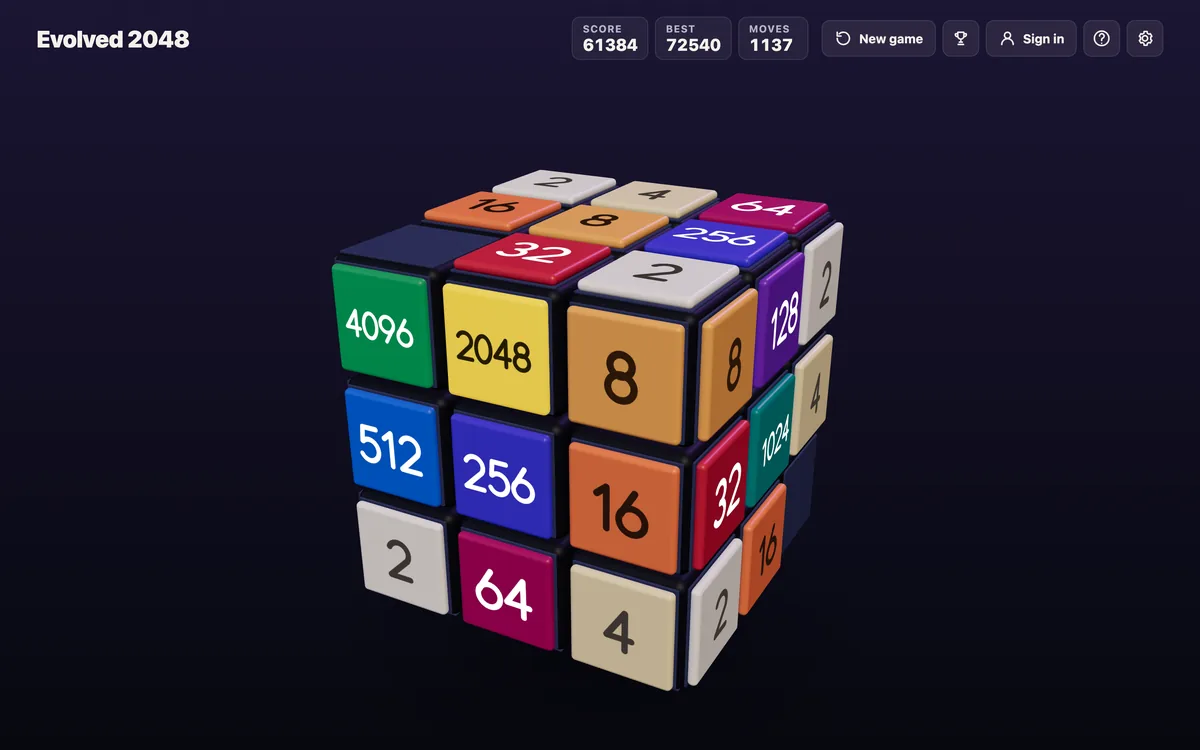
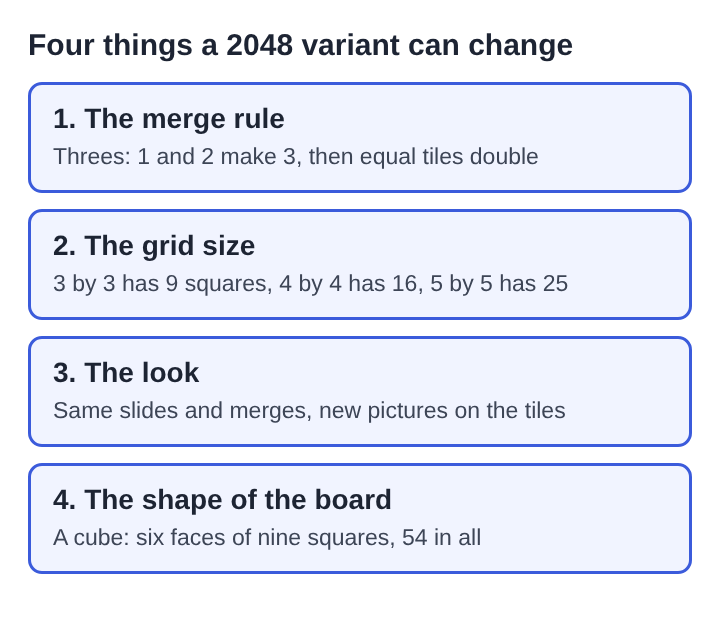
Ask what are the variants of 2048 and you get a long list of names that hide a short list of ideas. Almost every version changes one of four things: the rule for merging tiles, the size of the grid, the look of the tiles, or the shape of the board itself. Once you know which of the four a version touches, you can predict how it will play before your first swipe. The furthest change is the board's shape, and Evolved 2048 takes it as far as a cube: the 2048 puzzle on a Rubik's cube, played in a web browser on a computer or a phone.
It helps to start from the version every other one is measured against. Classic 2048), by Gabriele Cirulli, is played on a 4 by 4 grid. Tiles slide as far as they can in the direction you choose, two equal tiles merge into one tile with their total, a tile made in a move cannot merge again in that same move, and a new 2 or 4 appears after each turn. Reaching 2048 is the goal, and you can keep playing after it.
What are the variants of 2048, sorted by what they change
Sorting by change is more useful than sorting by name, because two versions with different names can play the same, and two with similar names can play very differently.
- The merge rule. Which tiles combine, and what they become.
- The grid size. How many squares you have to work with.
- The look. What is drawn on the tiles, with the rules left alone.
- The shape of the board. Whether the grid is flat at all.
Versions that change the merge rule
The oldest variants came before 2048 did. Cirulli described his game as conceptually similar to Threes and as a clone of 1024, a game that was itself a clone of Threes, and his README cites a 1024 clone called 2048 by Saming, with slightly different mechanics, according to the history of 2048 on Wikipedia). Threes came out for iOS on 6 February 2014 and 2048 on 9 March 2014.
Threes uses a different rule from the one most people know. A 1 and a 2 merge into a 3, and after that two equal tiles combine: two 3s make a 6, two 6s make a 12. A swipe also moves each tile only one square, not all the way to the wall, and a new tile enters from the side the tiles moved away from.
Those two changes matter more than the numbers. One square per swipe means you can nudge a single row without the whole board sliding. The 2048 rule lets tiles fly to the edge, which makes big chains of merges easy. The Threes team said they had tried that merging rule during development and dropped it because it made the game too easy.
Versions that change the grid size
The plainest variants keep every rule and only change the grid. Wikipedia lists versions with bigger and smaller grids among the game's spinoffs.
The square count tells you most of what you need. A 3 by 3 grid has 9 squares, the classic 4 by 4 has 16, and a 5 by 5 has 25. Every move adds a new tile, so fewer squares means the board fills sooner and a single misplaced tile costs more. A larger grid gives you room to park small tiles while you build a big one, so the same strategy that works on 4 by 4 becomes more forgiving.
When you move between sizes, keep your habits and change your pace. On a small grid, check every move for where the new tile can land. On a large grid, you can afford to build one long ordered line of tiles before you merge it down.
Themed versions that keep the rules
A large share of the versions that appeared in 2014 changed only the pictures. Wikipedia names spinoffs built around the Doge meme, Doctor Who, Flappy Bird and Tetris. Cirulli called these spinoffs part of the beauty of open source software and said he did not object to them as long as they added new, creative modifications to the game.
For play, a themed version is the classic game with new faces on the tiles. The hard part is that you lose the numbers as a guide: you have to learn which picture outranks which before you can plan a merge. Once you know the order, every strategy for the classic grid works unchanged.
The pace of copying was fast. Pocket Gamer reported in April 2014 that 15 new clones of Threes were being released every day in the App Store, which is why the list of names is so long while the list of ideas stays short.
2048 off the flat grid
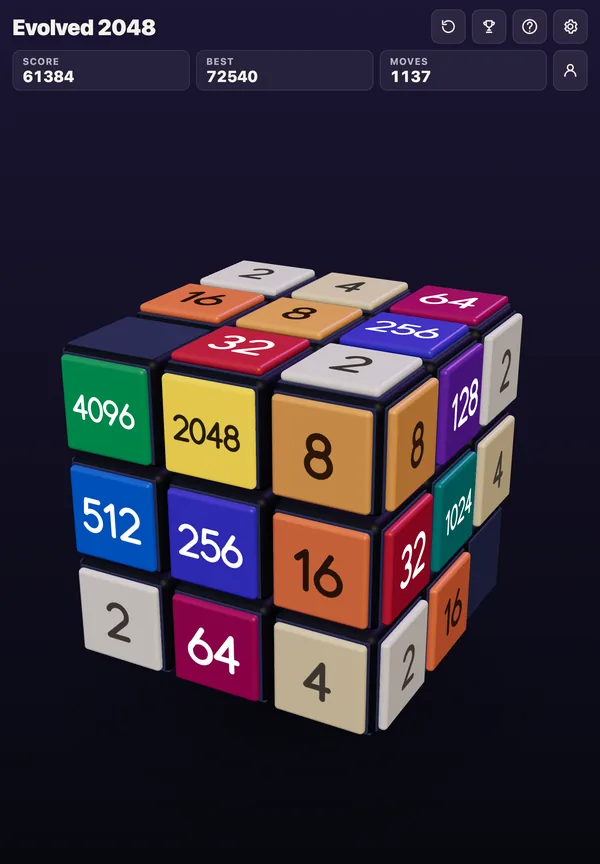
The biggest change is to the board's shape. Wikipedia notes a 3D version among the early spinoffs, and the idea has kept going. On a cube, the puzzle has six faces of nine squares, 54 squares in all, and 2048 is the first milestone rather than the end.
A cube adds moves a flat grid cannot have. You still slide the front face, by swiping or with the arrow keys or W A S D, and two equal tiles still merge into their sum. You can also twist a row on the right face or a column on the top face, which turns that layer a quarter and carries its tiles to the next face. Every slide or twist adds a new 2 or 4. Turning the whole cube to look at it adds nothing.
That cube version has three modes. In the main mode, slides move only the front face, and the game ends when all 54 squares are full and no face has two equal tiles side by side. Edge mode opens the edges: a slide towards an edge also merges the tile at that edge with an equal tile just over it, on the next face. Fun mode runs each row and column of the front all the way round the cube.
One swipe under two rules
Take one row of the front face of a cube, three squares wide, reading left to right: 2, 4, 8. Just over the right edge, on the next face, sits another 8. You swipe right.
- Under the classic rule, nothing in the row can move. The 2, 4 and 8 are all different, and the 8 already touches the edge. The swipe changes nothing in this row.
- Under Edge mode, the 8 at the right edge meets the equal 8 just over it on the next face. The two merge into a 16, and the front row has room to shift.
- Your next step differs too. In the classic case you need another move to free that row. In Edge mode, the next question is whether the 4 and the 2 can follow the 16 into an ordered line.
The same row, the same swipe, and two different boards afterward. That is the whole point of a rule variant: it changes which moves are good, so a habit from one version can be a mistake in another. Before you play a new version, run one row through its rules in your head the same way and see what changes. The rules for merging on a flat grid are set out in how to merge tiles in 2048, and the history of the first versions is in who created the game 2048.
Frequently asked questions
Is 2048 itself a variant of another game?
Yes. Cirulli described it as conceptually similar to Threes and a clone of 1024, which was a clone of Threes, according to Wikipedia's page on 2048).
Does a bigger grid make 2048 easier?
More squares give you more room before the board fills, so mistakes cost less. The rules stay the same, so the same strategies apply.
What is different about 2048 on a cube?
A cube has six faces of nine squares, 54 in all, and adds twists that carry a row or column of tiles to the next face. You can bring a tile from a side face next to its match on the front.
Do themed versions of 2048 play differently?
Most keep the classic rules and change only what is drawn on the tiles. You have to learn which picture stands for which value before you can plan merges.
Why 2048 variants keep appearing
The rules of 2048 fit in a few sentences, and the code was released under the MIT License, so anyone could change one piece and see what happened. Each of the four kinds of change asks a different question of the game. A new merge rule asks how fast tiles should grow. A new grid size asks how much room a player needs. A new look asks whether the numbers matter at all. A new board shape asks whether the puzzle needs to be flat. When you meet a version you have not seen, find which of the four it changes, and you will know which of your habits still hold.
Evolved 2048
The 2048 puzzle on a Rubik's cube, and past 2048. Visit evolved2048.vlvd.net