Who created the game 2048, in one answer
If you want to know who created the game 2048, the short answer is Gabriele Cirulli, an Italian web developer who wrote it over a weekend and released it on 9 March 2014. The longer answer is more interesting. According to Wikipedia's page on 2048), Cirulli called his game a clone of another game, which was itself a clone of a third. So 2048 has a creator, but it also has parents and grandparents.
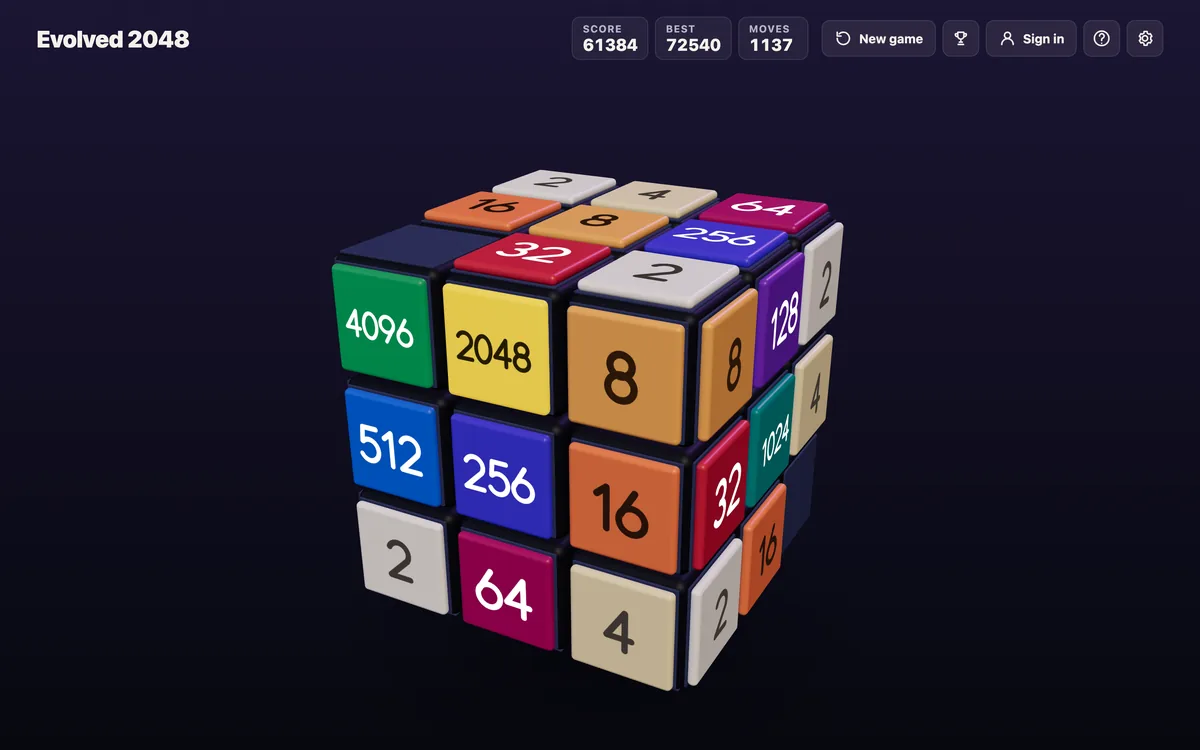
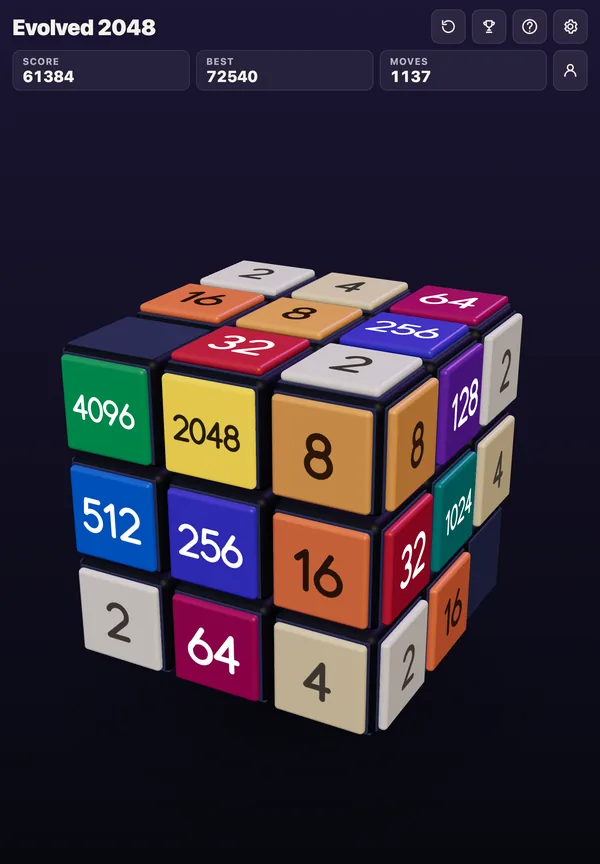
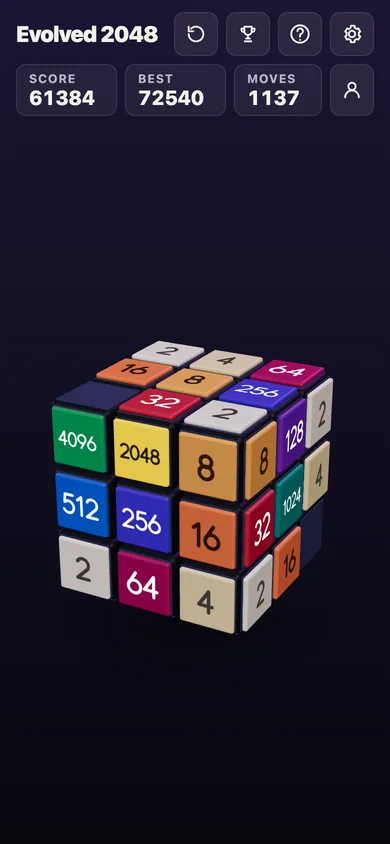
That family has kept growing ever since. Evolved 2048, for example, puts the same sliding and merging on a Rubik's cube of six faces, where you twist rows to bring tiles round from the other sides. To see where a version like that comes from, it helps to go back to the start of the line.
A weekend project in March 2014
Cirulli was nineteen when he made 2048. The game's Wikipedia page) says he built it in a single weekend to see whether he could program a game from scratch, and quotes him calling it "a way to pass the time". He wrote it in JavaScript and CSS, the languages of an ordinary web page, so it ran in any browser with nothing to install.
He published the code on GitHub under the MIT License, a short license that lets anyone copy, change and share the code. That one choice shaped everything that came after it.
The response surprised him. The same page reports that his weekend project had over 4 million visitors in less than a week. Versions for iOS and Android followed in May 2014. Cirulli said he did not want to earn from "a concept that [he] didn't invent", which is a plain admission that the core idea came from somewhere else.
Threes, the puzzle that came first
That somewhere else was Threes. Wikipedia's page on Threes describes it as a 2014 puzzle game by Sirvo, a small team of designer Asher Vollmer, illustrator Greg Wohlwend and composer Jimmy Hinson. It came out for iOS on 6 February 2014, about a month before 2048.
In Threes you slide numbered tiles on a four by four grid. A 1 and a 2 merge into a 3, two 3s make a 6, two 6s make a 12, and so on. A swipe moves the tiles one square in that direction, if they can move, and adds a new tile to the grid.
The team behind it took its time. The same page says the basic game was prototyped in a single night, but development ran for 14 months while the team tried themes such as sushi and chess before going back to plain numbers. It also notes that other developers released similar games and clones within weeks of the launch. 2048 was one of the results of that wave.
1024 and Saming's 2048, the steps in between
Cirulli did not copy Threes directly. Per the 2048 page), he described his game as "conceptually similar" to Threes and as a clone of 1024, a game by Veewo Studio that was itself a clone of Threes. His project notes also credit a second influence: another game called 2048, by a developer known as Saming, which was a clone of 1024 with slightly different rules.
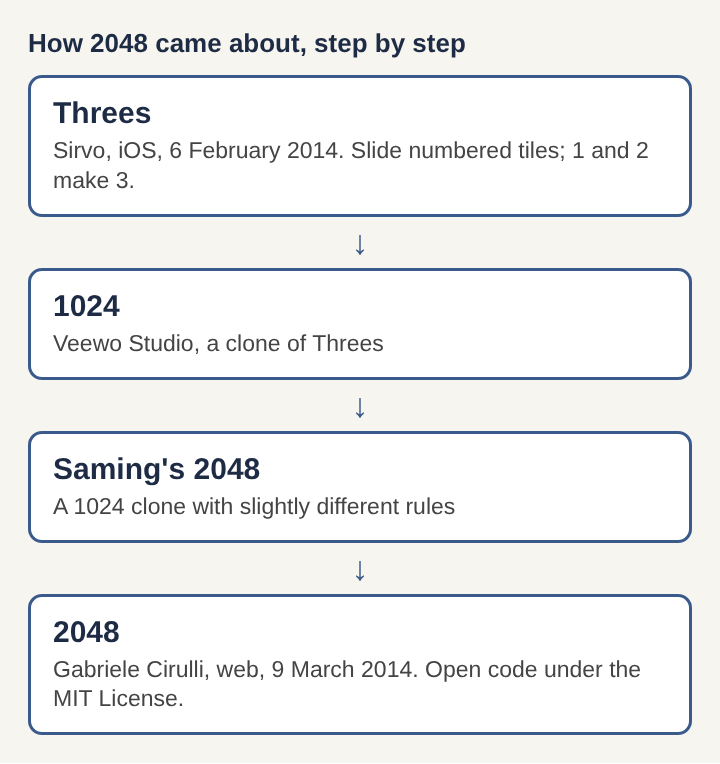
So the line runs like this:
- Threes (Sirvo, February 2014) set up the grid, the swipe and the merging of numbered tiles.
- 1024 (Veewo Studio) copied that idea.
- Saming's 2048 copied 1024 and changed some of its rules.
- 2048 (Cirulli, March 2014) built on both clones and became the version most people know.
Each step changed something. The step that mattered most was the move to powers of two and to tiles that slide all the way across the grid.
One row through two games, a worked example
The clearest way to see what changed is to push the same kind of row through both rule sets. Take a row of four squares and swipe left each time.
In Threes. Start with a row of 1, 2, empty, 3. Following the Threes rules, a swipe moves tiles only one square. The 1 is already at the wall, so the 2 moves into it and the two merge into a 3. The 3 at the end moves one square to the left, into the empty space. The row now reads 3, empty, 3, empty, and the game adds a new tile. Notice that the two 3s did not meet: each tile moved one step and no further.
In 2048. Start with a row of 2, 2, empty, 4. Under the 2048 rules), tiles slide as far as they can until they hit the wall or another tile. The two 2s merge into a 4. That new 4 sits at the wall, and the old 4 slides all the way across to sit beside it. The row reads 4, 4, empty, empty. The two 4s do not merge on this move, because a tile made in a move cannot merge again in that same move. On the next swipe left they become an 8, by the merge rules behind every 2048 slide. After each move a new tile of 2 or 4 appears in an empty square.
Three facts carry the whole comparison:
- Threes adds 1 and 2 to make 3, then doubles from there. 2048 only ever doubles, starting from 2.
- Threes moves tiles one square per swipe. 2048 moves them as far as they can go.
- In both games, two tiles can merge only once per move.
The long slide is why 2048 feels faster. A single swipe can clear half a row, so each move changes more of the board.
Why open code made 2048 spread
Because the code was public, other people could take it and build on it at once. The 2048 page) lists additions that others wrote, such as an undo feature and better touch controls, and spinoffs with the Doge meme, Doctor Who, Flappy Bird and Tetris. It also mentions a 3D version and versions with bigger or smaller grids.
Cirulli welcomed this. The same page) quotes him calling the spinoffs "part of the beauty of open source software", and said he did not object to them as long as they added new, creative changes to the game. That is the same thing he had done with 1024 and Saming's game: take an idea that was already out there and change the part that interested him.
The cube is one of those changes. In Evolved 2048 the board is six faces of nine squares, 54 in all. You slide the front face just as in the original, and two equal tiles merge into their sum. The new move is the twist: drag a row on the right face or a column on the top face, and that layer turns and carries its tiles to the next face. The core rule from Cirulli's weekend stays the same, and the shape of the board around it is new.
Frequently asked questions
Who invented 2048?
Gabriele Cirulli wrote and released 2048 on 9 March 2014, as the game's history) records. He described it as a clone of 1024, which was a clone of Threes, so the core idea of merging numbered tiles on a grid came from Threes.
How old was Gabriele Cirulli when he made 2048?
He was nineteen. He built the game in a single weekend, mainly to see whether he could program a game from scratch.
Is 2048 a copy of Threes?
Not directly. 2048 descends from Threes through 1024 and Saming's 2048, and it changes the rules: tiles double from 2 instead of starting from 1 and 2, and they slide all the way instead of one square.
Why are there so many versions of 2048?
Cirulli published the code under the MIT License, which lets anyone copy and change it. People quickly made themed versions, 3D versions and versions with other grid sizes.
The history of 2048 as a chain of small changes
The story of 2048 is less about one inventor than about a short chain of people each changing one thing. Sirvo spent over a year shaping the idea of merging numbered tiles. Veewo Studio and Saming copied it and changed the rules. Cirulli took those copies, made tiles slide all the way and double from 2, and put the result online with open code in a single weekend. Every version since, from bigger grids to boards in three dimensions, keeps the rule at the centre of that chain: slide the tiles, and two equal numbers become one.
Evolved 2048
The 2048 puzzle on a Rubik's cube, and past 2048. Visit evolved2048.vlvd.net