Can AI labs coordinate to slow down, in short
Can AI labs coordinate to slow down? In principle, yes. In practice, it has not happened yet. Many leaders of the largest labs say in public that advanced AI carries serious risk. Each of them also runs a company that loses ground the moment it stops training while a rival keeps going. A slowdown works only if every major lab slows together, and if each one can see that the others really did.
That tension between caution and competition is the subject of Contain ASI, a story strategy game for 1 to 4 players in which, from January 2024, the aim is to keep every AI lab from reaching recursive self-improvement, an AI system designing a more capable successor again and again, before 2027. The real question behind it is older than any game: what would it take for rivals in a race to agree to run slower?
The 2023 call for a pause
The clearest attempt so far came in March 2023, a week after OpenAI released GPT-4. The Future of Life Institute published Pause Giant AI Experiments: An Open Letter, which called on all AI labs to pause, for at least 6 months, the training of AI systems more powerful than GPT-4. It gathered more than 30,000 signatures, including academic AI researchers and industry chief executives.
The letter did not only ask for goodwill. It called for more government regulation, outside audits before training AI systems, tracking of highly capable AI systems and large pools of computing power, and public money for technical AI safety research. It also suggested using the amount of computation that goes into a training run as a rough measure of how powerful a system is, and so as a threshold for the pause.
Two months later, on 30 May 2023, hundreds of AI experts signed a one-sentence Statement on AI Extinction Risk: reducing the risk of extinction from AI should be a global priority alongside pandemics and nuclear war. Among the signers were scientific and executive leaders of several major AI companies, including OpenAI, Google DeepMind and Anthropic. So the people running the race had put their names to the claim that the race carries real danger.
Why a lab that pauses alone falls behind
The pause letter named the problem itself. It warned of race-to-the-bottom dynamics, in which some labs may be pushed to overlook safety so they can ship products faster. The logic is simple to state. If a pause is a good idea, each lab would prefer that everyone pauses. But if only one lab pauses, it gives up time, staff and customers to the labs that kept going, and the world is no safer, because the frontier still moves.
That is why a lab can sincerely believe in caution and still keep training. Its choice is not between a fast world and a slow world. Its choice is between a fast world where it has a say and a fast world where it does not. A closer look at those pressures is in why AI labs race to build AGI.
The same logic explains why promises alone are weak. A lab that says it has paused cannot easily prove it. A rival that suspects a secret training run has every reason to start its own. Trust breaks down not because anyone is lying, but because no one can check.
What actually happened after the letter
As of July 2024, no pause had taken place. On the letter's first anniversary, the Future of Life Institute pointed out that AI companies had instead poured vast investments into the infrastructure to train ever larger systems. Development of large language models carried on, and GPT-5 was announced in 2025.
The reactions to the letter show how hard the question is from every side. Eliezer Yudkowsky wrote that the letter did not go far enough and should ask for an indefinite pause, because solving alignment might take decades. One AI ethicist called it unactionable and unenforceable. Bill Gates did not sign, saying that asking one particular group to pause does not solve the problem. Some newspapers questioned whether the extinction statement was driven by public relations or by a wish to shape regulation in the signers' favor.
Still, the letter was credited with a renewed urgency inside governments to work out how to respond to fast AI progress. It did not slow the labs, but it moved part of the question from company boardrooms to lawmakers.
What would make a shared slowdown possible
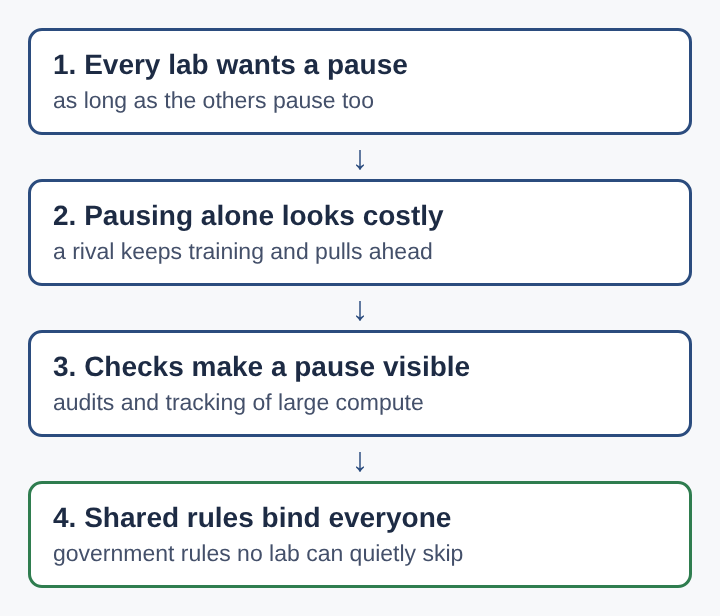
A slowdown that holds needs three things working together. The first is a clear line: which systems are too big to train without permission. The letter's answer was the amount of computation in a training run, because computing power can be counted, unlike vague ideas such as capability or risk.
The second is a way to see that the line is kept. Outside audits before training, and tracking of the largest pools of chips, give each lab some proof that its rivals are not racing in secret. Without that, every pause invites a hidden sprint. Counting and tracking compute is the core of compute governance for AI.
The third is a rule that binds everyone at once. A pledge that one company makes can be dropped the next quarter. A law that applies to every lab in a country, or an agreement between countries, changes the choice each lab faces: slowing down no longer means falling behind, because no one is allowed to speed ahead.
A worked example with two labs
Follow two labs, call them North and South, each planning a training run larger than anything built before.
- Both want caution. The leaders of each lab have signed a public statement saying advanced AI could be dangerous.
- North considers pausing. If North stops for 6 months and South does not, South ends up with the strongest system, the most users and the best hires. North gains nothing in safety, because the risky system still gets built.
- North keeps going. South reasons the same way. Both train. Neither is careless; each simply cannot afford to stop alone.
- A compute line is drawn. A rule says no training run may use more than a set amount of computation without an outside audit. Now both labs know where the line is.
- Checks are added. Large clusters of chips are tracked, so a secret run of that size would be hard to hide. North can now see that South has stopped, and South can see the same of North.
- The choice changes. Pausing no longer hands the lead to the other lab. Both can slow down without losing ground, and both have a reason to keep the deal.
The example leaves out a lot: labs in other countries, open models, and the cost of the checks themselves. But it shows where the difficulty lies. The obstacle is rarely that labs do not care. It is that caring is not enough when no one can see what the others are doing.
Frequently asked questions
Did any AI lab pause after the 2023 open letter?
No. As of July 2024 no pause had taken place, companies kept investing in larger training runs, and GPT-5 was announced in 2025.
Why can one company not simply slow down on its own?
A company that pauses alone hands time and customers to rivals that keep training, while the risky systems still get built elsewhere. Its pause costs it a great deal and makes the world only a little safer.
What did the pause letter ask governments to do?
It called for more regulation, outside audits before training AI systems, tracking of highly capable systems and large pools of computing power, and public funding for technical AI safety research.
Why is computing power used as the line for a pause?
The amount of computation in a training run can be counted and tracked, which makes it a workable threshold. It stands in for how powerful a system is likely to be.
Why coordination between AI labs is the real bottleneck
The record since 2023 points one way. Leaders of the biggest labs have said in public that advanced AI could be as dangerous as pandemics or nuclear war, and the largest training runs have kept growing anyway. That gap is not mainly a gap in belief. It is a gap in coordination: the lack of a shared line, a way to check it and a rule that holds every lab to it at once. A slowdown becomes realistic only when pausing stops being a sacrifice made by whoever is most careful, and becomes the same choice for every lab in the race.
Contain ASI
January 2024. Four AI labs. One race. Visit containasi.vlvd.net