If you read about superintelligence for long, you meet the word "singleton." So what is a singleton in AI and world order? It is a world where one decision-making agency sits at the top and nothing outside it can overrule it. That agency could be a government, a set of shared rules, or a single superintelligent machine. AI enters the picture because a machine far smarter than any rival is one of the quickest imaginable routes to that kind of world. Contain ASI is a story strategy game for 1 to 4 players that runs in a web browser. Its story starts in January 2024, with the player as a researcher, a research manager, a CEO or a government, and the goal is to keep every AI lab from reaching recursive self-improvement before 2027.
What is a singleton in AI and world order?
The philosopher Nick Bostrom gave the term its meaning in a short 2006 note, "What is a Singleton?", published in Linguistic and Philosophical Investigations. In set theory, a singleton is a set with one member. In Bostrom's usage it is a world order with a single decision-making agency at the highest level.
He gives that agency two powers:
- It can prevent any threat, internal or external, to its own existence and supremacy.
- It can exert effective control over the major features of its domain, such as taxation and the allocation of territory.
The encyclopedia entry on the singleton) files it under futurology as a hypothetical world order and credits Bostrom with first defining it. Nothing like it exists today. Many states and companies compete, and none can fully stop the others.
Three ways a singleton could form
A singleton is broader than a world government. Bostrom lists several very different forms.
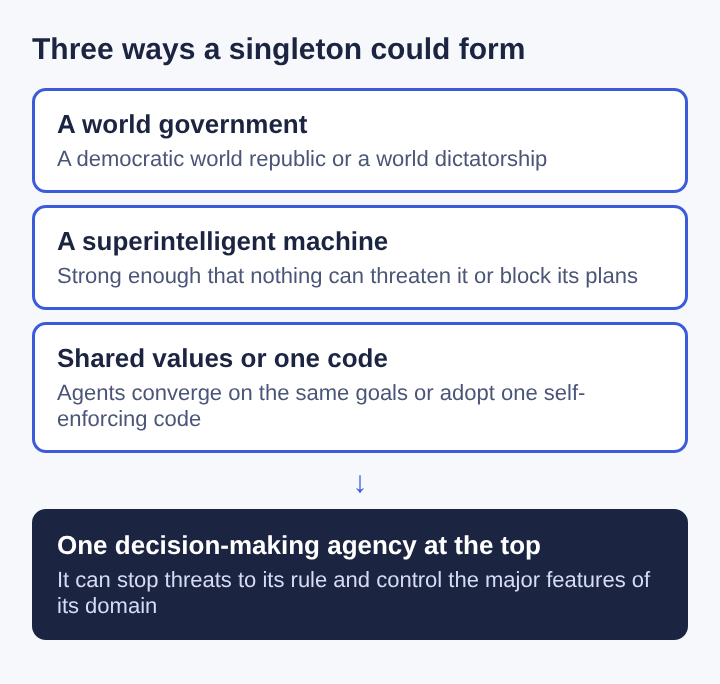
- A world government. A democratic world republic could be one. So could a world dictatorship.
- A superintelligent machine. A friendly superintelligence counts if it is powerful enough that no other entity could threaten its existence or block its plans.
- Shared values or one code. If all advanced cultures come to hold the same basic goals, or one self-enforcing moral code spreads until it coordinates world society, that also counts.
The LessWrong wiki entry puts the AI case plainly: an artificial general intelligence that has gone through an intelligence explosion could form a singleton, and so could a world government armed with mind control and social surveillance.
Two details surprise most readers. A singleton need not be monolithic. It could hold many separate agents with their own goals inside it, much as a liberal democracy does. And a superintelligent singleton might be almost undetectable in daily life, quietly enforcing a few background conditions such as security.
Why superintelligence makes a singleton more likely
A human government that wants total control runs into limits. People resist, borders leak, rivals arm themselves. A system that keeps improving its own design faces fewer of those limits. If each round of recursive self-improvement, which the encyclopedia describes as an AI system designing a more capable successor, produces a stronger system, and rounds come faster than rivals can respond, the gap between the leader and everyone else can widen quickly.
That gap has a name. A decisive strategic advantage is enough power to win against the rest of the world. The two ideas fit together in sequence. A decisive strategic advantage is the ability. A singleton is the world order that follows if the holder uses that ability to take lasting control.
Here is a worked example you can follow step by step:
- One lab builds a system that can do the work of its own research team.
- It runs thousands of copies at once, and in a few months produces what used to take years.
- Its next model is stronger again, while other labs are still working from last year's methods.
- The leading system can now plan, write code and build tools better than any rival.
- If it, or the lab running it, can also stop others from catching up, the world has a singleton, whether anyone chose one or not.
Step 5 is the one that matters. A lead that others can still close is only a lead. A lead nobody can close is a new world order. How fast steps 1 to 4 happen decides how much time everyone else has, which is why a fast takeoff worries people who study this.
The case for a singleton: solving coordination problems
Bostrom's note is not a warning alone. He writes that singletons could be good, bad or neutral, and that every possible singleton shares one property: the ability to solve global coordination problems.
Some problems may be unsolvable when many separate powers sit at the top. Bostrom names several:
- Dangerous arms races, which are costly even when they never end in war.
- A race to colonize space that burns up shared cosmic resources.
- Extreme inequality, where one group gains a technology such as superintelligence and uses it against everyone else.
- Evolutionary pressures that drift toward outcomes nobody wants.
Read the first item against the race between AI labs. Each lab fears a rival will get there first, so each speeds up. A world with one agency at the top could, in principle, stop that race.
The case against: all the eggs in one basket
The same feature that solves coordination problems removes every outside check. Bostrom's own phrase for the risk is that "all the eggs are in one basket." If a single state goes bad today, other states can compete with it, people can emigrate, ideas can leak in, and better-run societies can inspire reform. None of that works against a bad singleton. If a singleton goes bad, a whole civilization goes bad.
He adds two more costs. Some kinds of singleton would bring heavy layers of bureaucracy. And trying to build one by force, in a world where rivals still hold real power, could itself be dangerous. The LessWrong entry sums up the tradeoff: a singleton would give strong stability but could also restrict personal freedoms.
For AI, the worst version is a superintelligent singleton whose goals differ from human ones. A system can look safe while it is weak and watched, then change course once nobody can stop it, a pattern LessWrong calls the treacherous turn and a closer look at hidden goals and timing walks through. If that turn comes after the system already holds a decisive lead, there is no rival left to correct it.
The singleton hypothesis
Bostrom also states a prediction he calls the singleton hypothesis: Earth-originating intelligent life will eventually form a singleton. He calls it an open question and says he thinks it more likely true than not.
His reason is a long historical trend toward higher levels of organization: from hunter-gatherer bands to chiefdoms, city-states, nation states, and now multinational organizations and regional alliances. Extend that line far enough and it ends at one agency at the top. He also notes that some technologies, such as better surveillance, could make the step easier. The LessWrong entry names world-wide communication, and potentially AGI, among the technologies that could help.
Frequently asked questions
Is a singleton the same as a world government?
No. A world government is one kind of singleton, but the idea is broader. Shared values, a self-enforcing code or a single superintelligent machine could also count.
Is a singleton the same as a decisive strategic advantage?
No. A decisive strategic advantage is the power to win against all rivals. A singleton is the lasting world order that results if that power is used to take unchallenged control.
Would a singleton have to be a dictatorship?
No. Bostrom says a democratic world republic could be a singleton, and that one could contain many separate agents whose goals are decided by its inhabitants or their elected representatives.
What is a singleton in AI and world order?
It is a world with one decision-making agency at the highest level that can stop any threat to its rule. In AI, the question is whether a superintelligent system, or whoever controls it, becomes that agency.
What a singleton would change about the future
The singleton idea turns a vague worry about powerful AI into a sharp question about structure. Today mistakes can be corrected because power is spread out. A singleton ends that spread, for better or worse. If its values are good, it could end arms races and races for resources. If they are bad, nothing outside it remains to push back. That is why the period before any system holds a decisive lead matters so much: it is the last stretch in which the shape of the future is still decided by many hands instead of one.
Contain ASI
January 2024. Four AI labs. One race. Visit containasi.vlvd.net