What is compute governance for AI? It is the idea that the computing power used to train and run AI systems, often just called compute, can serve as a lever for governing AI itself. Data can be copied and algorithms can be shared in a paper, but the chips behind a frontier model are physical, expensive and made by very few companies. That makes compute one of the few parts of AI development that a government can actually count, track and limit.
The question matters most to anyone worried about a race between AI labs. If several labs push toward recursive self-improvement, a process in which an AI system designs a more capable successor, the hardware they need is one of the places where that race can be seen, and perhaps slowed. Contain ASI, a story strategy game for 1 to 4 players, is built around that same worry: starting in January 2024, the player tries to keep every AI lab from reaching that point before 2027.
What is compute governance for AI, and why chips?
Modern AI systems learn by running enormous amounts of arithmetic over training data. The more capable the model, the more of that arithmetic it tends to need. A 2024 paper, Computing Power and the Governance of Artificial Intelligence, opens with exactly this point: compute is crucial for the development and deployment of AI capabilities, and governments and companies have already started to use it as a way to govern AI.
The paper lists what that use looks like today. Governments invest in domestic compute capacity, control the flow of compute to competing countries, and subsidize compute access for certain sectors. The authors argue that these efforts only scratch the surface of what compute could do as a tool of oversight.
The reason is simple. Of the three main inputs to AI, which are data, algorithms and compute, only compute is a physical object that sits in a building, draws power and has to be shipped from a factory.
Four traits that make chips easier to govern
The same paper on computing power and AI governance names four traits that set AI-relevant compute apart from data and algorithms:
- Detectable. Large data centers are hard to hide. They use a lot of electricity and a lot of specialized hardware.
- Excludable. A chip given to one party is not available to another, so access can be granted or refused.
- Quantifiable. Compute can be measured in numbers: how many chips, how fast, and how many operations a training run used.
- Produced through a concentrated supply chain. A small number of firms design and make the most advanced AI chips, so a rule placed at a few points reaches most of the world's supply.
Data has none of these traits in the same way. A dataset can be copied a thousand times at almost no cost, and nobody can tell from outside who holds it. An algorithm, once published, spreads to anyone who reads it. Compute is the input that leaves the clearest trail.
Visibility, allocation and enforcement
The authors of the 2024 compute paper group the uses of compute governance into three jobs. Policymakers could use compute to make AI visible to regulators, to allocate resources toward good outcomes, and to enforce restrictions against irresponsible or malicious development.
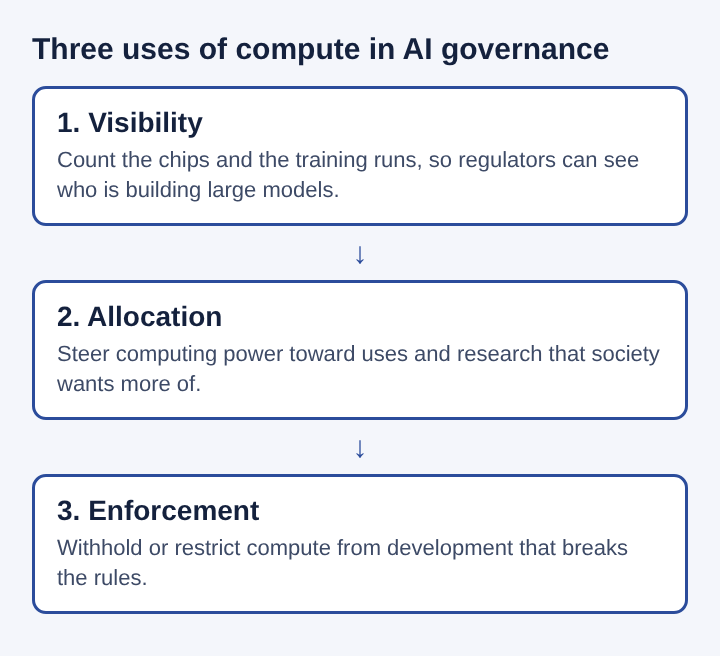
Visibility comes first, because nothing can be governed that cannot be seen. Counting chips and large training runs tells a regulator who is building the most capable systems and roughly how big they are.
Allocation is about direction. Compute can be offered to researchers working on safety, or to sectors a government wants to grow, so that the scarce resource flows toward uses that society values.
Enforcement is the hardest of the three. It means withholding or restricting compute from development that breaks the rules, which only works if the first job, visibility, is already in place.
Compute thresholds in real law
At least one major law already draws a line in units of compute. The European Union's Artificial Intelligence Act treats general-purpose models that need more than 10 to the power of 25 floating-point operations to train as high-impact models that may pose systemic risks, and it places more duties on them.
A threshold like this is a clear example of compute used for visibility. It does not ask what a model can do, which is hard to measure ahead of time. It asks how much arithmetic went into training it, which is a number a developer already knows.
A threshold is also a blunt tool. A clever new algorithm can reach the same capability with less compute, so a line drawn today may catch fewer of the most capable models over time.
A worked example: following one training run
Take a single lab that wants to train a new frontier model. Follow the run through the three jobs of compute governance, step by step.
- The lab orders chips. Because the supply chain is concentrated, the order goes to one of very few suppliers. The order itself is a record that the chips exist and where they went.
- The lab plans the run. It estimates how many floating-point operations training will take. If that number passes a legal threshold, such as the one in the EU law, the model falls into the class with extra duties.
- A regulator can see the run. A data center large enough for that training is detectable, so the run is visible before the model is finished, not only after release.
- The rules apply. If the lab meets its duties, the run goes ahead. If it does not, the excludable nature of compute means access to more chips can be refused.
Notice what made each step possible. The order was traceable because of the supply chain, the threshold worked because compute is quantifiable, the regulator could look because compute is detectable, and the limit could bite because compute is excludable. Take away any one trait and the chain weakens.
The same chain explains why compute keeps coming up whenever people talk about slowing a race between labs. A lab racing toward a system that improves itself needs more and more compute, and every extra chip it needs is another point where the race shows itself.
The risks of governing compute
Compute governance is not free of danger. The 2024 compute governance paper warns that naive or poorly scoped approaches carry significant risks in areas like privacy, economic impacts and the centralization of power. Tracking who uses large amounts of compute can drift into tracking ordinary users. Tight limits can hold back useful research and small firms. And control over the chips themselves can gather power in the hands of whoever sets the rules.
The paper also notes that the ideas differ widely in how ready they are. Some are already being piloted, while others still need fundamental research before they could work. The authors close by suggesting guardrails meant to keep these risks small.
Frequently asked questions
What does compute mean in AI?
Compute is the computing power used to train and run AI models, mostly specialized chips in large data centers. It is often measured in the number of floating-point operations a training run uses.
Why govern compute instead of data or algorithms?
Compute is detectable, excludable, quantifiable and made through a concentrated supply chain. Data and algorithms can be copied and shared freely, which makes them much harder to track or limit.
Does any law use compute thresholds today?
Yes. The EU Artificial Intelligence Act treats general-purpose models trained with more than 10 to the power of 25 floating-point operations as high-impact models that may pose systemic risks.
What are the main risks of compute governance?
Poorly designed rules can harm privacy, slow the economy and concentrate power in whoever controls the chips. Careful scope and guardrails are meant to keep those risks small.
Where compute governance goes from here
Compute governance rests on a plain fact: the most capable AI systems need huge amounts of physical hardware, and hardware leaves a trail. That trail can make the race between labs visible, steer resources toward safer work and set limits that actually hold.
Its weak points are just as plain. Algorithms get more efficient, so a fixed threshold catches less over time, and every tool that watches compute can also be turned toward watching people. The open question is how to keep the visibility that compute offers while building in the guardrails that stop it from becoming a new kind of unchecked power.