What are unit economics for an AI company? They are the numbers for one customer: what that customer brings in, what it costs to win them, and what it costs to serve them each month. For an AI product, the cost to serve is where most of the surprises sit, because every request runs a model, and running a model costs money each time. AI Entrepreneur is a set of short lessons on starting and growing a business with AI and on the history that led here. It gives the economics of growing an AI company a place in its third part, alongside agents, evals and moats. The core arithmetic fits on one page, and you can work it out for your own product today.
What Are Unit Economics for an AI Company
A "unit" is usually one paying customer, one seat or one account. Unit economics ask a simple question: does each unit make money once you count everything that unit causes you to spend?
Three numbers matter most:
- Revenue per customer, usually per month.
- Cost to serve per customer: model calls, server time, storage, payment fees and support.
- Customer acquisition cost: what you spend in ads, outreach and sales to win one customer.
Revenue minus cost to serve gives you gross profit per customer. Gross profit per customer, set against acquisition cost, tells you how long it takes to earn back what you spent to get that customer. If the answer is "never", growth makes the losses bigger.
Why AI Company Unit Economics Differ From Classic Software
In classic software, serving one more user costs very little. The code is already written. A bit more server time and some support is all the new user adds.
An AI product works differently. Each time a user asks a question, generates a draft or runs an agent, a model processes text on expensive hardware. Model providers charge by the token, a small chunk of text, for both the input you send and the output you get back. So your cost grows with usage, not with the number of accounts.
This has a direct effect. Two customers on the same monthly plan can cost you very different amounts. The one who uses the product lightly is very profitable. The one who uses it all day may cost more than they pay. A flat monthly fee hides that gap until you look at cost per user.
Inference Cost per User as the Core Unit Cost of an AI Company
Inference is the act of running a trained model to get an answer. For most AI startups it is the biggest single line in cost to serve. Here is a worked example with assumed numbers. Swap in your own.
Say you run an AI writing assistant at $20 a month. Assume your model provider charges $3 per million input tokens and $15 per million output tokens. A typical request sends 2,000 input tokens (instructions, context, the user's text) and returns 500 output tokens.
An average user makes 300 requests a month:
- Input: 300 × 2,000 = 600,000 tokens, which costs $1.80.
- Output: 300 × 500 = 150,000 tokens, which costs $2.25.
- Model cost: $4.05.
- Add $1.00 for server time, storage and logging, and $0.90 for payment processing.
- Total cost to serve: $5.95.
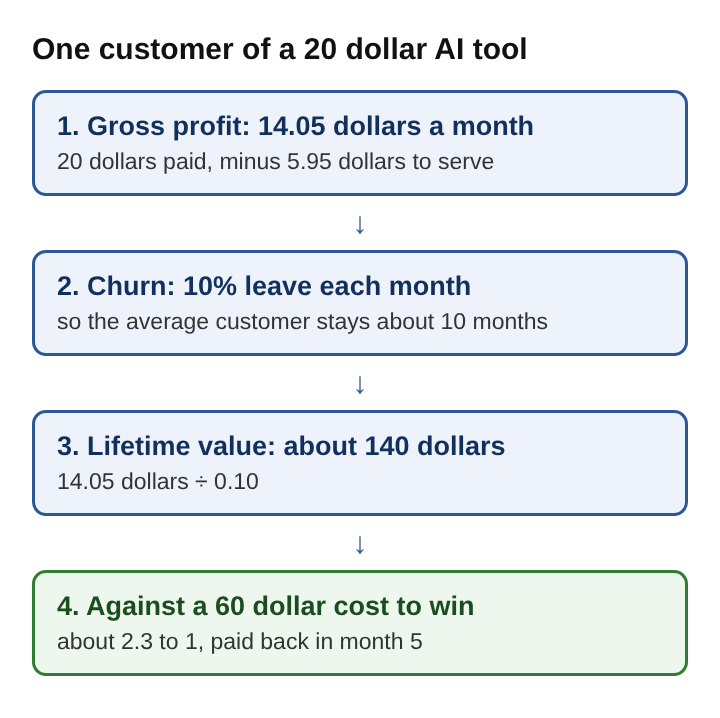
Gross profit for that user is $14.05 a month. That looks healthy. The next section shows why the average alone can mislead you.
Gross Margin Ranges for AI Companies
Gross margin is revenue minus the direct cost of delivering the product, divided by revenue. For the average user, that is $14.05 ÷ $20, about 70 percent.
In classic software, a new copy costs almost nothing to deliver, so little of each fee goes to direct costs. An AI product keeps less, because model calls count as a direct cost of delivery. But the range that matters most is the one inside your own customer base. Run the same assumptions for two other users:
- Light user, 50 requests a month: model cost $0.68, total cost about $2.58, gross margin about 87 percent.
- Heavy user, 3,000 requests a month: model cost $40.50, total cost $42.40, a loss of $22.40 every month.
One heavy user wipes out the gross profit of more than one average user. If heavy users cluster in a single type of customer, such as agencies running many drafts for many clients, your blended margin can fall fast as that segment grows. Look at the spread of cost per user, not only the mean.
Customer Acquisition Cost and Payback in AI Company Unit Economics
Serving a customer is half the picture. Winning them is the other half. Suppose you spend $3,000 on ads and outreach in a month and get 50 new customers. Your acquisition cost is $60 each. A full method for this is in the guide to working out customer acquisition cost for a startup.
Payback period is acquisition cost divided by monthly gross profit per customer. Using the average user, $60 ÷ $14.05 is a little over four months. Now say 10 percent of customers leave each month, a churn rate of 10 percent. A simple form of customer lifetime value divides monthly gross profit by monthly churn: $14.05 ÷ 0.10 is about $140, a bit more than twice what it cost to win each customer.
Use gross profit, not revenue, in the payback calculation. Many founders divide acquisition cost by the $20 fee and get three months. That number ignores the $5.95 it costs to serve each month, and in AI products that gap is large enough to change decisions about how much to spend on growth.
How Compute Costs Shaped the Business History of AI
The cost of computing has decided which AI businesses could survive for a long time. In the 1980s, companies built and sold expert systems and specialized hardware called Lisp machines to run them. When cheaper general-purpose workstations and desktop computers could do the same work, the market for that costly hardware collapsed. That collapse was part of the funding drop now known as the second AI winter. The fuller story of both collapses is in the account of what the AI winters were.
Modern AI grew on the opposite trend. Research on scaling laws for neural language models found that model performance improves in a predictable way as compute, data and model size grow. That pushed labs to train ever larger models. For a startup building on top of those models, the result is a business where the cost of each answer is a live variable. It can fall when providers release cheaper models, and it can rise when you switch to a stronger one.
Ways an AI Company Improves Its Unit Economics
Most fixes target cost per request or the match between usage and revenue.
- Shorten prompts. Input tokens are charged on every call. Cutting a 2,000-token prompt to 1,200 tokens lowers input cost by 40 percent on every request.
- Route by difficulty. Send simple requests to a smaller, cheaper model and save the large model for hard ones.
- Cache repeated work. If many users ask near-identical questions, store and reuse answers instead of calling the model each time.
- Tie revenue to usage. Usage caps, credit packs or per-task fees keep heavy users from becoming loss makers.
- Check quality before switching models. A cheaper model only helps if answers stay good enough. A set of graded examples, called an eval, shows whether quality holds. The basics are in the explainer on what an eval is for an AI product.
In the worked example, if routing and shorter prompts cut model cost per average user from $4.05 to $2.00, gross profit rises from $14.05 to $16.10 a month and payback falls to under four months, with no change to the fee.
Frequently asked questions
What gross margin is healthy for an AI startup?
There is no single right figure, because it depends on the market and how much model work each customer needs. What matters is that gross profit per customer covers acquisition cost within a payback period your cash can support, and that heavy users do not push the margin below zero.
How is inference cost per customer calculated?
Multiply each customer's monthly requests by the average input and output tokens per request, then by your provider's rate per token for each. Add server time, storage and other per-user costs to get the full cost to serve.
Can an AI company start with negative unit economics?
Many early companies lose money on each customer while they learn what people want, and Paul Graham's essay "Do Things That Don't Scale" argues that manual, costly work is normal at the start. The risk comes from scaling spend before there is a clear path to positive margins. A small minimum viable product keeps those early losses contained.
What are unit economics for an AI company in short?
They compare what one customer brings in with what it costs to win and serve that customer. For AI products, the cost of running the model on every request is the part that most often decides the outcome.
Tracking the Unit Economics of an AI Company Over Time
Unit economics are not a number you work out once. Model rates change, users find new ways to use your product, and the mix of light and heavy customers shifts. A short monthly routine keeps the picture accurate.
- Log tokens per request and requests per user, so cost per user is a fact, not a guess.
- Group customers by the month they started and follow their gross profit and retention separately.
- Watch the top tenth of users by cost. If their share of total model spend keeps rising, adjust usage caps or plan design.
- Recompute acquisition cost per channel and payback on gross profit every month.
- When a provider releases a cheaper model, run your eval set first, then switch and record the change in cost per user.
Done this way, the spreadsheet shows early when a growing segment is costing more than it pays, and it shows which change, a shorter prompt, a cheaper model or a new usage cap, moved the margin.
AI Entrepreneur
Building a business in the age of AI, from a first project to a company. Visit aientrepreneur.vlvd.net