Ask who were the pioneers of modern medicine and you get a list, but the list hides a story. Between 1796 and 1928, seven people moved medicine from guessing about bad air to naming the germ behind a disease and then killing it: Edward Jenner, Ignaz Semmelweis, John Snow, Louis Pasteur, Robert Koch, Joseph Lister and Alexander Fleming. Each one answered a question the one before could not. Learn 100 Influential People places this chain in its course Chemistry and Medicine, part of a section on how ideas and inventions spread and changed the world.
The useful way to read the list is as a set of questions. Why does a vaccine protect you? Why do clean hands save lives? What actually causes a disease? And once a germ is inside you, can anything stop it?
Medicine before germs: the bad air idea
For most of history, European doctors explained epidemics with miasma, the idea that disease rose from bad air and rotting matter. The history of germ theory notes that Galen's miasma theory stayed dominant among scientists and doctors, even though thinkers such as Girolamo Fracastoro had suggested living seeds of disease as early as 1546.
The bad air idea was not foolish. Swamps and sewers often did go with sickness. But it gave doctors nothing precise to act on, and it let them miss the one thing they carried from patient to patient: their own hands.
Edward Jenner and the first vaccine
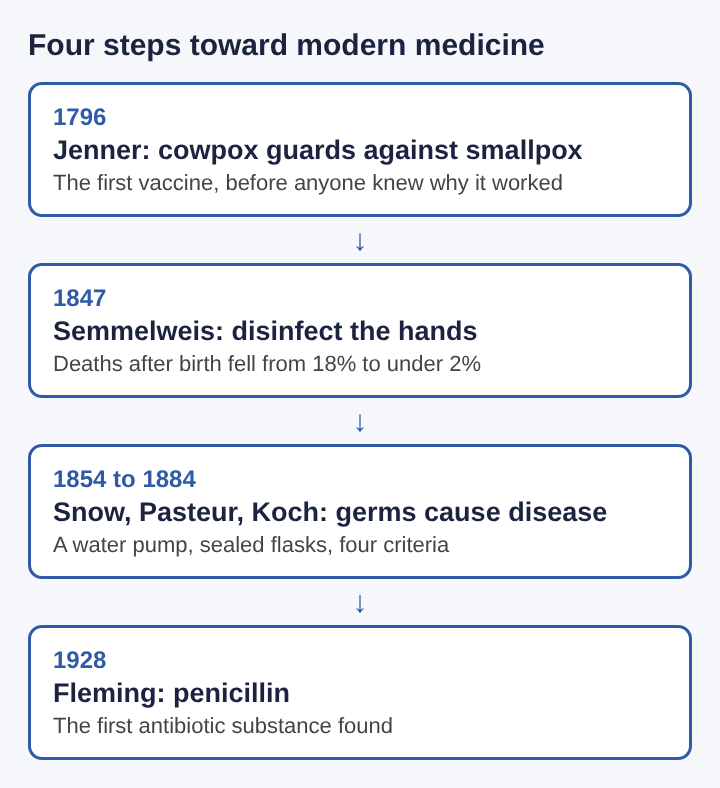
The chain starts with a country doctor in England. Edward Jenner believed that the pus in cowpox blisters, from a disease much milder than smallpox, protected people from smallpox. On 14 May 1796 he scraped pus from cowpox blisters on the hands of a milkmaid, Sarah Nelmes, and inoculated James Phipps, the eight-year-old son of his gardener.
The boy did not get smallpox. Jenner described the effect in 1798 under the name Variolae vaccinae, his term for cowpox, and the words vaccine and vaccination come from it. Here is the odd part. By the early 1800s smallpox vaccination was common in Europe, yet doctors had no idea how it worked or how to make a vaccine for anything else. Jenner had a method without a reason.
Semmelweis and the clean hands that saved mothers
The next pioneer found a cause by counting deaths. At Vienna General Hospital's First Obstetrical Clinic, the wards run by doctors had about three times the death rate of the wards run by midwives. Women died of childbed fever, an infection after giving birth. Ignaz Semmelweis proposed in 1847 that the doctors wash their hands in a chlorinated lime solution.
Deaths among mothers fell from 18% to under 2%. Semmelweis published his findings in a book in 1861, but many doctors rejected the idea. He could show that hand washing worked. He could not yet say what the hands had been carrying.
A worked example: what the Vienna numbers mean
Percentages can hide the size of a change, so turn them into people. Take the figures from the Vienna clinic and follow them step by step.
- Start with 1,000 births on the doctors' wards before the change.
- At a death rate of 18%, that is 180 mothers who die.
- After hand washing, the rate is under 2%, so fewer than 20 mothers die out of the same 1,000.
- Subtract: at least 160 more mothers survive for every 1,000 births.
Now notice what the numbers can and cannot do. They show that something on the doctors' hands killed mothers. They do not show what it was. That gap is why Semmelweis struggled to persuade his colleagues, and it is the gap the next three pioneers closed. You can use the same habit on any medical claim: ask what changed in the numbers, then ask whether anyone has explained why.
Snow, Pasteur and Koch prove that germs cause disease
Three people turned the hunch into science. In London, John Snow argued in 1849 that cholera spread through dirty water, not bad air. During the 1854 Broad Street outbreak he tied cholera cases to specific water pumps, and the germ theory history credits him as a founder of modern epidemiology, the study of how disease spreads through a population.
In France, Louis Pasteur, a chemist, disproved the old belief that life arises on its own from dead matter. In sterilized flasks that were sealed, nothing grew; in sterilized flasks left open, microorganisms grew. Pasteur went on to find the principles behind fermentation and pasteurization and to make vaccines for anthrax and rabies, giving Jenner's method the reason it had lacked.
In Germany, Robert Koch named the germs behind particular diseases and won the 1905 Nobel Prize in Physiology or Medicine for his work on tuberculosis. With Friedrich Loeffler he set out four criteria in 1884 for linking one microbe to one disease: find it in the sick, grow it pure, give the disease to a healthy host, and find the same microbe again. That same year Koch confirmed the cholera germ Snow had predicted. Pasteur and Koch are often called the fathers of microbiology together.
Lister brings germ theory into surgery
Knowing that germs cause infection only helps if someone acts on it in the operating room. Joseph Lister, a surgeon at the Glasgow Royal Infirmary, read Pasteur's papers on fermentation and reasoned that wounds became infected from microorganisms in the environment. From the mid-1860s he used carbolic acid to sterilise surgical instruments, patients' skin, stitches, surgeons' hands and wards.
This is the moment where Semmelweis's clean hands and Pasteur's germs meet. Lister had what Semmelweis lacked: an explanation that told surgeons exactly what to kill and where to find it.
Fleming and the first antibiotic
By 1900 doctors could prevent some infections and name their causes, but once a germ was deep in the body there was little they could do. In 1928 Alexander Fleming found that a mould, later identified as Penicillium rubens, made a substance that killed bacteria. It was the first antibiotic substance discovered.
Fleming did not make penicillin into a medicine alone. He shared the 1945 Nobel Prize in Physiology or Medicine with Howard Florey and Ernst Chain, who helped turn the discovery into a drug. That shared prize is a fair picture of the whole chain: each step needed more than one pair of hands.
Frequently asked questions
Who is called the father of modern medicine?
No single person holds the title. Pasteur and Koch are often named together as fathers of microbiology, while Jenner is credited with the first vaccine and Snow with founding modern epidemiology.
Why did doctors reject Semmelweis at first?
Semmelweis's figures showed that hand washing cut deaths from 18% to under 2%, but he could not explain what the hands carried. Germ theory, which gave that reason, came later from Pasteur and Koch.
What was the first vaccine?
Edward Jenner's smallpox vaccine, made from cowpox in 1796, was the world's first vaccine. The word vaccine comes from his Latin name for cowpox.
Are Koch's postulates still used?
Only partly. They cannot handle viruses or people who carry a germ without symptoms, so other criteria have largely replaced them.
Who were the pioneers of modern medicine, seen as one pattern
Look back at the chain and a pattern stands out. Jenner and Semmelweis both had results before they had reasons, and doctors were slow to accept them. Pasteur, Snow and Koch supplied the reasons, and only then did Lister's surgery and Fleming's antibiotic follow quickly. Medicine moved fastest when a result and an explanation arrived together. When you weigh a medical claim of your own, ask both questions: does it work, and does anyone know why?
Learn 100 Influential People
100 people who shaped history, from Moses to the web. Visit influentialpeople.vlvd.net