The view from above is a Stoic exercise in which you picture your own situation from a great height, then from a long span of time, until the thing troubling you shows its real size. It is described in the Internet Encyclopedia of Philosophy's entry on Marcus Aurelius as the point of view of the cosmos. If you have searched for what is the view from above, the short answer is that it is a change of scale on purpose. You rise in thought over your room, your city and the whole Earth, and then you come back down with a clearer idea of what is worth your effort today.
The exercise belongs to the same family as the daily practice that How to Find Your Meaning builds around Epictetus, Marcus Aurelius and Seneca: a morning question with one of the four Stoic virtues, a short passage with one thing to try during the day, and Seneca's three questions in the evening. A minute spent looking down from above fits easily into either end of that day.
What is the view from above in Stoic writing?
The clearest ancient source is the private notebook of the Roman emperor Marcus Aurelius, known as the Meditations, a book written to himself rather than to readers. The same encyclopedia entry says that of all the exercises in the book, the most prominent is what it calls the point of view of the cosmos. In passage after passage, Marcus urges himself to leave the narrow viewpoint of one person and look at the world from the scale of the whole universe.
The same entry points to Book 9, section 32, as a typical example, with related passages in Books 2, 5, 7 and 12. In his own words there, Marcus reminds himself that many of his troubles live only in his judgement, and that he can make room for himself by taking in the whole cosmos in thought, by thinking of all of time, of how quickly each thing changes, and of how short the span is between birth and death compared with the endless time on either side.
Two scales work together in that passage. One is space: the Earth is small against everything around it. The other is time: one life, and one bad morning inside it, is short against the past and the future. The name, the view from above, points at the first, but Marcus uses both.
An older picture: the Dream of Scipio
Marcus was not the first Roman to imagine looking down at the Earth. The statesman Cicero ended his work on the republic with a story now called the Dream of Scipio. In it, the general Scipio Aemilianus dreams that his dead grandfather, Scipio Africanus, shows him the world from a high place among the stars. From there, the younger Scipio sees that Rome is a tiny part of the Earth, and that the Earth itself is dwarfed by the stars.
The same page notes that the story is modelled on the Myth of Er in Plato's Republic, and that the conversation in it turns to the soul and to virtue from the Stoic point of view. Much of the text survived because the Latin writer Macrobius quoted large parts of it in a commentary in the fifth century. So the image of a person looking down on human affairs and seeing how small they are was already familiar in Rome long before the Meditations were written.
Why seeing the scale changes the feeling
The exercise is not meant to make you feel that nothing matters. Its purpose is more exact, and it rests on a Stoic idea about where distress comes from.
The IEP entry explains that Marcus followed Epictetus in holding that calling something good or bad is a judgement people add to what happens. Epictetus put this in section 5 of his Handbook: people are upset not by things but by their judgements about things. An impression arrives already mixed with a quick, half-conscious opinion, and the work is to examine that judgement before you accept it.
Seen up close, a sharp remark from a colleague and the label "this is a disaster" arrive as one single fact. Seen from far away, they come apart. The remark is a few lines of text on one screen in one building. The word disaster is something you added. Stepping back in space and time is a way of making that added part visible, so that you can decide whether to keep it. This is why the IEP links the cosmic exercise so closely to the analysis of judgements: the view from above is a tool for the same work.
A worked example on a bad morning
Take a plain case. At 9 in the morning you read a curt email from a colleague who says your report missed a deadline. Your face goes hot, and you start drafting an angry reply in your head. Here is the exercise in four steps, about two minutes in all.
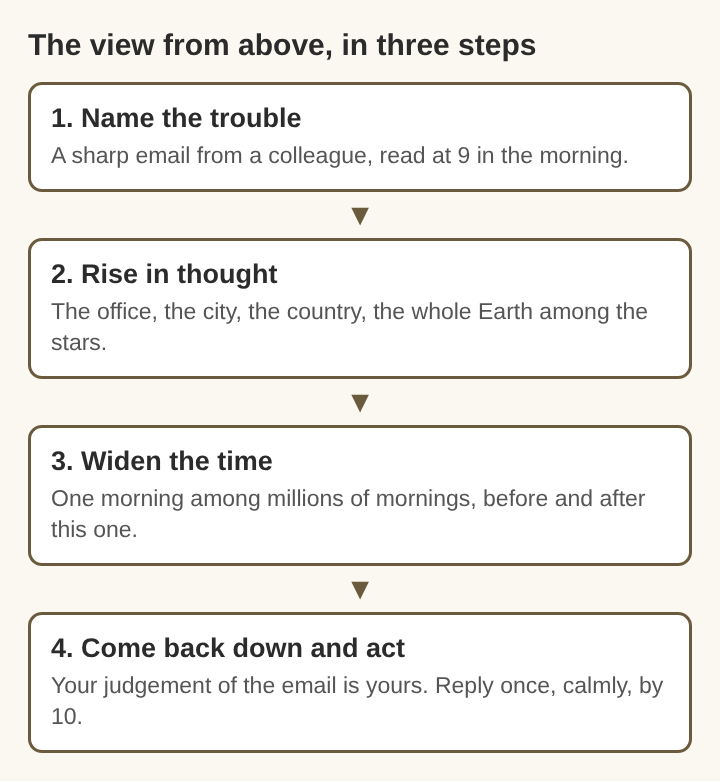
- Name the trouble. Say it plainly: a colleague wrote a short, sharp email about a late report. Leave out the label for now.
- Rise in thought. Picture your desk, then the building, then the city with thousands of other people reading their own emails, then the country, then the whole Earth turning among the stars. Your screen is now too small to see.
- Widen the time. Count this morning as one among the millions of mornings people have lived before you and will live after you. In a year, few people will remember this email at all.
- Come back down and act. Return to your desk. The email is still there, and the late report is real, but the sense of catastrophe has shrunk. What is left is a task: reply once, calmly, by 10, with a new date for the report.
Notice that the last step is the one that counts. The rise is only useful because it changes what you do when you land.
The view from above is not the same as not caring
A common worry is that seeing your life as tiny will make you careless or cold. The Stoics did not draw that conclusion. The IEP entry notes that Marcus probably wrote his notes while ruling an empire, with much of his reign spent on military campaigns. The Stanford Encyclopedia of Philosophy's entry on Marcus Aurelius describes how Pierre Hadot read the Meditations through three disciplines taken from Epictetus, one of which is acting justly toward other people. Shrinking your own trouble was meant to free attention for that duty, not to excuse you from it.
There is also a difference between distance and dismissal. Dismissal says the email does not matter, so you ignore it. Distance says the email matters about as much as a late report matters, and no more. You still reply. You simply reply without the extra weight you were about to carry for the rest of the day.
A modern echo in the overview effect
People who have actually seen the Earth from space report something close to the ancient exercise. The Wikipedia page on the overview effect describes a shift in awareness that some astronauts report while viewing the Earth from orbit, which researchers have called a state of awe with self-transcendent qualities. The author Frank White coined the term in the 1980s after interviewing many astronauts, and wrote a book about it in 1987.
The same page is careful on two points. Not every astronaut feels it, and the way people describe it ranges from religious to plainly naturalistic. That fits the Stoic exercise well. The view from above was never a promise of a special feeling. It is a practice of imagination that anyone can try at a desk, and its value is measured by whether it helps you judge the next hour more clearly.
Frequently asked questions
Who wrote about the view from above in ancient times?
Marcus Aurelius returns to it often in his Meditations, and a similar vision appears in Cicero's Dream of Scipio, at the end of his work on the republic.
Is the view from above meant to make life feel meaningless?
No. It makes a trouble look its real size, so that the judgement you added to it becomes visible. Marcus used it while carrying heavy duties, not to escape them.
How long does the exercise take?
A minute or two is enough. Name the trouble, rise in thought over the Earth, widen the span of time, then come back down and choose one action.
How is it different from the overview effect?
The overview effect is a shift some astronauts report after seeing the Earth from space. The view from above is an exercise of imagination that you do on purpose, from wherever you are.
Bringing the view from above back down to earth
The view from above asks you to do two things in order. First you go up: over your room, your city and the planet, and across a long stretch of time, until today's trouble is small enough to see whole. Then you come down, because the point was never to stay above. Back at your desk, the problem is the same size it always was, and you can finally see that size clearly. That is what Marcus kept reminding himself of in his notebook: the weight he felt came from his own judgement, and a wider look was the quickest way to set the extra part down and get on with the next right action.
How to Find Your Meaning
Find what your life is for. Visit findyourmeaning.vlvd.net