What is interleaved practice? It is a way of ordering study so that different kinds of material are mixed in one session, instead of finishing all of one kind before moving to the next. You do a few problems on one idea, switch to another idea, switch again, and come back to the first one later in the same sitting. The mix feels slower and messier than working in neat blocks. That feeling is part of how it works.
Mixing needs a stock of questions from several pages or chapters. Study Shot makes one such stock: it turns a photo of a page from a textbook, notes or a worksheet into multiple-choice practice questions, from the basics to advanced, and explains every answer. The method itself works with any questions you can collect, including ones you write by hand.
What is interleaved practice, in plain terms
The plain definition comes from the research on spacing. The spacing effect is repeated study with a delay between the repetitions. When that delay is created by studying another task or subject, the method is known as interleaving. So interleaving is spacing inside a single session: the gap before an idea comes back is filled with other work, not with a break.
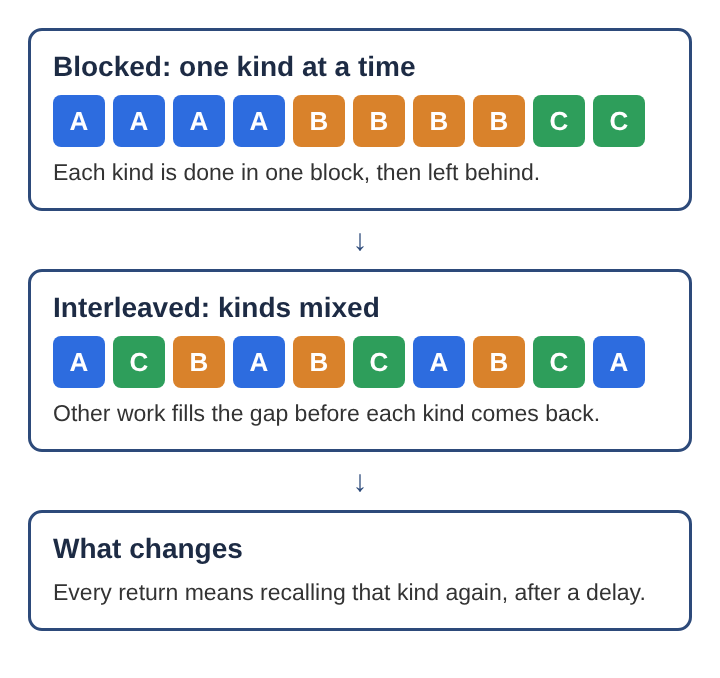
The opposite order is usually called blocked practice. In a blocked session you do ten questions on fractions, then ten on percentages, then ten on ratios. In an interleaved session the same thirty questions arrive mixed: a fraction, a ratio, a percentage, another fraction, and so on. Nothing is added or taken away. Only the order changes.
Why mixing makes each answer harder
In a block, the first question on a new idea takes real effort. By the fifth, the method is sitting in your head, warm from the last four. You copy the move you just made. It feels fluent, and the run of right answers feels like progress.
In a mixed set, the idea you need is never the one you just used. Every time a kind of question returns, you have to pull its method back out of memory after doing something else. That pulling out is retrieval practice, also known as active recall, and it is the work that makes material stick. Interleaving turns each return into one more act of recall instead of one more repetition of a move that is already in front of you.
There is a second difference. In a block, the heading of the exercise tells you which method to use. In a mixed set, part of each question is working out what kind of question it is. An exam does not label its questions by chapter either, so a mixed set is closer to the conditions you will face.
What the research says, and what it does not
Interleaving sits in the family of study methods called desirable difficulties: ways of studying that feel harder in the moment but help later. The Wikipedia page on desirable difficulty gives an example of spacing that any student can use: going back over notes from previous weeks every week up to the final, which spaces out the sessions instead of cramming them and increases what goes into long-term memory. It also says students can use spacing and interleaving while studying, and that mixing several subjects while spreading study over different intervals enforces interleaving.
The evidence is not as settled as it is for recall itself. The Wikipedia page on retrieval practice lists interleaved practice, along with self-explanation and elaborative interrogation, as methods that can be useful but need more research. So the honest position is this: retrieval practice and spacing have strong support, and interleaving is a promising way to get more of both into one session. It is a sensible default for exam preparation, not a guarantee.
When to interleave and when to block
Mixing is not useful on day one of a new idea. If you have never seen a kind of problem, a mixed set just means getting lost on every question. A short block first, enough to understand what the method is and to get a few right, gives you something to recall later.
A workable rule is to block while learning and mix while practising. Read a section, answer a handful of questions on that section alone, then fold it into a mixed set with earlier sections from that point on. The kinds you mix should also be close enough to be confused with each other. Mixing a history chapter with a chemistry chapter gives you spacing, but mixing three kinds of chemistry problem also asks you to tell them apart, which is closer to what an exam asks.
- Block: the first few questions on a brand new idea.
- Mix: every later session, across ideas you have already met.
- Space: come back to the same mix on later days, so the gap grows.
A worked example: three pages, one mixed round
Say a biology chapter has three pages you need for an exam: photosynthesis, cellular respiration and cell division. The home page of Study Shot shows a question of exactly this kind, made from a photosynthesis page: "Where in a plant cell does photosynthesis take place?", with the mitochondria, the chloroplasts, the nucleus and the cell wall as the four choices. The right answer is the chloroplasts.
Day 1, learn in blocks. Read each page and answer a short set on it straight away. A quiz can have 5 to 20 questions, each with four choices, so you make one quiz per page. Its guide on choosing the level suggests that revising a chapter page by page works with Tiered, the ladder from Basic through Intermediate to Advanced, at 10 questions per page. Each answer is checked right away and explained, so each miss is corrected while the page is fresh.
Day 3, mix the round. Every quiz is kept in a library with its page photo, ready to take again. Instead of retaking the photosynthesis quiz, then respiration, then division, take a short pass of each in turn and keep switching. Five questions of photosynthesis, five of respiration, five of division, then back to photosynthesis. A question about where respiration happens now sits right after one about chloroplasts, and you have to keep the two organelles apart.
Day 6, mix harder. The same guide suggests, in the week before an exam, Advanced with 10 or 15 questions, then retaking the quiz until you get them right. Make the Advanced quizzes for all three pages and rotate through them the same way. Write down every question you miss, with the page it came from.
By the end of day 6 you have recalled each page on three separate days, with other material between every return. The list of misses shows which page needs another look and, just as often, which two ideas you keep mixing up.
Common mistakes with mixed practice
Mixing too early. If you cannot answer any question on a page yet, a mixed round only shows that. Learn first, then mix.
Mixing without feedback. Answering with feedback is more useful than answering without it, according to the research summarised on the retrieval practice page. A mixed set with no answer check lets a wrong method repeat unnoticed.
Judging the session by how it felt. A mixed round gets fewer right than a block of the same questions, especially at first. A lower count in a mixed set is not a sign the method is failing. Judge it by how much you recall on the next day, not during the session.
Mixing material that never meets. Switching between unrelated subjects still spaces your study, but it skips the work of choosing between similar methods. Mix within a subject too.
Frequently asked questions
Is interleaved practice the same as spaced practice?
They are close relatives. Spacing puts a delay between repetitions of the same material; interleaving creates that delay by doing other material in between, inside the same session.
How many kinds of material should one mixed session hold?
Two to four kinds is easy to manage. More than that makes each kind return so rarely that the session turns into a sample of everything.
Does interleaving work for subjects other than maths?
The idea applies to any material with several kinds of question, such as biology processes, grammar rules or historical causes. The research is still growing, so watch your own results from one day to the next.
Why do mixed practice sessions feel worse than blocked ones?
Each question needs a fresh recall of its method, so fewer answers come easily. That extra effort is the reason it helps later, even though the session feels less smooth.
Interleaved practice as a habit
Interleaved practice is a change of order, not a change of material. The same questions that sit in neat blocks can be shuffled so that each idea returns after a gap filled with other work, and each return becomes one more recall. Block for the first few questions on a new idea, mix once you have met it, and come back to the mix on later days. Over a few weeks, the mixed round becomes the normal way to practise, and the exam's own mix of questions looks familiar.
Study Shot
Turn any page into a practice quiz. Visit studyshot.vlvd.net