What customer acquisition cost means
Customer acquisition cost, usually shortened to CAC, is the money a business spends to persuade one new customer to make a purchase. It is one of the first numbers a young company has to know, because it tells you whether growth makes you richer or poorer. If winning a customer costs more than that customer will ever bring in, every new sale digs the hole deeper.
The definition on Wikipedia's customer acquisition cost page is short: the cost of persuading a customer to purchase a product or service. It counts the marketing, the salaries and the related expenses that went into winning that customer. Lessons on building and growing a business with AI, such as the ones at AI Entrepreneur, treat it as part of the economics of growing a company, next to moats, agents and evals.
The idea sounds obvious. The trouble is in the details: what you count as a cost, which customers you count, and over what period.
The simple formula for CAC
The simple method takes the marketing money spent to win new customers in a period and divides it by the number of new customers won in that same period.
- Marketing cost: ads, sponsorships, placements in newsletters, conference booths.
- Customers acquired: people who became customers in that period, not visitors and not people on a waiting list.
- CAC: marketing cost divided by customers acquired.
If you spend 900 dollars on ads in March and 25 new customers start in March, your simple CAC is 36 dollars. This version is quick and useful when marketing is almost all of your spending on growth. It flatters you when it is not.
The full formula, and why it is usually higher
The fuller method adds everything else that went into winning those customers. The Wikipedia page lists the pieces: wages tied to sales and marketing, the software used for sales and marketing (email tools, a shop platform, data dashboards), outside professional help such as designers and consultants, and other overhead tied to marketing and sales.
For a small startup, the biggest hidden cost is often the founder's own time. If you spend half your week writing to prospects and running demos, that time has a cost even when no salary changes hands. Some founders leave it out because it does not show up on a bank statement. That makes the number look good today and misleads you later, when someone has to be hired to do the same work.
A good habit is to keep both numbers. The simple CAC tells you how well your ads work. The full CAC tells you what growth really costs the business.
A worked example with a small AI product
Say you run a small AI tool that turns sales call recordings into written follow-up emails. Customers pay 20 dollars a month. Here is one month of growth.
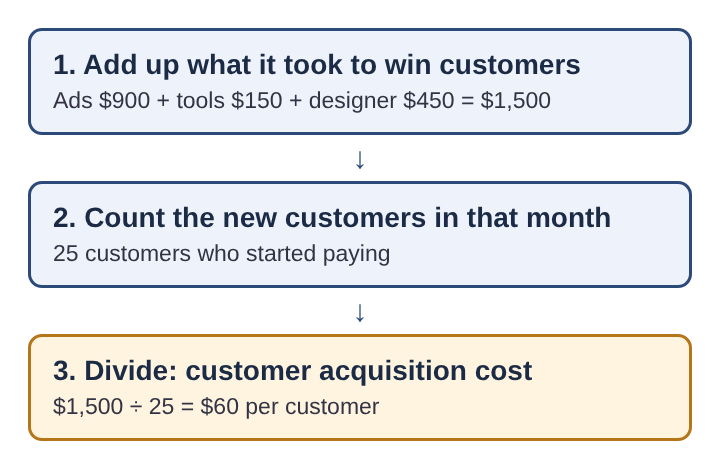
- Add up the spending. You spent 900 dollars on ads, 150 dollars on an email outreach tool and 450 dollars on a freelance designer for a landing page. That is 1,500 dollars.
- Count the new customers. 25 people started a monthly plan that month.
- Divide. 1,500 divided by 25 is 60 dollars. That is your full CAC. Ads alone give a simple CAC of 900 divided by 25, or 36 dollars.
- Work out what a customer leaves you each month. Of the 20 dollars a customer pays, say 5 dollars goes to model calls, servers and card fees. That leaves a margin of 15 dollars a month.
- Find the payback time. 60 dollars of CAC divided by 15 dollars of monthly margin is 4 months. A customer has to stay 4 months before you earn back what it cost to win them.
- Estimate lifetime value. If the average customer stays 10 months, they leave you 10 times 15, or 150 dollars of margin.
Now compare: 150 dollars of lifetime margin against 60 dollars of CAC is a ratio of 2.5 to 1. Each customer pays back what they cost and then some, but there is not much room for error. If customers start leaving after 3 months instead of 10, the same 60 dollars of CAC loses money on every one of them.
Customer acquisition cost against lifetime value
CAC on its own says little. It means something only next to what a customer is worth. Customer lifetime value, or LTV, is an estimate of the net profit a customer brings over the whole future relationship. Wikipedia's page on it makes the link plain: lifetime value is an upper limit on what a firm should be willing to spend to win that customer.
That is why founders and investors talk about the LTV to CAC ratio. The CAC page gives a common reading of it:
- Under 1 to 1: you pay more for customers than they are worth, and the business gets into trouble.
- Around 1 to 1: you lose money once the cost of serving customers is counted.
- Around 3 to 1: often called a healthy level, where customers are won at a sensible cost.
- Well above 3 to 1: you may be spending too little on growth and leaving customers for others to win.
Treat these as rough marks, not laws. Lifetime value is a forecast, and the Wikipedia page notes that it is much harder to measure than past profit, because it depends on guessing how long customers will stay. Retention matters most here: when few customers stay, lifetime value barely grows over time, and any CAC starts to look expensive.
Why the number is so hard to read early on
In the first months of a startup, CAC is noisy. You may have 8 customers, half of whom came from a single post that went around a forum. That gives a tiny CAC that will not repeat. Or you may have spent a month on ads that brought nothing while you learned how to write them, which gives a huge CAC that will not repeat either.
Paul Graham's essay Do Things That Don't Scale argues that the most common unscalable thing founders have to do at the start is to recruit users by hand. You cannot wait for users to come to you; you have to go out and get them. Early CAC built on that kind of work is real cost, mostly the founder's time, but it is not a forecast of what ad channels will cost later. The ways of finding your first customers for a new business are mostly this kind of hand work. Keep the channels apart:
- By channel: CAC from ads, from cold email, from referrals and from search are different numbers. A blended average hides the one channel that works.
- By period: compare month to month, and expect it to jump around until you have a few dozen customers per channel.
- By the definition of a customer: decide once whether a customer is someone who started a plan or someone who stayed past the first month, and keep it fixed.
Ways to bring CAC down
There are two levers: spend less to reach people, or turn more of the people you reach into customers. Most improvements come from the second.
- Narrow the audience. Ads aimed at a precise group, such as sales managers at small agencies, waste less money than ads aimed at anyone in business.
- Fix the step where people drop out. If many people try your tool and few finish setting it up, a smoother first use lowers CAC without touching the ad budget.
- Use referrals. Customers who arrive through another customer's word often cost little to win and tend to stay longer.
- Build things that keep bringing people. Useful guides and a product people share can bring customers month after month without new spending.
- Raise lifetime value instead. A product people keep using makes the same CAC affordable. Better retention often helps more than cheaper ads.
Frequently asked questions
What is a good customer acquisition cost for a startup?
There is no single good number, because CAC only means something next to lifetime value. A common rule of thumb is a lifetime value about three times the CAC, with the CAC earned back within months rather than years.
Should the founder's time count in CAC?
For an honest full CAC, yes. Founder time spent on sales and outreach is a real cost, and leaving it out makes growth look cheaper than it will be once someone is hired to do that work.
What is the difference between CAC and cost per lead?
Cost per lead counts what you spend to get someone interested, such as an email address or a demo booking. CAC counts only people who actually become customers, so it is always the same or higher.
How often should a startup calculate CAC?
Monthly is a sensible rhythm for a young company, split by channel. Early numbers move a lot, so look at the trend over several months rather than any one month.
Customer acquisition cost as a question about the whole business
CAC seems to be a marketing number, but it measures the whole business. A product people do not want makes every customer expensive to win. A product people keep using and tell others about makes the same spending go further. When the number goes the wrong way, the fix is often not a new ad but a clearer offer, a smoother first use or a reason for customers to stay. Watching CAC next to lifetime value keeps one question in view: does each new customer leave the business stronger than before?
AI Entrepreneur
Building a business in the age of AI, from a first project to a company. Visit aientrepreneur.vlvd.net