Why studying feels like learning when little sticks
You read a chapter, every line makes sense, and you close the book sure you have it. Two days later the question in front of you draws a blank. The reason studying feels like learning when it is not is simple: a page you have seen before reads smoothly, and your mind treats that smoothness as proof that the ideas are stored. They often are not. The feeling comes from recognising the words, while the exam asks you to bring them back with the page closed.
The fix is not to study harder. It is to stop trusting the feeling and start checking with recall. Study Shot is built around that check: it turns a photo of a page into multiple-choice practice questions and explains every answer, so a page that only feels known gets a quick, honest look. The ideas behind the gap matter more than any one method, though, so they come first.
Familiar is not the same as remembered
Psychologists call the shortcut at work here the fluency heuristic. When something is processed more fluently, faster or more smoothly than something else, the mind infers that it has the higher value for whatever question is being asked. In study, the question is "do I know this?", and the answer your mind gives is "yes, it reads easily".
The same page describes early work by Jacoby and Dallas in 1981: when an object is readily perceived and seems to jump out, a person has likely seen it before, even without consciously remembering seeing it. That is useful in daily life. It is a trap at a desk. The second time you read a paragraph, it jumps out because you saw it an hour ago, not because you could explain it to someone with the book shut.
So there are two different signals, and they are easy to confuse:
- Recognition: the page looks right when it is in front of you.
- Recall: you can produce the idea, the term or the steps when the page is gone.
Exams, essays and real use mostly ask for recall. Rereading mostly builds recognition.
How your judgment of learning steers study time
Research on metamemory, the awareness of your own memory, adds the next piece. While studying, students make judgments of learning, quick calls on whether a section has been learned, and they use those calls to decide where to spend their time.
That is where the illusion does its damage. If a familiar page gets a confident "learned", you move on from it. If a hard page earns an anxious "not yet", you go back to it and reread it until it, too, feels familiar. Both choices rest on the same unreliable signal. Time flows away from pages that need it and toward making every page feel smooth.
The same research describes the feeling of knowing: the sense that something is in memory even though it cannot be recalled right now, and would be recognised if seen. An early study by Hart in 1965 found that feeling to be a fairly accurate sign of what is in memory. Notice what it predicts, though: recognition. A feeling of knowing can be right that you would pick the answer out of a list, and still leave you unable to write it down.
The habits that feel productive and fall short
The Wikipedia page on desirable difficulty, a term Robert Bjork coined in 1994, puts the problem plainly: many tasks give the illusion of learning because they are easily completed. Its example is rereading notes or a textbook. The words are more familiar on the second or third read, so a student feels they are learning, but that familiarity does not mean the material has been processed and kept.
A few common habits share this pattern:
- Rereading the chapter. Each pass is faster and smoother, which feels like progress. The question of whether rereading is a good way to study comes down to this gap.
- Highlighting as you go. Choosing a line to mark feels active, yet the page stays open the whole time.
- Reading the answer key straight away. The worked answer makes sense, so it feels as though you could have produced it.
- Copying notes out neatly. The hand is busy, but the source sits right beside you.
None of these is useless. They just measure the wrong thing. What they share is that the material never leaves your sight, so recall is never asked for and never checked.
What recall changes
The same desirable difficulty page contrasts rereading with flashcards. When a card asks you to generate a definition, it engages recall. That is harder and takes more effort, and at first you may feel less sure of yourself than you did while rereading. Over time, though, the knowledge is retained better. The effort is the point: it is the work of pulling something out of memory, rather than the ease of seeing it again.
This also explains why honest practice feels worse. A set of questions on a page you were sure of can end at three right out of five. That result is not a sign you studied badly. It is the first accurate reading of where you stand, and it arrives while there is still time to act on it. The live article on what a desirable difficulty is goes further into why the harder route pays off.
A five-minute check on one page
Here is a check you can run on any page you believe you know. Take a textbook page on photosynthesis that you have read twice and that now feels easy.
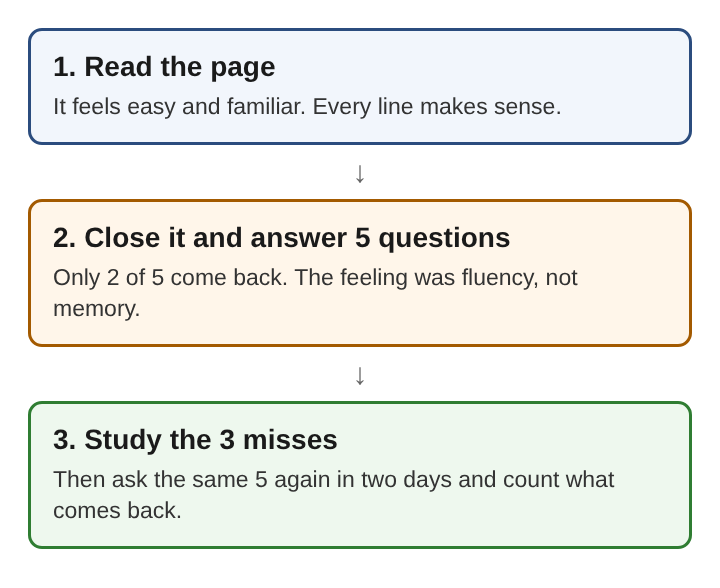
- Read it once more, then close it. Before you look away, mark how sure you feel, from 1 to 5. Write the number down.
- Answer 5 questions with the page closed. One might be: "Where in a plant cell does photosynthesis take place?" with four choices: the mitochondria, the chloroplasts, the nucleus and the cell wall. Commit to an answer before you check. The right answer is the chloroplasts. You can write the questions yourself from the headings, or have Study Shot make a quiz of 5 from a photo of the page, which checks each answer right away and explains it.
- Compare. Say you marked the page a 5 for sureness and got 2 of 5 right. That gap between how sure you felt and how many came back is the illusion, measured on your own material.
- Study only the 3 misses. Read the explanation for each, find the line on the page it came from, and say the idea out loud in your own words.
- Ask the same 5 again in two days. Count what comes back without the page.
The steps use only a few facts about the page, which is the point: you are not covering it all again, only the parts the questions showed you did not have.
Reading the result honestly
The number from the check is worth more than the feeling, but only if you let it change your plan.
- Sure, few right: the page is the trap. Move it to the front of the next session, however familiar it looks.
- Unsure, most right: you know more than you think. Spend less time here and stop rereading it for comfort.
- Both high: good, but ask again after a few days, since an answer recalled an hour after reading is still fresh.
- Both low: start with the basic ideas on the page before the harder questions.
Over a few weeks, writing how sure you felt next to how many came back also trains the judgment itself. You start to notice which kinds of pages fool you, often the ones with clean diagrams and short paragraphs, and you check those first.
Frequently asked questions
Why do students forget things they were sure they knew?
The sureness usually came from recognising the page, not from recalling it. A familiar page reads smoothly, and that ease is taken as memory, so the gap only shows when you have to produce the answer yourself.
Is the feeling of knowing always wrong?
No. Research on metamemory found the feeling of knowing to be a fairly accurate sign that something is stored, at least well enough to recognise it. The problem is that recognising is easier than recalling, and most exams ask you to recall.
How can you tell whether you have really learned a page?
Close the page and try to answer questions about it, then check every answer. What you can produce with the page shut is the honest measure; how easily the page reads is not.
Why does practice with questions feel harder than rereading?
Because it asks you to pull the idea out of memory instead of seeing it again. That effort is a desirable difficulty: it feels slower and less confident at first, and leads to better retention over time.
Trusting recall over the feeling of knowing
The sense that a page is learned is real, but it reports on familiarity, and familiarity grows every time you look at the same words. Recall is the only signal that matches what you will be asked to do later. When a page feels easy, treat that as a reason to check it, not a reason to skip it. Five questions with the book closed will tell you more than a third careful read, and the misses they turn up are exactly where the next half hour of study belongs.
Study Shot
Turn any page into a practice quiz. Visit studyshot.vlvd.net