What is eudaimonia, in plain words
If you are asking what is eudaimonia, the short answer is that it is the ancient Greek word for the best life a person can live. The Wikipedia page on eudaimonia gives its literal sense as the state of having a good spirit, and notes that it is usually translated as happiness or welfare. Many writers prefer the word flourishing, because the Greek idea is less about a passing mood and more about how a whole life goes.
Every major school of Greek ethics treated eudaimonia as the goal. They argued about what it takes to reach it. The Stoics gave the boldest answer: virtue alone is enough. How to Find Your Meaning, at findyourmeaning.vlvd.net, teaches Stoic philosophy in short lessons with a daily practice that opens each morning with one of the four Stoic virtues, and that daily habit makes most sense once you see what the Stoics thought happiness was.
A word for the highest human good
In the works of Aristotle, eudaimonia was the name for the highest human good, the thing everything else is done for. The same Wikipedia page places it at the centre of Aristotle's ethics and of the Hellenistic schools that came after him, always paired with another word, arete, which means virtue or excellence.
That pairing is the key to the whole debate. Nearly every Greek thinker agreed that virtue and happiness are bound together. What they disagreed about was how tightly. Is virtue one ingredient among several, or is it the whole recipe? Your answer changes how you treat money, health, praise and loss.
A modern reader often hears happiness as feeling good. The Greek question is wider. It asks what kind of life is worth having from beginning to end, so that you could look back over it and call it a good one. A day of pleasure can sit inside an unhappy life in this sense, and a hard day can sit inside a flourishing one.
Eudaimonia in Stoic philosophy: virtue is enough
Stoic philosophy began with Zeno of Citium around 300 BC, and Cleanthes and Chrysippus built it into a full system. The Wikipedia page records how each described the happy life: Zeno as a life that flows well, Cleanthes as living in agreement with nature, and Chrysippus as living by an understanding of what happens by nature.
The Stanford Encyclopedia of Philosophy's entry on Stoicism unpacks Zeno's shorter version, living in agreement. Part of it is agreement with yourself. The flourishing person is not split inside, and does not swing from one set of priorities to another. Their choices come from one consistent outlook that holds over time. Cleanthes added that this agreement should also be with nature, the rational order of the world.
From there the Stoics made their famous claim. Virtue is both necessary and sufficient for eudaimonia. You cannot be happy without it, and with it you cannot fail to be happy. The Wikipedia page traces this view back to the Socrates of Plato's early dialogues, and calls Stoic ethics a particularly strong version of eudaimonism.
Health, wealth and the Stoic indifferents
If virtue is the only good, what about everything else people chase? The Stanford entry says the Stoics held two linked doctrines: human happiness is fully in your power, and virtue is the only good. Health, wealth and reputation are neither good nor bad. They are indifferent to happiness, which the Stoics called adiaphora.
That does not mean you should not care about them. Mainstream Stoics said some indifferents are preferred. Health, wealth and a good name have value and are in line with nature, so it is fitting to choose them over sickness, poverty and disgrace. The Stoic chooses them with energy. What the Stoic refuses is to treat them as the thing that makes a life go well or badly.
The Stanford entry is frank that ancient critics found this hard to accept. If health has real value, why does it add nothing to happiness? And if it adds nothing, why pursue it at all? The Stoics answered that choosing well among indifferents is itself the work of virtue, so the value lies in the choosing, not in what you end up holding.
This is the same split that sits behind the Stoic line between what is up to you and what is not. Your judgments and choices are up to you. Outcomes, other people and your body are not. If happiness depends only on what is up to you, it cannot be taken from you.
How the Stoic view differs from Aristotle's
Aristotle agreed that virtue is central, but he thought a happy life also needs some outside support. According to the Wikipedia page, he held that severe misfortune, such as the death of your family and friends, could rob even a very good person of eudaimonia. The Stoics disagreed. For them, external goods such as wealth or physical beauty are not needed for virtue, and so not needed for happiness.
The Stoic position has a striking consequence. The Stanford entry explains that on the Stoic view happiness does not come in degrees. A virtuous person under torture is as happy as they were before it began, because they still have the one thing that truly benefits them, even though their share of pain and health has changed.
Most people find that hard to believe, and the Stoics knew it. But the claim is less cold than it sounds. It says that the worth of your life is not held hostage by luck. A loss can hurt, and you can grieve it, while the core of a good life stays in your own hands.
A worked example: one job offer
Here is how the idea sorts a real decision. Suppose your manager offers you a promotion. It brings more money, a better title and the respect of your colleagues. There is one catch: the new role means signing off each month on sales figures you know have been padded.
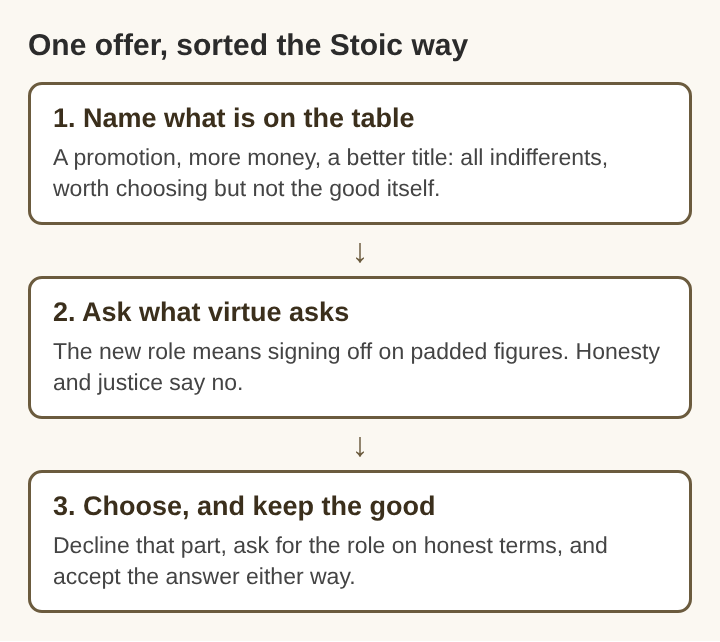
- Name what is on the table. The promotion, the money and the title are preferred indifferents. They have value, and wanting them is reasonable. None of them is the good itself.
- Ask what virtue asks. Signing padded figures would mean being dishonest and unjust to the people who rely on them. That touches the one thing the Stoics counted as good.
- Choose, and keep the good. You decline that part of the role and ask whether the promotion can come on honest terms. Then you accept the answer, yes or no, because the outcome was never the part that was yours.
Notice what changed. Without the Stoic frame, this seems to be a trade between money and comfort on one side and a vague unease on the other. With it, the money is still welcome, but it sits on a different level from your honesty. If the answer is no, you have lost an indifferent. You have not lost your eudaimonia.
Frequently asked questions
Does eudaimonia just mean happiness?
It is often translated as happiness, but the Greek word means a whole life going well, closer to flourishing than to a good mood. It describes how a life turns out, not how one afternoon feels.
Why did the Stoics say virtue is enough for eudaimonia?
They held that virtue is the only real good and that everything else, health and wealth included, is indifferent to happiness. Since virtue is up to you, happiness is up to you too.
What are preferred indifferents in Stoicism?
They are things such as health, wealth and a good name that have value and are worth choosing over their opposites. They do not make a life happy or unhappy on their own.
How is the Stoic view different from Aristotle's?
Aristotle thought great misfortune could take eudaimonia away even from a good person. The Stoics held that a virtuous person stays happy whatever happens outside.
Eudaimonia as a life in agreement
Eudaimonia, for the Stoics, is not something you collect or wait for. It is a way of living in which your choices agree with each other and with the world as it is. Money, health and praise still matter, and you can pursue them with real effort. They simply stop deciding whether your life is a good one. That decision rests on how you act, one choice at a time, and no turn of luck can make it for you.
How to Find Your Meaning
Find what your life is for. Visit findyourmeaning.vlvd.net