What is the Stoic reserve clause? It is a small condition the Stoics attached to every plan: you aim at something with your whole effort, and you want it only if nothing prevents it. The Greek name is hupexairesis, usually translated as "reservation" or "reserve". Said aloud, it often sounds like nothing more than "if all goes well". Held as a habit, it changes how a blocked plan feels.
What is the Stoic reserve clause in plain words
The reserve clause splits every wish into two parts. The first part is the aim: finish the report, see your friend, win the race. The second part is the reserve: if the world allows it. The aim keeps you working. The reserve keeps your peace of mind from resting on things you cannot fully control.
Most people make plans without the second part. They want the result flatly, so when traffic, illness or someone else's choice gets in the way, the wish is broken and they feel cheated. A Stoic makes the same plan and puts in the same effort, but the wish itself already allows for the world saying no. Nothing in the wish is broken when that happens.
How to Find Your Meaning, a set of short lessons on Stoic philosophy, healthy habits and the story of who you are, builds this into a daily Stoic practice: a morning question with one of the four Stoic virtues, a passage from Epictetus, Marcus Aurelius or Seneca with one thing to try that day, and an evening with Seneca's three questions. A morning plan made with a reserve fits that rhythm well, because the evening questions then look at what you did, not at what the day handed you.
Where the reserve comes from in Stoic ethics
The reserve grows out of the Stoic split between real goods and things that are only preferred. In the Internet Encyclopedia of Philosophy's account of Stoic ethics, the company of a friend is preferred, but it is not a real good in the way virtue is. A friend's absence does not harm the soul of a good person; only vice does. So the good person wishes to see the friend only if, in the course of events, it is good for it to happen. That wish is made with reservation, on the condition that it is fated. If the meeting does not happen, the person is not thwarted, and so is not disappointed or unhappy.
The same entry draws the contrast. A person who treats riches as a real good is gripped by pleasure while the money lasts. When the wealth is lost, the old judgment flips into a new one, that poverty is really bad, and the person becomes miserable. The reserve is the Stoic way out of that swing. You still pick wealth over poverty and health over illness when you can, but you never stake your happiness on getting them.
The Stanford Encyclopedia of Philosophy's entry on Stoicism puts it in terms of selection. The Stoics held that choosing among preferred and dispreferred things can be done correctly even when the thing pursued never arrives. A good selection counts as successful without getting the object it aims at. The entry notes that the wise person's selections carry "reservations", the same idea named in the ancient sources and discussed by modern scholars of Stoic action.
Why a wish with a reserve cannot be blocked
A plan without a reserve has a single way to succeed: the result must happen. A plan with a reserve has a different success condition: you acted well and chose sensibly given what you knew. The world can stop the result. It cannot stop the second kind of success, because that one was finished the moment you acted.
This is why the reserve sits so close to the dichotomy of control. That teaching, central to what Epictetus taught, sorts the world into what is up to you and what is not. The reserve clause takes that sorting and writes it into each single plan. Before you start, you already know which part of the plan is yours: the effort, the care, the honesty. The rest is labelled as not yours, so a setback lands on the label and not on you.
It also connects to assent, the Stoic idea that you choose which impressions to agree with. When a plan fails, the first impression is often "this is a disaster". With a reserve in place, you were never committed to the result being yours by right, so it becomes easier to withhold agreement from that first impression and ask what is actually true.
The archer and the target
The Stoics' best-known image for the reserve is an archer. The Internet Encyclopedia of Philosophy's entry on Epictetus explains it. The outcome of your actions is not wholly in your power, but your inclination to act one way rather than another is. The archer wants to hit the centre of the target, yet cannot be sure of the wind, of a slip of the fingers or even of the bow holding together. So the good archer does everything in her power to shoot well and is not disappointed if she shoots well and still misses. The entry traces this to Cicero's On Ends: the ordinary person counts success as hitting the target, while the Stoic counts success as having shot well.
Notice what the archer does not do. She does not shoot carelessly because the result is uncertain. She aims at the centre with full attention. The reserve never lowers the aim. It only moves where her peace of mind is kept: in the shot, not in where the arrow lands.
A worked example: one report due on Friday
Here is one plan, worked through with a reserve. You need to send a finished report to your team on Friday. It depends on data from another group, which has promised it by Wednesday.
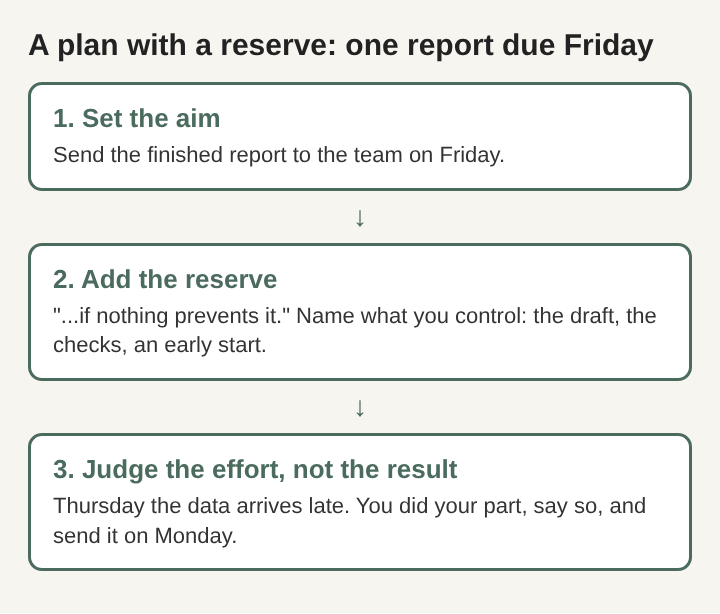
- Set the aim. On Monday morning, write the plan in one line: send the finished report to the team on Friday. Aim at it fully; the reserve does not make the deadline softer.
- Add the reserve. Add four words: "if nothing prevents it". Then list the parts that are yours: drafting the sections that do not need the data, checking your figures, starting early, and asking on Wednesday if the data has not arrived.
- Judge the effort, not the result. On Thursday the data arrives a day late and the report cannot be finished well by Friday. You did each part on your list. You tell the team plainly what happened, give a new date, and send it on Monday.
Without the reserve, Thursday feels like failure, and the frustration tends to spill onto the other group or onto yourself. With it, Thursday is just information. The plan you could keep, you kept. In the evening, the question "what did I do well today" has a clear answer, and the question "what could I do better" has a useful one: ask for the data a day earlier next time.
How the reserve differs from giving up
The reserve clause is often mistaken for low expectations. It is the opposite. Someone who expects little stops trying hard, because the result seems out of reach. Someone with a reserve still tries hard, because the effort is the part that counts. The aim stays high; only the claim on the result is let go.
It also differs from simple optimism. An optimist says "it will work out". A Stoic with a reserve says "I will do my part, and it may or may not work out, and both are acceptable". The first can be proved wrong by events. The second cannot, which is why it holds up on bad days.
Finally, the reserve is not a way to avoid responsibility. In the example, you still owned the delay to your team and you still changed your habit for next time. The reserve only removes the extra layer of distress that adds nothing to the fix.
Frequently asked questions
What is the Greek word for the Stoic reserve clause?
The Greek word is hupexairesis, sometimes spelled hupexhairesis. It is usually translated as "reservation" or "reserve", meaning a condition attached to a wish.
Is the reserve clause the same as saying "God willing"?
The wording can be close, since the ancient Stoics framed it as wishing for something if it is fated or if Zeus wills it. The Stoic point is about where your happiness rests: on acting well, not on getting the outcome.
Does using a reserve mean caring less about results?
No. You still aim at the result and work for it with full effort. You simply do not let your peace of mind depend on a result that other people and events also shape.
How do you practice the reserve clause each day?
Write the day's main plan in the morning and add "if nothing prevents it". In the evening, judge the day by what you did on your part of the plan, not by whether the world cooperated.
Living with a reserve on every plan
The reserve clause is a small sentence with a large effect. It lets you aim as high as you like while keeping your calm in the place it cannot be taken from: your own choices. Plans will be delayed, meetings cancelled and arrows blown off course. A wish made with a reserve stays whole through all of it, because it never asked for more than you could give. Over time, the habit makes setbacks quieter and effort steadier, and it turns each blocked plan into a plain question about what to do next.
How to Find Your Meaning
Find what your life is for. Visit findyourmeaning.vlvd.net