What Seneca on the shortness of life argues
Most people say life is too short. Seneca on the shortness of life says the opposite: life is long enough, if you use it well, and it only feels short because so much of it leaks away on things you never chose. Short lessons on Stoic thinkers, with a daily practice that ends each evening on questions Seneca asked himself, are the subject of How to Find Your Meaning.
The essay is called De Brevitate Vitae, in English On the Shortness of Life. Wikipedia's page on the essay) sums up its claim: people waste much of their time in meaningless pursuits, nature gives each person enough time for what really matters, and the task is to spend it on purpose. Time is best used, on Seneca's view, by living in the present and pursuing a life you have chosen.
Who the essay was written for
Seneca wrote it to a man named Paulinus, most likely the father of his wife, Pompeia Paulina, according to the essay's Wikipedia page). Paulinus was not an idle man. Chapters 18 and 19 make clear that he was the official in charge of Rome's grain supply, a post of real weight in a city that depended on shipped grain.
The essay is usually dated to around 49 AD. It must come after the death of the emperor Caligula in 41 AD, because Seneca mentions it. The historian Miriam Griffin, the same page notes), suggested a later date and a practical purpose: the essay may have been written to give Paulinus a reason to retire early, in 55 AD. Either way, the essay is not aimed at the lazy. It is aimed at busy, capable people who still feel their lives slipping away.
Where the time goes: the engrossed
The essay moves in four steps. Chapter 1 answers the complaint that life is short. Chapters 2 to 9 list the ways people squander their years. Chapters 10 to 17 set the leisure of a philosopher against the common idea of leisure. Chapters 18 to 20 describe the wise, who rise above the preoccupied lives around them.
Seneca has a name for the people who lose their time: the occupati, often translated as the engrossed or the preoccupied. They are busy without being directed. Their hours go to errands for others, to chasing favour, to pleasures that leave them restless, and to plans for a future that keeps moving away.
He gives three famous Romans as examples: the emperor Augustus, the orator Cicero and the politician Livius Drusus. Each had power and fame, and each, in Seneca's telling, was caught by the engrossed life in a different way. The lesson is plain: success does not protect you. A full calendar can be an empty life.
Even study does not escape. In section 13 Seneca says that people who give their days to scholarship are still wasting them if the work aims at nothing. The essay closes, in section 20, on its hardest line of thought: the engrossed die without ever having lived.
Why people guard money and give away hours
The center of the argument is a question of value. People work hard to protect their money and their property. Time, though, seems intangible, so they hand it to anyone who asks. A neighbour, a meeting, an old habit: each takes a share, and nobody keeps the accounts.
Seneca reverses the ranking. The wise, he argues, see time as the most valuable thing a person has. With effort they pull their hours out of the control of others and spend them on reflection and on a life they have chosen.
This is also why the essay says life is long enough. If the years were truly too few, nothing could be done. But most of the shortage is self-made. A person who counted their hours as carefully as their savings would find far more of them than they expected.
Leisure that counts, and the present moment
The second half of the essay turns to otium, a Latin word for leisure or time away from public business. Seneca separates two kinds. Common leisure is still engrossed: luxury, idle display, rest that is only a pause before the next distraction. The leisure he praises is time spent thinking about how to live, in the company of the great minds of the past.
He links this to the present moment. The engrossed live in a thin present, regret their past and fear their future, so their lives feel short. A person who lives each present moment fully, in agreement with nature, as the Stoics put it, owns their past and can face their future calmly. In Seneca's picture, such a mind can range across all of time, and that is the sense in which the wise person's life is long.
One tension is worth knowing. In On the Shortness of Life Seneca urges Paulinus to step back from public duties, while in another work, On Tranquillity of Mind, he advises a friend to seek public work. In On Leisure he argues that the two do not conflict: a person can serve the wider community through public office or through reflection. The aim is to stop giving your life away without choosing.
A week's tally of your own hours
Seneca's argument becomes useful when you count. Here is a tally you can make in one week, using an invented but ordinary schedule.
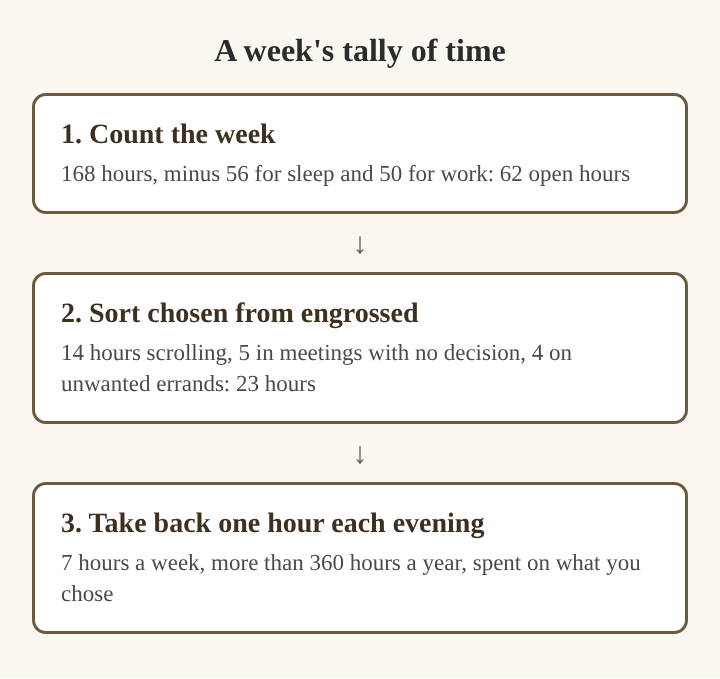
- Count the week. A week has 168 hours. Say sleep takes 56 and work with the commute takes 50. That leaves 62 hours that feel as if they vanish.
- Sort chosen from engrossed. For seven days, note each evening where those hours went. Suppose the tally shows 14 hours of scrolling on a phone, 5 hours in meetings that reached no decision and 4 hours of errands you agreed to without wanting to. That is 23 hours, more than a third of the open time, spent the way Seneca's occupati spend theirs.
- Take back one hour each evening. Pick the largest leak, the scrolling, and move one hour a day to something you chose: a walk, a book, a friend, a skill. Seven hours a week is more than 360 hours over a year, close to nine working weeks.
Nothing in the tally asks you to work harder. It asks you to notice. That fits Seneca's own practice: in the evening he looked back over his day with three questions he learned from Sextius, about which bad habit he had cured, which fault he had resisted and how he had become better. A short look back at where the hours went fits naturally into the same evening habit. The earlier piece on Seneca's three questions for the end of the day sets out that evening habit in full.
The same lesson in the letters to Lucilius
Seneca came back to time in his later Letters. The Internet Encyclopedia of Philosophy's article on Seneca notes that the very first letter warns his friend Lucilius against wasting time carelessly. The theme was familiar in Latin writing, from Vergil's tempus fugit to Horace's carpe diem. What Seneca adds is the step from the hour to the whole life: to let time slip is to let yourself be occupied by things that do not matter.
The letter also carries an admission. Seneca confesses that he still wastes time himself, but that he has learned to notice when he does, and he counts the noticing as progress. He tells Lucilius to keep hold of what is truly his own. Unlike the private notes of Marcus Aurelius, the encyclopedia article points out, Seneca wrote these works to be read, and his focus stays practical: philosophy as a way to live, not a show of learning.
The same thread runs through the Stoic practice of remembering death. The earlier piece on the Stoic reminder of death covers that habit, which gives the question of how to spend the hours its weight.
Frequently asked questions
What is the main idea of On the Shortness of Life?
Life is long enough if it is well used. It feels short because people let it drain away into pursuits they never chose and fail to value time as highly as money.
Who are the occupati in Seneca's essay?
They are the engrossed or preoccupied, people who are always busy but never directed. Seneca says they cling to life at the end because they never truly lived it.
Did Seneca tell everyone to quit their jobs?
No. He urged Paulinus to retire from public office, but in On Leisure he argues that a person can serve the community in public work or in reflection. The point is to choose how your time is spent.
When was On the Shortness of Life written?
It is usually dated to around 49 AD, after the death of Caligula in 41 AD, which Seneca mentions. Some scholars, among them Miriam Griffin, place it nearer 55 AD.
What Seneca's view of time asks of a single day
Seneca's claim is simple to state and hard to live: the length of a life depends less on its years than on how many of its hours were chosen. The engrossed person can live to old age and still feel cheated, while a person who keeps account of their time can feel that a life of ordinary length was full. His remedy has no secret in it. Value your hours at least as highly as your money, notice where they go without blaming yourself, and spend the present on what you would choose if you were deciding on purpose. Each evening is a chance to look back at one day and see how much of it was yours.
How to Find Your Meaning
Find what your life is for. Visit findyourmeaning.vlvd.net