What does amor fati mean, in plain words
If you are asking what does amor fati mean, the short answer is "love of fate." It is the habit of wanting what happens in your life, the hard parts included, rather than only putting up with it. The Latin phrase is best known from Nietzsche, but the attitude behind it is far older and runs through Stoic philosophy, from Epictetus to Marcus Aurelius.
The idea sounds extreme on first reading. Love a missed train? Love an illness? The Stoic version is calmer than that. It asks you to stop fighting what has already happened, so that your effort goes into the part of the day that is still yours. How to Find Your Meaning, at findyourmeaning.vlvd.net, teaches Stoic philosophy in short lessons with a daily practice built on Epictetus, Marcus Aurelius and Seneca, and amor fati sits close to the centre of all three.
Where the phrase comes from
The Wikipedia page on amor fati describes it as an attitude that sees everything in a life, suffering and loss included, as necessary. The words themselves are Latin, and the most famous use of them is Friedrich Nietzsche's. In Ecce Homo, he called amor fati his formula for greatness in a human being: not only to bear what is necessary, and not to hide from it, but to love it.
In The Gay Science, aphorism 276, Nietzsche wrote that he wanted to learn to see what is necessary in things as beautiful, and to become one day only a yes-sayer. The same page notes that he did not treat suffering as good in itself. He treated it as a condition for good, part of a whole that he wanted to accept without picking and choosing. The idea is often tied to his thought of eternal recurrence, the picture of a life lived over again in every detail, which pushes the question hard: could you want this exact life once more?
So the slogan is modern. What it points to is not.
The Stoic root: wish things to happen as they happen
The historian Pierre Hadot, cited on the same Wikipedia page, traces the idea back to Epictetus. In chapter 8 of the Handbook, the Enchiridion, Epictetus advises you not to ask that events happen as you wish, but to wish that they happen as they actually do. That, he says, is the way to be happy.
The Internet Encyclopedia of Philosophy's article on Epictetus shows where this comes from in his teaching. The Handbook opens by dividing things into those that are up to you and those that are not. Sickness, possessions, reputation and the final outcome of any affair are not up to you. In the Discourses, Epictetus goes further: to be instructed, he says, is to learn to wish that each thing happens as it does. Since you cannot change how things are, you bring your mind into line with what happens.
For Epictetus this had a ground. He held that a divine providence orders the whole cosmos, so accepting your fate means accepting something that comes from an intelligence making the best that is possible. The same IEP article calls this living according to nature. You do not need to share his theology to use the practice. The working part is the split: the event belongs to the world, and your response belongs to you. That split is the same one behind the dichotomy of control.
Marcus Aurelius and the fruit of the seasons
Hadot also points to Marcus Aurelius. In Meditations IV.23, Marcus writes that whatever the seasons of nature bring is fruit to him, and that all things come from nature and return to it. He wrote in Greek, so he never used the Latin words amor fati, but the attitude is the same: what arrives is not an insult to be resisted. It is part of the whole, and you meet it as such.
Epictetus gives a plain image for the same habit. In Handbook 17 he says life is a play in which another chose your role. Your task is not to pick the part. It is to play the part you were given, and to play it well. A short role, a hard role or an unwanted role can still be played well.
A worked example: one cancelled flight
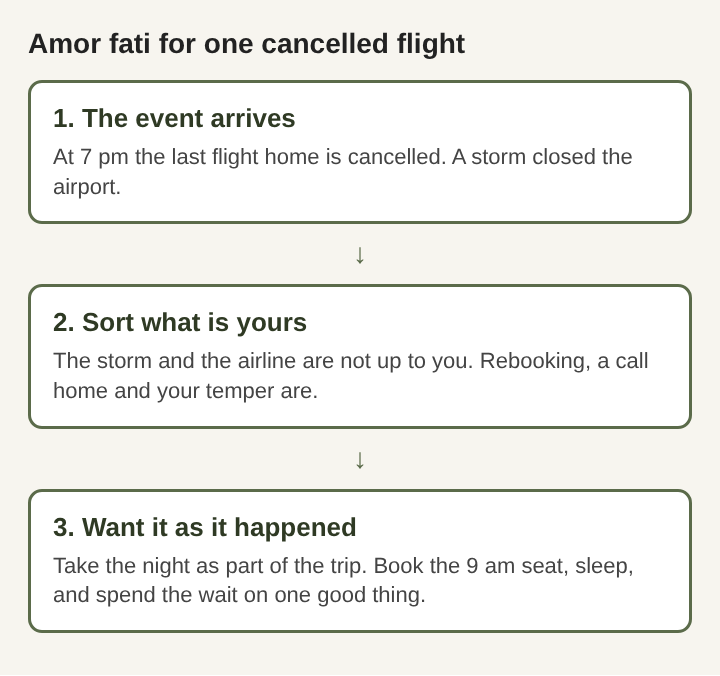
Take a concrete case. It is 7 pm in an airport, and your last flight home is cancelled because a storm has closed the runway. You were meant to be home tonight. Here is how amor fati works on it, in three steps.
- Let the event be what it is. The flight is cancelled. Arguing with that fact, inside your head or at the desk, changes nothing about the storm. Say the fact to yourself in one flat sentence: "The flight is cancelled and the next seat is at 9 am."
- Sort what is yours. The storm and the airline's decision are not up to you. Rebooking the 9 am seat, a call home to say you are safe, a bed for the night and your own temper are up to you. That second list is where all of your effort goes.
- Want it as it happened. This is the amor fati step. Instead of filing the evening as a stolen night, take it as part of the trip, the trip you actually had. Then choose one good use for it: an hour of reading, a proper meal, a long sleep before the morning flight.
Notice what did not happen. You did not pretend to be glad about the storm. You did not stop rebooking. You simply dropped the second fight, the one against a fact that was already settled, and kept the first, the one about acting well. The Stoics would say the night was never going to hurt you. Only the judgment that it was a disaster could do that.
How amor fati differs from giving up
A common worry is that loving fate means never trying to change anything. The Stoic answer is no. Acceptance applies to what has already happened and to what is not up to you. It never covers your own choices. You still rebook the flight, treat the illness, fix the mistake and argue for what is right.
The difference is in what you ask of the world. A person who gives up stops acting. A person practicing amor fati keeps acting, but stops demanding that events go one particular way before they can be at peace. That is why the idea pairs well with the habit of planning with a quiet condition, the Stoic reserve clause: you aim at a result if nothing prevents it, and when something does, you accept what came instead.
It also differs from forced cheer. Epictetus's advice in Handbook 4, the bath example, is to expect that people at the public baths will splash and shove, so that when they do, you are not caught off guard. Amor fati is not a smile pasted over pain. It is clear sight about how things go, followed by a willing response.
Frequently asked questions
Is amor fati a Stoic phrase?
The Latin phrase is best known from Nietzsche, not from the ancient Stoics. The attitude, wishing that things happen as they do, is Stoic, and Pierre Hadot traced it to Epictetus and Marcus Aurelius.
Does amor fati mean you should love bad things?
It means you stop resisting what has already happened and accept it as part of your life. You can still dislike pain and work to end it; what changes is that you no longer demand the past be different.
Did Marcus Aurelius use the words amor fati?
No. The Meditations are in Greek, so the Latin words never appear there. Pierre Hadot still reads Meditations IV.23, on taking what the seasons bring as fruit, as the same attitude.
How can you practice amor fati each day?
When something goes against your plan, state the fact in one flat sentence, list what is still up to you, and choose one good use of the new situation. An evening look back over the day is a good place to notice where you fought a settled fact.
Living with amor fati day to day
Amor fati asks for one change in where your attention goes. Events arrive on their own schedule: storms, delays, illnesses, people who act in ways you did not choose. You can spend your strength wishing they had gone otherwise, or you can take them as the material of your actual life and put your strength into the part that is yours.
Epictetus put it as learning to wish that each thing happens as it does. Marcus took what the seasons brought as fruit. Nietzsche wanted to see the necessary as beautiful. Each of them was describing the same quiet turn: from asking why this happened to you, to asking what you will do with it now that it has.
How to Find Your Meaning
Find what your life is for. Visit findyourmeaning.vlvd.net