What is a decision journal? It is a written record of a choice, made on the day you choose and before you know how it turns out. Each entry holds the decision, the options you weighed, what you expect to happen and how sure you are, and a date to look back. When that date comes, you write what happened next to what you expected, and you can see whether the choice was sound or only lucky.
The habit sits close to keeping a problem journal, where each problem goes down in one line and every solution tried gets an outcome. Problem Graph works that way: a solution is added as an idea, marked when it is being tried, and given an outcome of worked, partly or failed, and a failed solution stays on the map. A decision journal applies the same discipline to the moment of choosing, before any outcome exists.
Why memory makes a poor record of your choices
Once you know how something turned out, your memory of what you believed beforehand starts to shift. Psychologists call this hindsight bias, also known as the knew-it-all-along phenomenon: the common tendency to see past events as more predictable than they were. It can change your memory of what you knew before the event, and it feeds overconfidence about predicting the next one. The idea entered psychological research in the 1970s, with Fischhoff's 1975 paper on how knowing the outcome changes judgment.
The result is simple to state. If you only think back on a choice after it plays out, you are judging it with information you did not have. A good result makes the choice seem obvious. A bad one makes the warning signs seem loud, even if nobody could hear them at the time.
Outcome bias and why a good result is not proof
A second error sits next to the first. Outcome bias is a mistake in judging the quality of a decision when its outcome is already known. It is different from hindsight bias: hindsight bias bends memory, while outcome bias gives the result more weight than everything else you knew.
In a 1988 study by Jonathan Baron and John Hershey, people read about a surgeon deciding whether to do a risky operation with a known chance of success. Some were told the patient lived, others that the patient died. Those told of the bad outcome judged the surgeon's decision worse, even though the decision itself was the same. The page on outcome bias gives the fix: judge a decision by what was known when it was made, and set aside what you learned after.
That fix is hard to apply from memory, because memory is the thing hindsight bias changes. A decision journal solves this by writing down what you knew before the outcome could touch it.
What is a decision journal entry made of
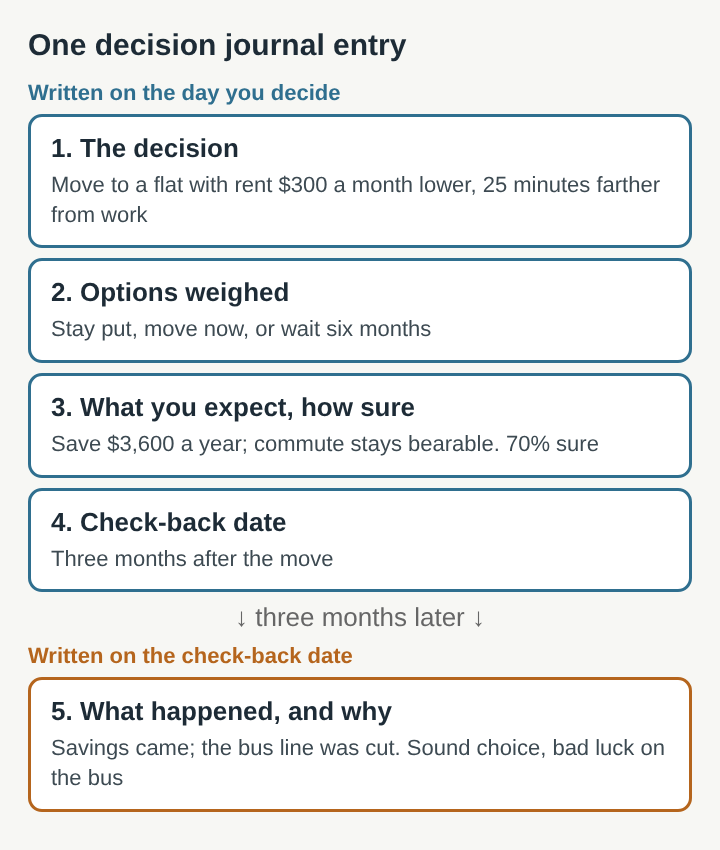
An entry does not need to be long. Five parts cover most choices, and the first four are written on the day you decide.
- The decision. One sentence that says what you chose, with the numbers that matter.
- The options you weighed. Every real alternative, including doing nothing or waiting. This is the part people forget, and it is the part that tells you later whether you missed something.
- What you expect, and how sure you are. The result you think will happen, in plain terms you can check, and a number for your confidence, such as 70%.
- A check-back date. The day you will read the entry again. Pick a date far enough out for the result to show.
- What happened, and why. Written on the check-back date: the actual result, set next to the expectation, and whether the gap came from the choice or from things outside it.
Some people also add a line on their mood or energy at the time, since a choice made tired or angry can look different later. Keep it short, so the entry stays quick to write.
A worked example: moving to a flat with lower rent
Say you are deciding whether to move to a flat where the rent is $300 a month lower, but the trip to work is 25 minutes longer each way. Here is the entry you write on the day you sign.
- The decision: move to the flat with rent $300 a month lower, 25 minutes farther from work.
- Options weighed: stay where you are, move now, or wait six months and look again.
- What you expect: you will save $3,600 a year, and the longer bus ride will stay bearable because you can read on it. You are 70% sure about the bus part.
- Check-back date: three months after the move.
Three months later you open the entry. The money came through as planned. But the bus line you counted on was cut after the second month, and the trip now takes a change of buses. Without the entry, you might decide the move was a mistake and that you should have seen it coming. With the entry, you can see what you knew: the line was running, you had a sound reason to expect it to keep running, and you even wrote that this was the part you were least sure of. So you write the fifth part: the savings happened, the bus line was cut, the choice was sound and the bus was bad luck.
The entry also shows what to do next. The weak point was the 70% part, so the next choice that depends on a bus or train line gets a backup route written in from the start.
How to keep a decision journal going
The habit breaks in a few familiar places, and each has a small fix.
- Pick which decisions go in. Not every choice needs an entry. Write one when the choice is hard to undo, costs real money or time, or is one you will face again.
- Write before you act. An entry written after the result is known is only a story. The value comes from fixing your thinking in place first.
- Make the expectation checkable. "It will go well" cannot be judged. "Save $3,600 a year" can.
- Put the check-back date in your calendar. An entry nobody reads again does nothing. A reminder on the date is enough.
- Judge the choice and the luck apart. When you write the fifth part, ask two questions: given what you knew, was it a sound choice, and how much of the result came from things you could not control?
Over time, the journal shows patterns. You may find you are often too sure about timelines, or that you rarely list waiting as an option. Those are things a single decision never reveals.
Decision journal or problem journal
The two records answer different questions. A decision journal asks, "Was this choice sound, given what was known?" A problem journal asks, "What did you try on this problem, and did it work?" One looks at the moment of choosing; the other looks at the chain of attempts that follow a problem.
They fit together well. When a problem has several possible fixes, choosing between possible solutions is itself a decision, and the reasons for the pick belong in a decision entry. When the fix has had time to run, knowing whether a solution really worked is the fifth part of that entry: what happened, set against what you expected.
Frequently asked questions
How often should you write in a decision journal?
Only when you make a choice worth looking back on: one that is hard to undo, costly, or likely to come up again. For most people that is a few entries a month, not one a day.
Can a decision journal be kept on paper?
Yes. A notebook works as well as a file, as long as each entry has a date and you can find it again on the check-back date.
What if the decision turned out well but the reasoning was poor?
Write that down too. A good result from weak reasoning is luck, and the entry is where you notice it before you count on the same luck again.
How long should you wait before looking back at an entry?
Long enough for the result to show. A change of routine may need a few weeks; a move, a new job or a big expense may need three months or more.
What a decision journal changes over time
A single entry protects one choice from being rewritten by its outcome. A year of entries does more: it shows how sure you tend to be, where your expectations miss, and which kinds of choices you get right. Hindsight bias and outcome bias work quietly, by changing what you remember and what you weigh. A decision journal answers both by keeping what you knew in writing, dated, before the result could change it. Then you can learn from the decision itself, not only from how it happened to turn out.
Problem Graph
Every problem you carry, on one map. Solved together. Visit problemgraph.vlvd.net