Why are online ads labeled as ads
If you have wondered why are online ads labeled as ads, the short answer is that the label tells you a business put those words in front of you for money. That one fact changes how you should read them. A tip from the site you trust is the site's own judgment. A sponsored message is a pitch, written by the person who wants your click.
The label is there so you never have to guess which is which. Small ad services that place one plain ad at a time, such as vlvd ads, make the line easy to see: a short headline, one sentence and a button, set apart from the page. Much of the web is harder to read, because many ads are now built to match the content around them.
Ads that match the page around them
For most of the history of print, an ad was easy to tell apart. It had its own box, its own type and often a picture of the product. Readers learned to spot one in a glance and skip it when they wanted to.
The trouble starts when an ad borrows the look of the page. The Wikipedia entry on advertorials describes an advertorial as an advertisement in the form of editorial content. The word is a blend of "advertisement" and "editorial", and Merriam-Webster dates it to 1946. In print, such an ad is usually written to resemble an objective article, so it reads as a news story rather than a sales pitch.
Online, the same idea has a newer name. The Wikipedia entry on native advertising calls it sponsored advertising that appears in the style and format of the content near where it is placed. It can be a post, an image, a video or an article. The word "native" means it fits in with everything else on the platform.
That fit is the point for the advertiser. It is also the reason a label matters so much. When the ad matches the page exactly, the label is the only thing left that tells you it is sponsored.
What the label protects you from
A label does one job: it lets you weigh what you read. If you know a paragraph praising a budgeting app was sponsored by that app, you read it with the right amount of doubt. You look for what it leaves out. You check the claims somewhere else before you act on them.
Without the label, you lose that choice. The same Wikipedia entry on advertorials reports that, according to a 2016 study, as many as two thirds of readers confuse advertorials for reporting. That is not a small slice of careless readers. It is most people, reading in good faith, taking a pitch for the site's own work.
There is a second loser: the site itself. Researchers have found that ads dressed as articles, when not clearly disclosed, mislead readers and damage the reputation of the publication that runs them, as the advertorial entry notes. That is why most publications prohibit ads that are identical in appearance to their regular articles. The label protects the reader's judgment and the publisher's name at the same time.
What the rules ask for
In the United States, the Federal Trade Commission has required sponsored content to be labeled since the early 2000s, according to the native advertising entry. Advertisers can use different words, but in every case the ad must be clearly labeled as an ad. For sponsored search listings, the agency asks for labels with terms that make plain the ranking came from money, not merit.
Notice what that sentence asks for. It is not enough for a label to exist somewhere on the page. The words have to make plain that the placement is sponsored. A label that hides that does not meet that bar, even if it sits right next to the ad.
Other countries have their own rules, and the details differ. The shared idea is simple: a reader should be able to tell, at the moment of reading, that a message is an ad.
Why a label alone is not always enough
Here is the uncomfortable part. A label helps, but it does not undo the blending. The native advertising entry notes that these ads reduce a reader's ad recognition even when they carry a label such as "sponsored" or "branded". The closer the ad matches the page, the more readers skim past the small word above it.
Some labels make things worse on purpose. The same entry points to deceptive labels such as "From around the web", which describe where links come from without ever saying that anyone was compensated. A reader sees a row of headlines under that phrase and assumes the site picked them.
So the question is not only "is there a label?" It is "would a hurried reader understand it in one glance?" That depends on three things: the word used, where it sits, and how different the ad looks from the content next to it.
A worked example: one ad, three ways
Take a lesson page on a learning site. In the middle of the text there is room for one ad, a banner inside the text. The advertiser has a page about a typing course and wants readers to visit it.
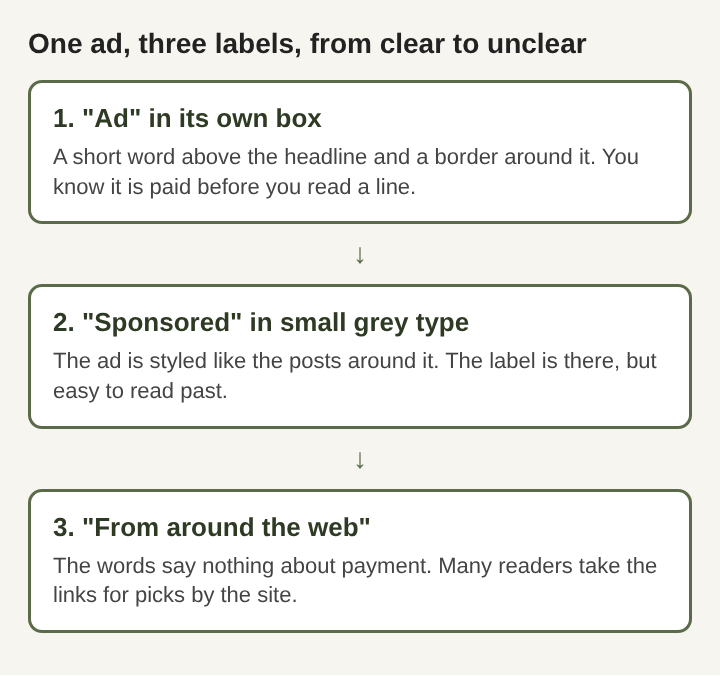
Here is how that one ad could be shown, from clearest to least clear.
- A plain ad in its own box. A small word "Ad" sits above the headline. The headline is short, at most 40 characters. One sentence of up to 90 characters says what the page offers, and a button of up to 18 characters names the next step. The picture is the typing course page's own preview image. The box has a border, so it stands apart from the lesson.
- A post styled as part of the lesson. The same message is rewritten as a paragraph in the lesson's own font and color. Above it, in small grey letters, is the word "Sponsored". The label is there, but a reader moving fast takes the paragraph as part of the lesson.
- A row of links under a vague heading. The typing course appears as one of four headlines under "From around the web". Nothing on screen says the spot is sponsored.
Only the first version lets the reader decide in under a second. The second leans on a word most readers skip. The third gives the reader no fair chance at all.
The first version also has two quieter strengths. A person can read the whole ad before it runs, so the check is quick and careful; the service in the first section checks every ad by hand, usually within two working days. And the ad must describe the page it links to truthfully, so a click goes straight to the page the ad promised. A label tells you the message is an ad. An honest ad makes sure the message is also true. The case for that check is laid out in why ad networks reject some ads.
How to spot an ad on any page
You do not need to know the law to read a page well. A few habits catch most ads, labeled clearly or not.
- Look for the small words. "Ad", "Sponsored", "Promoted", "Partnership" and "Partner content" all mean a business is behind the message.
- Read vague headings with care. "From around the web", "More to read" and "Picked for you" can sit above sponsored links.
- Check where a link goes. Hover over it, or long-press on a phone. A link that leaves the site for a shop page is often an ad.
- Notice a sudden change of voice. A paragraph that turns from explaining to selling, with one product named again and again, is a pitch.
Clear labels also tend to come with other good habits. An ad that is easy to spot can ask less of you, too: the service in the first section gives people who see its ads no cookies and no visitor id. For how harmful ads slip into ordinary networks, see what malvertising is and how it spreads.
Frequently asked questions
Is "sponsored" the same as an ad?
Yes. "Sponsored" means a business funded the placement or the content, which makes it an ad, even when it matches the rest of the page.
What is the difference between native advertising and an advertorial?
An advertorial is an ad written in the form of editorial content, an idea that goes back to print. Native advertising is the online form of sponsored content styled to match the platform; whether the two terms mean the same thing is contested, as the advertorial entry notes.
Who requires online ads to be labeled in the United States?
The Federal Trade Commission. It has required sponsored content to be clearly labeled since the early 2000s, according to the native advertising entry.
Why do some readers still miss labeled ads?
Because the ad is built to match the content next to it. When the style matches, many readers skim past a small label, which is why the look of the ad matters as much as the word.
What a clear ad label gives the reader
A clear label is a small courtesy with a large effect. It hands the reader one fact, that the message is an ad, at the exact moment it matters. With that fact, a reader can enjoy an ad, ignore it or check it, and stay in charge of their own judgment. The clearest labels pair a plain word with a look that sets the ad apart, so the line between the page and the pitch is never in doubt.
vlvd ads
Show your project to people who are already exploring. Visit ads.vlvd.net