Why do ad networks reject some ads?
Why do ad networks reject some ads? Because every ad a network shows is something it hands to a stranger on a site it does not own, and a bad ad hurts three people at once: the reader who sees it, the site that shows it and the network that sent it. So before an ad runs, someone or something asks whether it is safe, whether it is true and whether it belongs on the pages it would appear on. An ad that fails one of those questions is turned away.
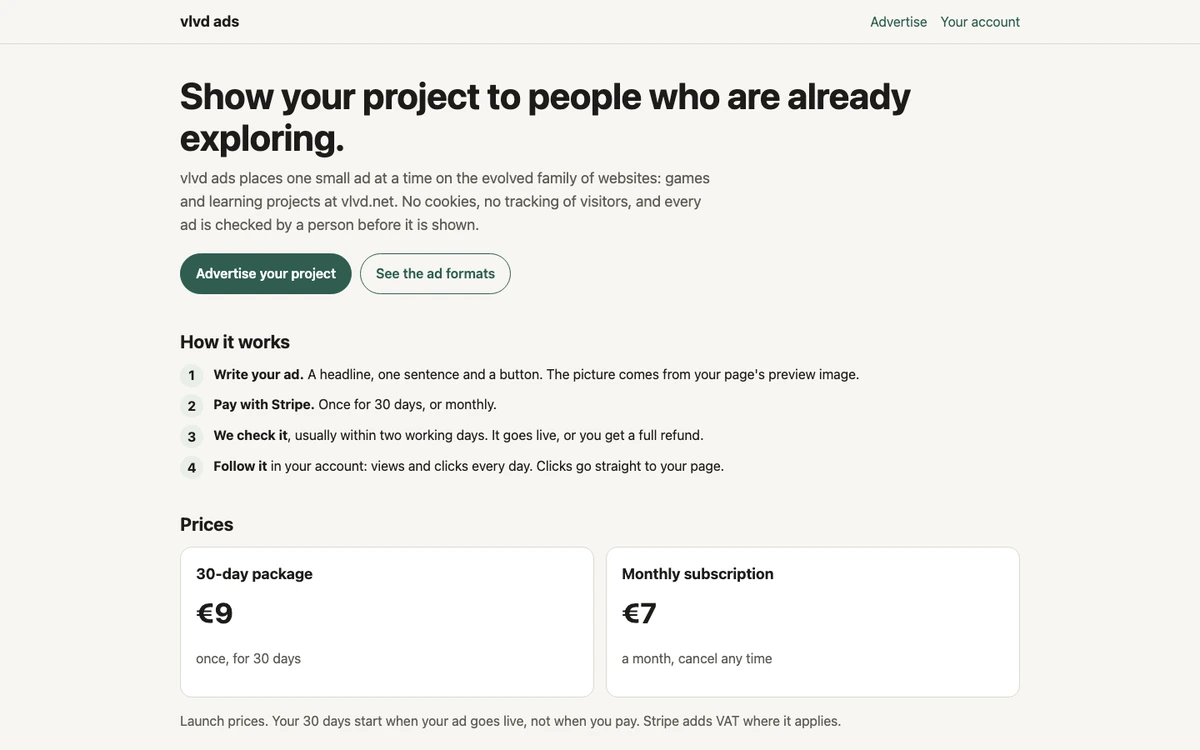
The checks differ from one network to the next, but the reasons for a rejection fall into a short list. A small service such as vlvd ads, which places one ad at a time on game and learning websites, writes its list on its home page: a person checks every ad before it is shown, usually within two working days, some categories are never accepted, and every ad must describe the page it links to truthfully. Other networks write longer lists, but they guard against the same few dangers.
Malware hidden inside an ad
The most serious reason is code that attacks the reader. Security researchers call this malvertising: malicious ads placed into legitimate ad networks and so onto legitimate pages. The danger is reach. One poisoned ad can travel across a large number of trusted websites without any of those sites being broken into, and some infections need no click at all, because the harm is in what the ad loads.
That is why many networks limit what an ad is allowed to contain. Each extra script, outside image or redirect is one more place where something hostile can slip in after the ad was approved. An ad made only of a few lines of text and one picture, both served from the network's own address, leaves very little room for that. On that service, every ad, its picture included, loads from ads.vlvd.net, so the reader's browser never fetches anything from the advertiser at all, and no tracking pixel can ride along.
Claims an ad cannot back up
The second reason is a claim that is not true. False advertising is the public circulation of an ad that carries a false statement to promote a sale, and it counts as deceptive when the advertiser means to mislead. The forms are old and familiar: misleading health claims, hidden fees, and bait-and-switch, where the thing in the ad is not the thing on offer.
Laws already cover much of this. In the United States the Federal Trade Commission enforces truth-in-advertising rules, and in the United Kingdom the Consumer Protection from Unfair Trading Regulations 2008 set the rules. A network that runs a false ad does not escape the problem by pointing at the advertiser: readers remember where they saw it. So networks turn away claims they cannot check, and the vaguest promises (a cure, a sure win, double your income) are the first to go.
A link that leads somewhere else
The third reason is a mismatch between the ad and the page it opens. An ad that promises a puzzle game and opens a shop, or one whose page changes after approval, breaks the reader's trust as surely as a false claim does.
The trick has a name in search engines: cloaking, where a server shows one version of a page to an automated visitor and another to a person's browser, choosing by IP address or by the browser's User-Agent header. Ad checkers face the same trick, which is why a rule such as "the ad must describe the page it links to truthfully" matters. The checker opens the real page and compares it with the ad's headline and sentence. Taking the ad's picture from the advertised page's own preview image, as that service does, also ties the ad to the page it points at.
Categories some networks refuse outright
The fourth reason is not about one ad at all. Some kinds of product are refused no matter how honest the ad is, because the network decides its audience should not see them or because the rules around them are too hard to check case by case.
Lists vary, but the same groups come up again and again. The small service from the first section refuses ads for gambling, adult content, weapons, crypto and trading, politics, health or medical claims, and get-rich or money-making claims. A network for game and learning sites has a reason to be strict: its readers include young people and people who came to play or study, not to be pushed toward a risk. A network for a different audience may draw the line elsewhere, but every network draws one.
Format rules sit beside the category rules. An ad that is too long, shouts in capital letters or does not fit its slot is often turned away for that alone, because a slot that breaks the page breaks the site for its readers.
One ad, walked through the checks
Follow one imaginary ad through a check of this kind. A developer has made a small word puzzle and writes an ad for it.
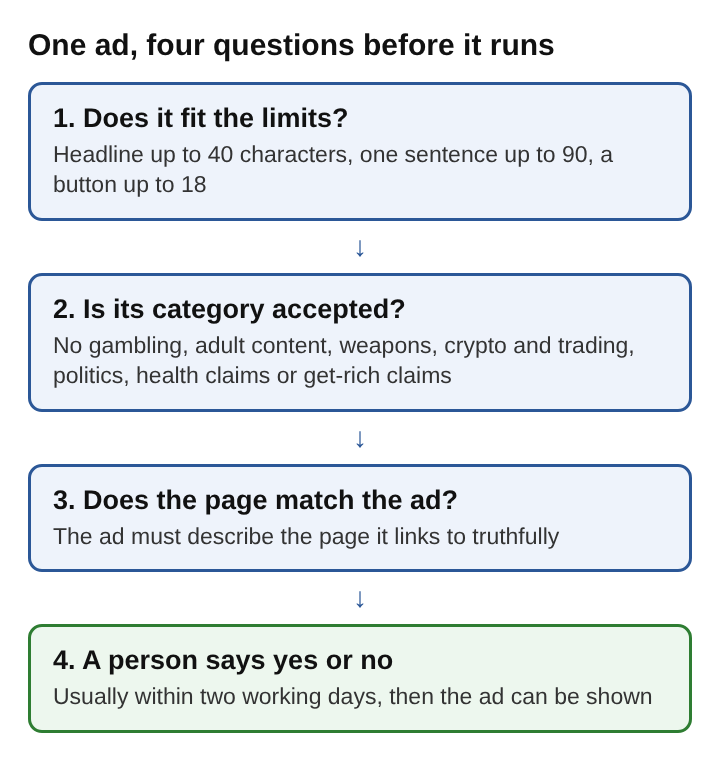
- The limits. The headline is "A word puzzle for five minutes" (30 characters, under the 40 allowed). The sentence is "Find the hidden word in six guesses, with a new grid every day." (63 characters, under 90). The button says "Play now" (8 characters, under 18).
- The category. A word game is not gambling, weapons, crypto, politics or a health claim, so the category is accepted.
- The page. The checker opens the link. It shows the puzzle, a daily grid and six guesses, so the ad describes the page truthfully. If the page had opened on a betting site, the ad would stop here.
- The person. Someone reads the ad and the page together and says yes. The ad can now be shown, and nothing in it reaches the reader except text and one picture from the network's own address.
Change one fact and the outcome changes. Rewrite the sentence as "Win real prizes every day" and the ad now makes a money claim and points at a page that does not match, so it fails two checks at once.
Frequently asked questions
Is an ad rejection permanent?
Usually not. Most networks reject the ad as written, so a fixed headline, a truthful sentence or a corrected link can pass a second check, unless the product itself sits in a refused category.
Do people or software check ads?
It depends on the network. Some send every ad to a person, which takes longer: on the small service from the first section a person checks each one, usually within two working days.
Why would an honest ad be refused?
Its category may be refused outright, its format may not fit the slot, or its page may say something the ad does not. Honesty is one requirement among several.
Can an approved ad cause harm later?
Yes, if its page or its code changes after approval. That is why some networks limit ads to plain text and a picture they serve themselves, which leaves nothing to swap later.
What an ad rejection tells you
An ad rejection is rarely a judgement on the product. It is a statement about risk: the ad could carry something harmful, could promise something it cannot show, could lead somewhere other than it says, or belongs to a kind of product the network keeps away from its readers. Read the reason as one of those four, fix the one that applies, and the same ad often passes. When the reason is the category, no rewrite helps, because the line was drawn for the audience, not for the ad.
vlvd ads
Show your project to people who are already exploring. Visit ads.vlvd.net