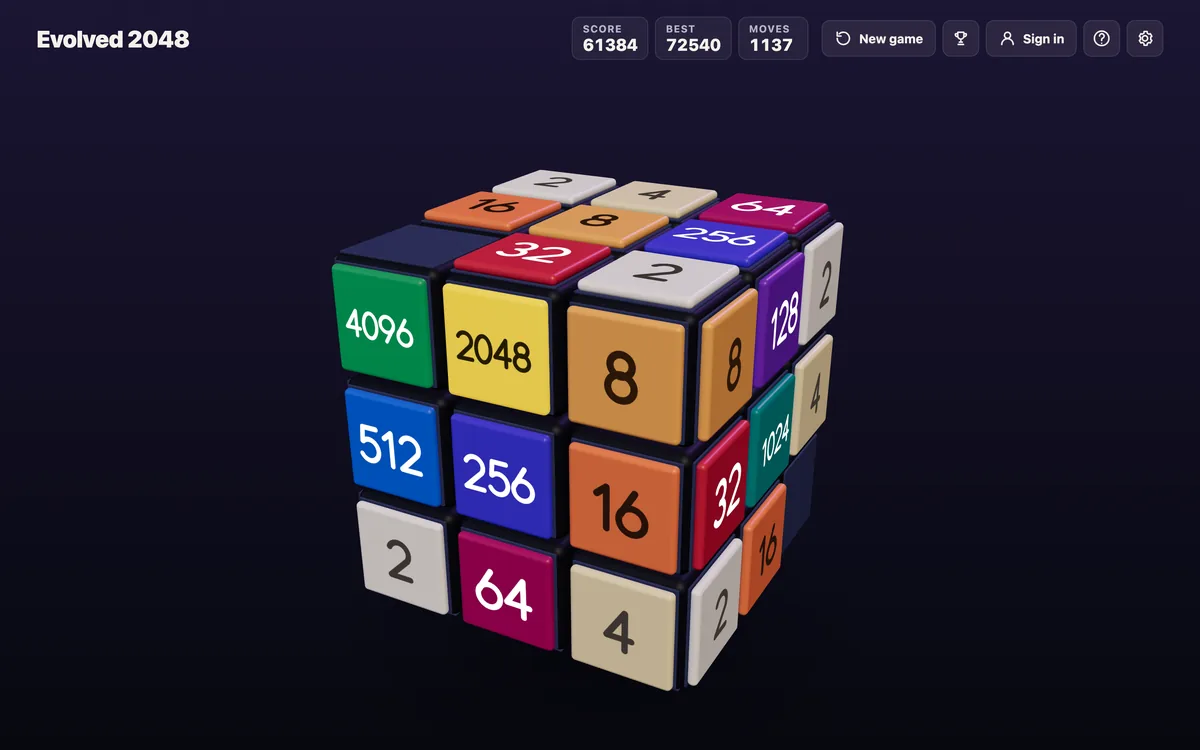
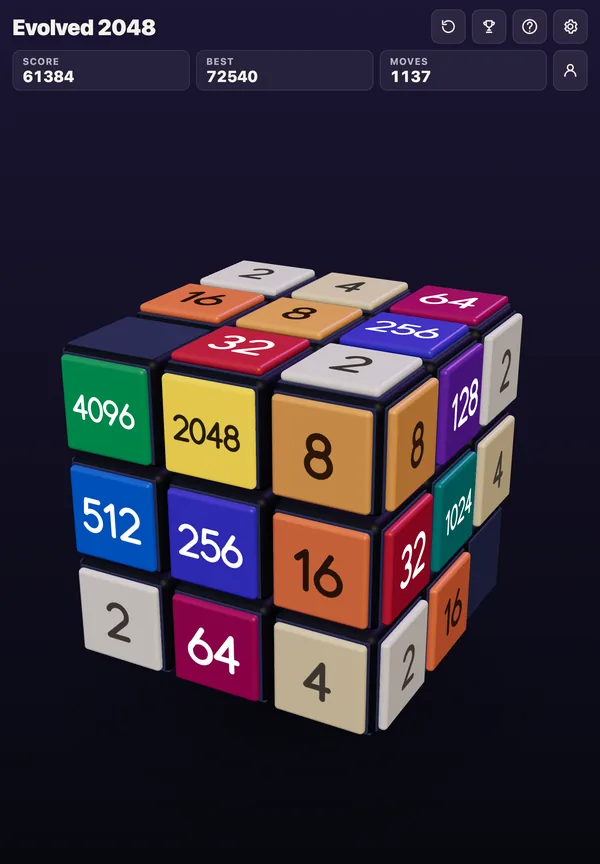
If you have ever pushed numbered squares around a small frame to put them in order, you already know the answer to what is a sliding tile puzzle. It is a puzzle where pieces move only by sliding along a board, never by being lifted off it, until they reach a target arrangement. The oldest famous one is the 15 puzzle from 1880. The most famous modern one is 2048, and there is now a version of 2048 played on a cube, Evolved 2048, which bends the same rule onto six faces.
The family looks simple from outside. Each member changes one thing about how tiles move, and that one change decides what kind of thinking the puzzle asks of you.
What is a sliding tile puzzle, in one rule
Wikipedia's page on the sliding puzzle defines it as a combination puzzle in which you slide pieces, almost always flat ones, along set routes on a board to reach a certain end arrangement. The pieces can carry numbers, letters, colours or parts of a picture.
The key line is the one about lifting. A sliding block puzzle forbids lifting any piece off the board, and that is what separates it from a rearrangement puzzle, where you may pick pieces up and put them anywhere. Because nothing can jump, the moves you make open and close paths for the next moves. Planning those paths is most of the work.
That gives three parts to look for in any sliding tile puzzle:
- A board with a fixed number of squares.
- A movement rule that says which tiles may slide, and how far.
- A goal, which in the older puzzles is an arrangement and in newer ones can be a number to build.
The 15 puzzle: one gap and a fixed set of tiles
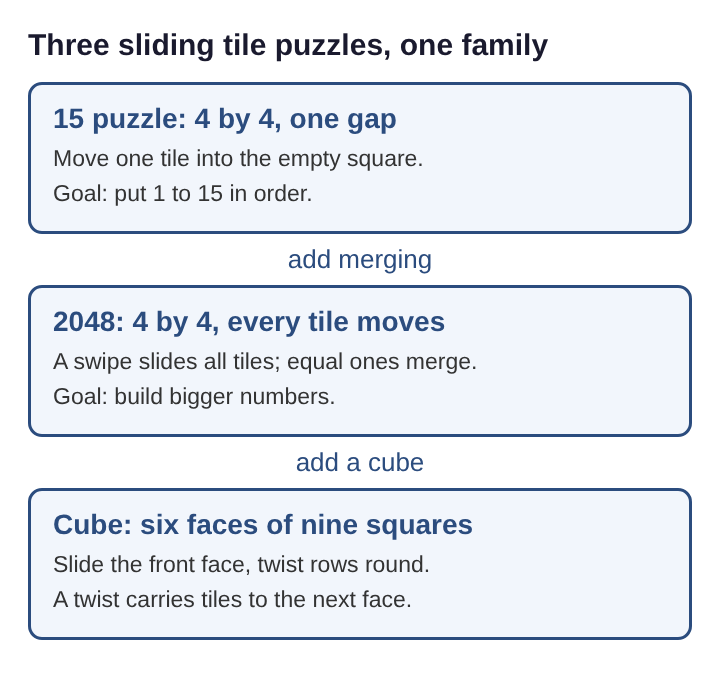
The 15 puzzle has 15 square tiles numbered 1 to 15 in a frame four squares high and four wide, with one square left empty. A tile in the same row or column as the empty square can slide into it. The goal is to put the tiles in order, left to right and top to bottom. A smaller cousin, the 8 puzzle, uses eight tiles in a 3 by 3 frame.
Wikipedia credits the invention to Noyes Chapman and says it set off a craze in the United States in 1880. Sam Loyd is often named as the inventor, but that rests on his own false claim.
Two facts about the 15 puzzle shape how you play it:
- Half of all starting positions cannot be solved. In 1879, Johnson and Story used a parity argument to show that half the possible arrangements can never reach the goal, however many moves you make. Swap just the 14 and the 15 in a solved frame and the puzzle becomes impossible.
- The longest solved positions need 80 moves. Counting one tile slid one square as a move, the shortest solutions run from 0 to 80 moves, and only 17 positions need the full 80.
Notice what never changes in the 15 puzzle. There are always 15 tiles, each keeps its number, and there is always exactly one gap. The puzzle is pure arrangement.
How 2048 changed the sliding rule
Wikipedia's page on 2048) opens by calling it a single-player sliding tile puzzle, written by Gabriele Cirulli. It keeps the 4 by 4 board and the ban on lifting, but it rewrites the other two parts.
First, the movement rule. In the 15 puzzle you move one tile into one gap. In 2048 a single swipe moves every tile on the board in the chosen direction, as far as each can go until it hits another tile or the edge. Second, the tiles themselves change. Two tiles with the same number that collide merge into one tile worth their total. After each move a new tile, a 2 or a 4, appears in an empty square. The page on how merging works in 2048 goes through those rules move by move.
Those two changes turn the goal around. The 15 puzzle asks you to restore an order that already exists. 2048 asks you to build a number, 2048, that is not on the board at the start. The number of tiles rises and falls as you play, and the empty squares become the thing you protect.
A worked example: one row, two rules
Take a single row of four squares and run it through both rules. Write an empty square as a dot.
The 15 puzzle row. The row reads 3, dot, 5, 6. You can slide the 3 right into the gap, giving dot, 3, 5, 6. Either way, exactly one tile moves exactly one square. After the move you still have the same three numbers in the row and still one gap. Nothing new arrives.
The 2048 row. The row reads 2, dot, 2, 4. You swipe left.
- The first 2 is already against the edge, so it stays.
- The second 2 slides left through the empty square and meets the first 2. They are equal, so they merge into a 4 at the edge.
- The 4 slides left until it stops against the new 4. The new 4 was made by a merge on this move, so it cannot merge again until the next one. The row now reads 4, 4, dot, dot.
- A new 2 or 4 appears in an empty square somewhere on the board.
Compare the two results. In the 15 puzzle row, one tile moved and the contents stayed the same. In the 2048 row, three tiles moved, two became one, a value doubled, and the board gained a tile it did not have before. The next swipe left would merge the two 4s into an 8. That is why 2048 rewards thinking about rows and corners, while the 15 puzzle rewards thinking about the path of the single gap.
The sliding tile puzzle on a cube
Evolved 2048 takes the 2048 rule onto a cube of six faces, each a 3 by 3 grid, so 54 squares in all. Three moves work together:
- Slide. You swipe the front face, or press the arrow keys or W A S D. Tiles slide as they do in 2048, and two equal tiles merge into their sum.
- Twist. You drag a row on the right face sideways, or a column on the top face. That layer turns a quarter and carries its tiles to the next face, so a tile from a side face can land next to its match on the front.
- Turn. You drag around the cube, or press Shift and an arrow key, and the whole cube turns. Turning adds no tile; only a slide or a twist does.
Every slide or twist adds a 2 or a 4, on the front face when it has room, and a twist needs one empty square for the new tile. In the main mode the game ends when all 54 squares are full and no face has two equal tiles side by side.
Run the earlier row onto the cube's front face, which is three squares wide. A front row of 2, dot, 2 swiped left becomes 4, dot, dot, exactly as in 2048. The twist is what is new. If the tile you need is on the right face, you can turn its row round so it arrives on the front beside its match. The board is still a set of squares where nothing is lifted, yet tiles can now travel between faces. The variants of 2048 sort that change alongside others, such as bigger grids and different merge rules.
What stays the same across the family
For all their differences, these puzzles share a few habits of thought.
- Space is the resource. In the 15 puzzle you have one empty square and every move is about where it goes. In 2048 and on the cube, empty squares are where new tiles land, so losing them ends the game.
- Moves have side effects. Sliding one tile in the 15 puzzle shifts the gap. Swiping in 2048 shifts every tile in a row at once. A good move is one whose side effects you can live with.
- Looking ahead pays. The 15 puzzle can need dozens of moves to undo a small mistake. In 2048, a careless swipe can pull a large tile out of its corner.
Frequently asked questions
Is 2048 a sliding tile puzzle?
Yes. Its Wikipedia page describes it as a single-player sliding tile puzzle, because tiles move only by sliding on a grid. It differs from the 15 puzzle in that every tile moves at once and equal tiles merge.
Why can some 15 puzzles not be solved?
Every legal move keeps a hidden parity the same, so the positions split into two halves that can never reach each other. A frame with only the 14 and 15 swapped sits in the wrong half and cannot be solved.
What is the difference between the 8 puzzle and the 15 puzzle?
The 8 puzzle has eight tiles in a 3 by 3 frame, and the 15 puzzle has fifteen tiles in a 4 by 4 frame. Both leave one square empty and share the same sliding rule.
Can a sliding tile puzzle work on a cube?
Yes, if the cube's moves still slide tiles rather than lift them. A 2048 cube slides tiles on the front face and twists rows to carry tiles from one face to the next.
Why the sliding tile puzzle keeps finding new forms
The sliding tile puzzle has lasted since the 1880s because its one rule, slide and never lift, leaves so much room to change the rest. Fix the tiles and you get the 15 puzzle, a problem of order and parity. Let tiles merge and you get 2048, a problem of space and growth. Wrap the board round a cube and you get rows that carry tiles from face to face. Each new form keeps the same discipline: every move changes the board for the next one, and the space you leave open decides what you can do after that.
Evolved 2048
The 2048 puzzle on a Rubik's cube, and past 2048. Visit evolved2048.vlvd.net