If you want to know how to write a good introduction for a guide, start with the answer. The first sentence tells the reader what they will do and what they will get. The next few lines say who the guide is for, what they need before step one, and what they will have when they finish. Four short parts, in that order, and then the steps begin.
That is less than most guide introductions try to do, and that is the point. A reader who opens a guide has a job in front of them. They want to know in a few seconds whether this page will get it done. On a site where guides open with the answer and then work through an example, the introduction carries that weight: it is the part that decides whether anyone reads the rest.
How to write a good introduction: its four jobs
An introduction is the beginning section that states the purpose and goals of the writing that follows). It usually describes the scope of the document and gives a short explanation or summary, so the reader has an idea of the text before they start reading it. That is a fair description of any introduction. A guide adds one more demand: the reader is about to act.
So a guide's introduction answers four practical questions, and only these four:
- What will the reader do, and what is the short answer? One sentence.
- Is this guide for their situation? One or two sentences.
- What do they need before they start? A short list, or one sentence.
- What will they have at the end? One sentence, concrete.
Anything else, such as history, background, the story of how you learned this, can wait until after the steps or be cut. The reader did not come for it.
Put the answer in the first sentence
News writers have a name for the opening paragraph: the lead, the opening paragraph that summarizes the main ideas of a written work. Most news leads give brief answers to who, what, why, when, where and how. Leaving the most important part out of the first paragraph is called burying the lead.
Guides bury the lead all the time. They open with "Houseplants bring life to any room" or "Many people struggle with spreadsheets." Neither sentence helps a reader who searched for how to repot a plant or how to freeze a row. The fix is simple. Write the answer as if the reader will read only that one sentence. "To repot a houseplant, move it to a pot 2 to 5 cm wider than the old one and fill the gap with fresh potting mix." A reader who knows the basics may stop there. A reader who needs more now knows exactly what the steps will walk them through.
A quick check: cover everything after the first sentence. Does the reader know what the guide will have them do? If not, rewrite the sentence until they do.
Say who the guide is for, and who it is not for
The second part saves readers time in both directions. It tells the right reader they are in the right place, and it lets the wrong reader leave early, before they waste ten minutes on steps that do not fit their case.
Describe the reader by their situation, not by a label. "Beginners" means little. "Your plant's roots are coming out of the drainage hole, or water runs straight through the pot" tells a reader at once whether this is their problem. If there is a common case the guide does not cover, name it in one line: "If the plant is wilting and the soil smells sour, the problem is root rot, which needs a different fix."
List what the reader needs before step one
Nothing breaks trust faster than step four saying "now take your fresh potting mix" when the reader has none. The introduction is where the reader finds out what to gather, so they can gather it before they start.
Keep this part short and concrete. Name the tools, the materials, the time it takes and any skill the steps assume. If the list runs past five or six items, it probably deserves its own short section after the introduction, under a heading such as "Before you start", and the introduction just points to it in one line.
Name the result the reader will have
The last part of the introduction describes the finish line. A reader who can picture the result can check their own work, and they stay with the guide longer because they know where it ends.
Make the result something they can see or check. "A healthier plant" is vague. "A plant sitting at the same depth in a bigger pot, watered until water drains from the bottom" is a result a reader can compare against what is on their table.
A worked example: one plant, four parts
Here is how the four parts fit together for a short guide on repotting a houseplant. Each line maps to one part.
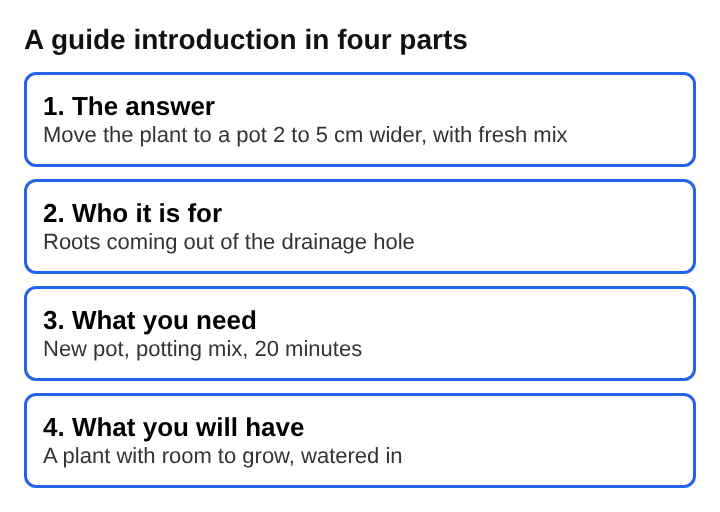
Written out, the introduction reads like this:
To repot a houseplant, move it to a pot 2 to 5 cm wider than the old one and fill the gap with fresh potting mix. Do this when roots are coming out of the drainage hole or water runs straight through the soil. You need the new pot, a bag of potting mix and about 20 minutes. At the end, your plant sits at the same depth in a bigger pot, watered in, with room to grow for another year or two.
That is four sentences and about 70 words. Check it against the four questions. What will the reader do? Move the plant to a slightly bigger pot with fresh mix. Is it for them? Yes, if roots poke out of the hole. What do they need? Pot, mix, 20 minutes. What will they have? A plant at the same depth, watered, in a bigger pot. Every question has its answer, and the reader can start step one right away.
Now compare a common draft of the same introduction: "Houseplants are a wonderful way to brighten your home, but over time they can outgrow their containers. Repotting can seem daunting, but with a little care, anyone can do it." It is pleasant to read and answers none of the four questions. The reader has spent two sentences and still does not know the pot size, the signs to look for or how long it takes.
When to write the introduction
Writers disagree on this, and both camps have a point. Some authors write their introduction first, others leave it for later, and another option is a rough draft introduction that is finished after the body text is done).
For a guide, the rough draft approach works well. Write a one-line answer before you start the steps, so you know what the guide is for. Then write the steps and the ending. Only then go back and finish the introduction, because now you know the real list of things the reader needs and the real result they will have. Writing those parts first tends to produce a list that misses the item step four turns out to need.
A user guide for a product is a little different: its introduction is about the product). Even there, lead with what the reader will be able to do with it, not with the product's history.
Frequently asked questions
How long should a guide introduction be?
Usually 40 to 100 words, or three to five sentences. If it runs longer, move the list of what the reader needs into its own short section before the first step.
Should a guide introduction tell a story?
Rarely. A one-line story can help when it shows the reader's exact problem, but put it after the answer, never before it.
Is the introduction the same as the first paragraph?
Often, yes, for a short guide. For a longer one, the first paragraph holds the answer and the introduction may run to a second paragraph with who it is for and what to gather.
Should the introduction repeat the title?
No. The title names the job; the first sentence gives the answer to it. Repeating the title wastes the most valuable line on the page.
Why the opening lines of a guide matter most
The reader of a guide arrives with a task and a little patience, and the introduction spends that patience first. When it gives the answer, names the situation, lists what to gather and shows the finish line, the reader starts step one already knowing where they are going. Every step after that reads easier, because the reader can see how it moves them toward a result they already pictured. When the introduction wanders, even good steps arrive to a reader who has half left. The four parts take a few minutes to write, and they are the lines most readers will read most closely.
Electrified