How to choose between possible solutions when none clearly wins
Knowing how to choose between possible solutions matters most once you have more than one good idea. A long list of fixes seems to be progress, yet it can leave you stuck, because every option has a cost and none clearly wins. The usual result is that you pick whichever idea came to mind last, or you pick nothing and the problem stays.
A better way is short: say what success looks like, give each option points against a few plain questions, try the one with the highest total, and write down how it turned out. Tools such as Problem Graph keep that record for you, with each problem in one line and every solution tried attached to it with its outcome. The method works just as well in a notebook.
Write the success line before you compare
Options can only be compared against something. Before you look at any fix, write one sentence that says what the problem looks like once it is solved. Keep it concrete enough that you could check it on a given day.
A vague line such as "a better commute" gives you nothing to measure against. A line such as "get to work by 9:00 without arriving worn out" tells you two things every option must do. It also stops you from drifting toward the fix that sounds clever but misses the point.
If you cannot write the line, the problem is not clear yet. Go back and write a problem statement in one sentence first, then return to the options.
Keep the list of options short and real
Three to five options is enough. More than that and the counting turns into a chore you will skip. Cut any option you would never actually do, however good it looks on paper, and merge options that are really the same idea in two forms.
Each option should be a step you could start this week. "Move closer to work" may be a real option for some people, but for most it is a year away. Write it down if you like, then mark it as a later idea and leave it out of this round.
Weigh each option with a simple decision matrix
A decision matrix is a set of rows and columns that sets each choice against the same set of factors. Its use, as the Wikipedia entry describes it, is to look at many factors at once and weight each one by how much it matters. The wider field that studies this, multiple-criteria decision analysis, is a part of operations research built around one fact: real choices weigh criteria that pull against each other.
For an everyday problem you need only a small version. Pick four questions and give each option 1 to 5 points on each, where 5 is always the better answer:
- How much does it fix? Give 5 if it meets your success line in full.
- What does it cost? Give 5 if it costs nothing.
- How much effort does it take? Give 5 if it is easy to start and keep up.
- How easy is it to undo? Give 5 if you can stop tomorrow with no harm done.
The first question matters most, so count it twice. Add the points and the highest total is the one to try first. The numbers do not decide for you; they make you look at every option the same way, which a gut choice rarely does.
A worked example: the long commute
Say your problem is a 70-minute drive that leaves you late and tired. Your success line is "get to work by 9:00 without arriving worn out". You list three options: leave 30 minutes earlier, take the train, or ask for two days a week at home.
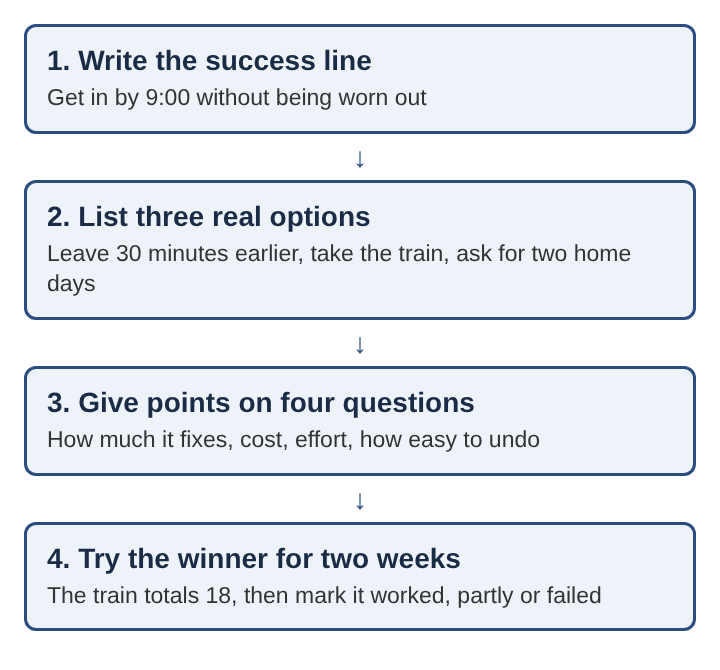
Now add up the points, with "how much it fixes" counted twice:
- Leave 30 minutes earlier: fixes 2 (you arrive on time but just as tired), doubled to 4; cost 5; effort 2, since you lose sleep; undo 5. Total 16.
- Take the train: fixes 4 (on time, and you can rest or read), doubled to 8; cost 2, for a monthly pass; effort 4; undo 4. Total 18.
- Ask for two home days: fixes 3, since three days still mean the drive, doubled to 6; cost 5; effort 2, since it needs a manager's yes; undo 3. Total 16.
The train comes first with 18. The other two tie at 16, which is useful in itself: if the train does not work out, you have two ready options and no need to start over.
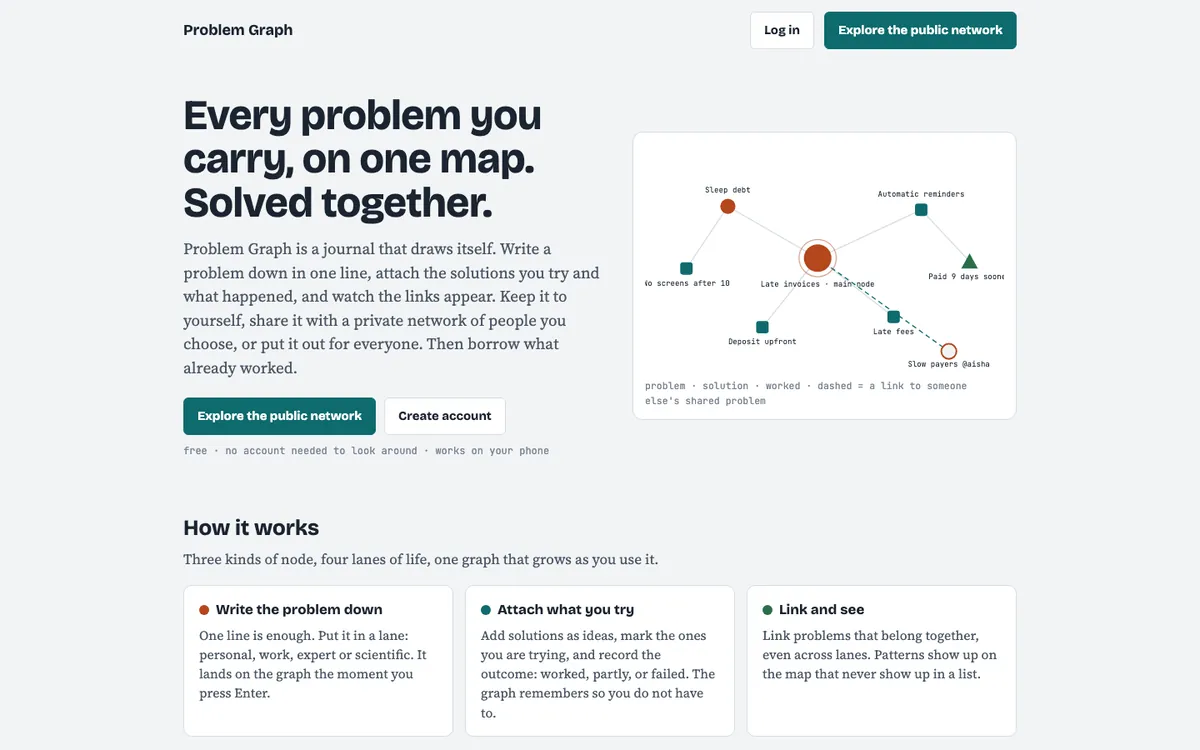
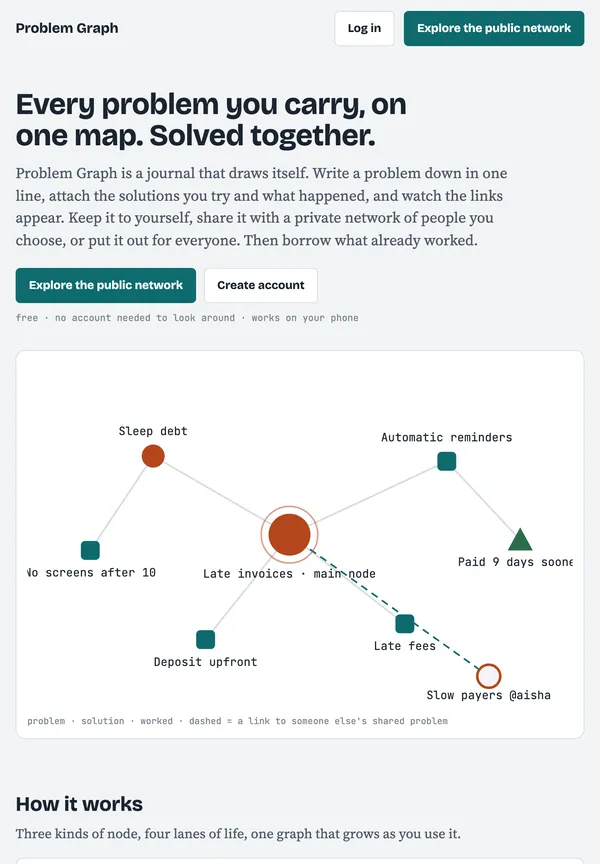
Set a short trial, such as two weeks, and decide in advance how you will know it worked: how many days you arrived by 9:00, and whether you felt rested. When the two weeks are up, mark the train as worked, partly or failed, with one line on why. Problem Graph uses those same three outcomes, and a failed solution stays on the map instead of vanishing. Its home page shows the same shape on a work problem: "Late invoices" carries three fixes, and automatic reminders are marked as settling invoices 9 days sooner.
Traps that skew the choice
A few habits push people toward the wrong option even with a list in front of them.
- Weighing the favorite first. Give every option its points on one question before you move to the next question. Going option by option lets the first number you give set the bar for the rest.
- Changing the questions after counting. If the result surprises you and you add a new factor to rescue your favorite, notice it. Sometimes the new factor is real; often it is not.
- Ignoring how easy it is to undo. A fix you can reverse is cheap to try even when its total is a little lower. A fix you cannot reverse deserves more care.
- Never closing the trial. An option tried with no end date drifts on for months. Without an outcome you cannot tell whether to keep it or move to the next one.
When the totals are close
If two options sit within a point or two of each other, the points have done their job: they tell you either is a fair first try. Pick the one that is cheaper or easier to undo, since a short trial will teach you more than another hour of weighing.
If one option clearly wins on "how much it fixes" but loses on everything else, ask whether a smaller version of it exists. A one-week train pass costs less than a monthly one and answers the same question.
Frequently asked questions
How many solutions should you compare at once?
Three to five is enough for most problems. Fewer leaves you with no real choice, and more makes the counting slow enough that you stop doing it.
What if every option ends up with few points?
Low totals across the board usually mean the problem is too broad or the list is missing an idea. Split the problem into a smaller part, or spend ten minutes listing new options before you count again.
Should gut feeling count?
Yes, as a check rather than a number. If the winner feels wrong, ask which factor your gut is reacting to, and add it as a question if it truly matters.
How long should a trial last?
Long enough for the problem to show up several times, often one or two weeks for a daily problem. Write the end date down when you start.
Choosing between solutions, one problem at a time
Choosing between possible solutions comes down to a few plain moves. Write one line that says what solved looks like. Keep the list of options short and real. Give each option points on the same few questions, count the one that matters most twice, and try the winner for a fixed time. When the time is up, mark it worked, partly or failed and say why. The runners-up are not wasted; they are the next fixes in line, already weighed, for the day the first choice falls short.
Problem Graph
Every problem you carry, on one map. Solved together. Visit problemgraph.vlvd.net