What is a go-to-market strategy? It is the plan a business makes for getting a new product to its first customers: which people it sells to, what it promises them, how they pay, and how they come to hear of it. A good one is short enough to fit on a page and specific enough that you know what to do on Monday morning.
The question matters most at the point where something works and nobody knows about it yet. AI Entrepreneur covers this stretch in the part of its courses called "Your first business", which runs from finding a real problem to building a first AI project and launching it.
What Is a Go-to-Market Strategy, in Plain Terms
The go-to-market strategy page on Wikipedia describes it as a plan for using outside resources, such as a sales force and distributors, to deliver a company's unique value proposition to customers and to gain a competitive advantage. The short form is GTM, and you will see it in startup writing all the time.
Two words in that description do the work. The first is "deliver": a plan is about reaching people, not about the product itself. The second is "customers": a go-to-market strategy names who the customers are, rather than hoping the right ones will appear.
The same page says the plan can improve a customer's whole experience. That is not only by offering a better product or a lower cost, but by setting out how the company will enter a defined market and reach the audience it chose.
The Four Choices at Its Core
Wikipedia lays out the order in which a company usually builds the plan. Read closely, it comes down to four choices, each one resting on the one before it.
- Who the first customers are. The company defines its target market, then checks whether people it already serves could become customers of the new product.
- What they get. The product is researched until there is a final decision on the value proposition: the one thing the customer gains that they cannot easily get elsewhere.
- How they pay. The company decides how to charge, which differs from one product to the next and can change even when the product stays the same.
- How they hear of it. The company chooses its distribution and marketing channels, the support the product needs, and then how it will promote the product.
The page gives a well known case of the third choice changing. Adobe moved from selling its Creative Suite, which bundled Photoshop, Illustrator and its other programs, as a single purchase, to a Creative Cloud plan at $50 a month and other monthly plans. The product was much the same; the way customers were charged for it was not.
Customers, Company and Competition
The same source names three things to weigh while making those choices: customers, the company and the competition.
On customers, it notes that many of the people a business wants may not know it exists yet. Visiting a website, attending a webinar or answering an email can each be a step toward a sale. The first real milestone it names is the marketing qualified lead: a person who has shown interest, for example by filling in a contact form or asking for a demo, and whom the marketing team has checked.
On the company, it points to the mission and vision as key factors, settled in the earliest stages. On the competition, it suggests looking at how rivals are doing, what customers think of the products already on offer and what is missing from the market.
The first choice, the first customers, is usually sharpened through market segmentation: dividing possible customers into groups with shared needs who would react the same way to the same offer. The factors Wikipedia lists include the customer's industry, their size, their behavior, where they are, how they use the product, the benefit they get and how profitable it is to sell to them.
How It Differs From a Marketing Plan
People often use the two terms as if they meant the same thing. They do not. A marketing strategy, in the Wikipedia account, is broader: it covers all of a company's products, their market share and position, its clients and rivals, and the basics of a marketing plan.
A go-to-market strategy is narrower and has a start date. It is usually made when a new product or service is introduced. A company with one marketing strategy can write a fresh go-to-market plan each time it launches something new, or each time it takes an old product to a new kind of customer.
The page's own example shows why. A car insurance company that sells to households creates interest through television, social media and billboards, then lets people purchase through its website or licensed agents. The same company selling to corporate accounts works through direct sales, agents or the internet. One product, two kinds of customer, two plans.
Why the First Channel Is Often You
For a large company, the channel choice is about sales teams and distributors. For a startup with no customers, the honest answer is usually the founder.
In his essay "Do Things that Don't Scale" (July 2013), Paul Graham writes that doing things that don't scale is one of the most common pieces of advice Y Combinator gives. Many would-be founders believe a startup either takes off or does not. He argues that startups take off because their founders make them, and that the most common unscalable thing founders do at the start is recruit users by hand.
His examples are specific. Stripe's founders were known within Y Combinator for a habit called the "Collison installation": when someone agreed to try the product, they asked for the laptop and set it up on the spot instead of promising to send a link. Airbnb's founders went door to door in New York, recruiting new users and helping existing ones improve their listings.
Graham also explains why small numbers are worth the effort. If you have 100 users and add 10 more next week, you have grown 10% that week. Keep that up and, by his arithmetic, you have about 14,000 users after a year and 2 million after two. Growth slows eventually, but a market that exists can usually be started by hand and moved to less manual methods later.
A Worked Example: One Page for a Small AI Tool
Say you have built an AI tool that listens to a physiotherapy visit, with the patient's consent, and drafts the clinical notes. A handful of people you know have used it and liked it. Here is a go-to-market plan that fits on one page.
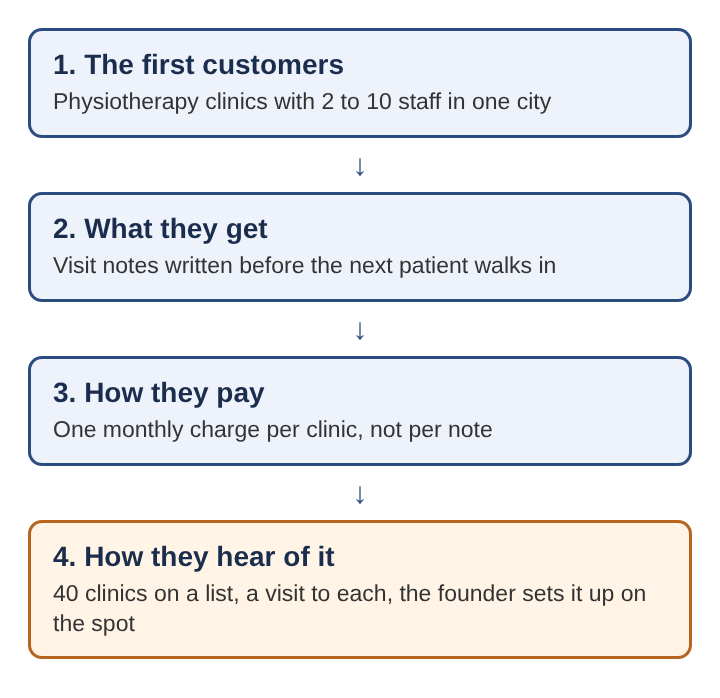
- First customers: physiotherapy clinics with 2 to 10 staff, in one city. Not all clinics, and not hospitals, whose purchases take months and passes through several people.
- What they get: notes written before the next patient walks in. That is the value proposition, in words a clinic owner would use.
- How they pay: one monthly charge per clinic, not a charge per note, so a busy week never costs the owner a surprise.
- How they hear of it: a list of 40 clinics in the city, a visit to each, and the tool set up on a clinic laptop during that visit.
Each line narrows the next. Because the customer is a small clinic, the founder can reach the owner directly, so visits make sense and a sales team does not. Because the promise is time saved between patients, the setup has to happen in a few minutes, or the visit itself breaks the promise.
The plan also tells you what to count. If 40 visits produce 6 clinics still using the tool a month later, you know far more than you did. The churn rate of those first clinics shows whether the promise holds, and the cost of each visit is your first rough customer acquisition cost.
Frequently asked questions
When should a startup write a go-to-market strategy?
Before launch, once you know the problem is real and have something people can use. It usually develops when a new product or service is introduced, and it is worth rewriting when you take the product to a new kind of customer.
Is a go-to-market strategy the same as a business plan?
No. A business plan covers the whole company, while a go-to-market strategy covers how one product reaches its customers: who they are, what they get, how they pay and how they hear of it.
How long should a go-to-market plan be?
For a young startup, one page is often enough. If you cannot name the first customer group and the first channel in a sentence each, the plan is not finished.
What is a marketing qualified lead?
It is a possible customer who has shown interest, such as by filling in a contact form or asking for a demo, and whom the marketing team has checked. Wikipedia names it as the first conversion point in a go-to-market strategy.
Making a Go-to-Market Strategy Specific
Most weak plans fail in the same place: the first customer is too broad. "Small businesses" is not a market you can visit; "physiotherapy clinics with 2 to 10 staff in one city" is. Once that line is narrow, the value proposition can be said in the customer's own words, the way they pay can match how they already spend, and the first channel is often a list of names and a week of visits.
A go-to-market strategy is a set of guesses about people, written down so you can check them. The first month of real customers will change some of those guesses. That is the point of making them plain enough to be wrong.
AI Entrepreneur
Building a business in the age of AI, from a first project to a company. Visit aientrepreneur.vlvd.net