Every processor, memory chip and phone chip you own starts as a slice of one element. So why are computer chips made of silicon and not copper, carbon or something rarer? The answer comes in three parts: silicon can be tuned from insulator to conductor, it grows its own protective glass, and it can be made purer than almost anything else on Earth.
Why are computer chips made of silicon? The short answer
The browser game Tank City Reboot builds its battlefield on a circuit board, with blocks of silicon that stop every shot until your cannon is fully overclocked, and its note on that terrain is plain: silicon is the material most computer chips are made from. The real reason sits in the element's chemistry.
Silicon is element 14, a hard, blue-grey crystal that sits in the same column of the periodic table as carbon and germanium. It is a semiconductor, and it dominates semiconductor uses for three reasons the reference sources give: low cost, excellent electronic properties and a body that is easy to shape. Each of those deserves a closer look, because none of them alone would have been enough.
A semiconductor you can switch on and off
A metal wire always conducts. A piece of glass never does. A chip needs something in between: a material whose ability to carry current can be set, region by region, and then switched by a small voltage. That is what a semiconductor offers.
Pure silicon is, in fact, close to an insulator at room temperature. Its electrons sit just below a small energy gap, the band gap, and few of them have the energy to cross it and move. Heat lets more of them across, which is why pure silicon conducts better as it warms. On its own that is not useful for a circuit. What makes it useful is how easily it accepts a tiny amount of a foreign element.
Doping turns silicon into transistors
Add a trace of phosphorus, arsenic or antimony and each of those atoms brings one extra electron that can move, giving n-type silicon. Add boron, aluminium or gallium instead and each atom leaves a gap that can trap an electron, giving p-type silicon. The silicon reference page describes what happens when the two meet: a p-n junction lets current pass more easily one way than the other, which is a diode, and an n-p-n stack with a thin p-type middle layer is a transistor.
A transistor is the switch a processor is built from. Billions of them sit on one chip, and each is nothing more than silicon doped in a pattern. Because the dopants go in at tiny, controlled amounts, engineers can draw n-type and p-type regions side by side on the same crystal and wire them into logic.
The glass silicon grows on itself
The second reason is less famous and just as important. Heat silicon in oxygen and it grows a thin, even layer of silicon dioxide, which is glass. That oxide is an excellent electrical insulator, and in a chip it separates and protects the doped regions. The history of silicon semiconductors records that Carl Frosch and Lincoln Derick at Bell Labs found by accident in 1955 that this layer could be grown on silicon, and by 1957 they had built the first planar transistors with it.
Germanium, silicon's neighbour in the periodic table, has similar electronic behaviour, and the very first transistor in 1947 used it. But germanium's oxide is unstable and dissolves in water, while silicon's does not. The reference page puts it directly: germanium-based technologies ultimately failed because of the instability of their oxide. Germanium still appears in modern chips, but only as an added ingredient in silicon transistors. In 1959 Robert Noyce built a silicon integrated circuit at Fairchild Semiconductor, following Jack Kilby's work on germanium, and silicon has held the job since.
Plenty of it, made purer than almost anything
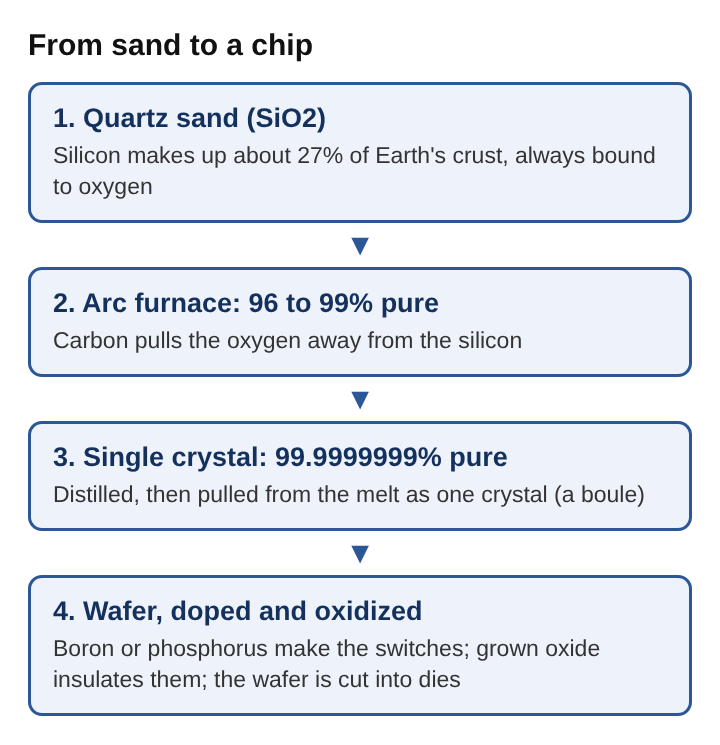
The third reason is supply. Silicon makes up 27.2% of Earth's crust by weight, second only to oxygen, and it is always found bound to oxygen as silica or silicate minerals. Sand and quartz are the starting point. The catch is that a chip needs silicon of extraordinary purity.
Ordinary refining reduces quartz or sand with carbon in an electric arc furnace, which pulls the oxygen away and leaves silicon 96 to 99% pure. For chips, that silicon is turned into a volatile compound such as trichlorosilane, purified by repeated distillation, reduced back to silicon and grown into single crystals. The result is called nine nines: 99.9999999% pure. Transistor production needs impurity levels below 1 part in 10 billion, and silicon is made at a higher purity than almost any other material.
Silicon also comes out of this as one large, nearly perfect crystal. Using the Czochralski method), a seed crystal is dipped into molten silicon and slowly pulled up, drawing a cylindrical ingot called a boule. Boron or phosphorus can be added to the melt to dope the whole crystal at once. The boule is sawn into thin wafers, etched and polished, and the circuits are built on the wafer before it is cut into individual chips, called dies.
Following one batch from furnace to wafer
The proportions show why the crystal is precious. Take an invented 1,000 tonnes of elemental silicon leaving the furnaces. The silicon reference page says most of that output stays as ferrosilicon, an iron alloy for steelmaking, and only about 20% is refined to metallurgical grade:
- Metallurgical grade: 20% of 1,000 tonnes is 200 tonnes, at 95 to 99% purity.
- Semiconductor grade: about 15% of that is refined further, so 200 × 0.15 = 30 tonnes reach nine nines.
- Impurity budget: at 1 part in 10 billion, a crystal of 10 billion atoms may hold one foreign atom, and even that one is counted.
- Wafer size: today's leading factories use 300 mm wafers. A 300 mm disc has (300 ÷ 200)² = 2.25 times the area of a 200 mm one, and the move to 300 mm from early 2000 cut the cost of each die by about 30 to 40%, according to the wafer reference page.
So out of 1,000 tonnes, about 30 tonnes become chip-grade silicon, and that small share ends up in the transistors inside nearly every computer and phone. The numbers are rounded from the sources; the 1,000 tonnes is only a starting figure to make the shares easy to follow.
Where silicon falls short
Silicon is not perfect at everything. Pure silicon conducts too poorly to use as a circuit element until it is doped. Single-crystal silicon is expensive to make, and it is worth the expense mainly in integrated circuits, where tiny flaws in the crystal can break tiny circuit paths. For solar panels and display panels, cheaper polycrystalline or amorphous silicon is used instead.
Heat is the other limit. The reference page lists silicon's ability to conduct the heat of electrical activity as adequate, not outstanding, which is why a fast processor needs a heatsink, fans or a liquid cooling loop to carry that heat away. The wafer page also notes that other materials, such as gallium nitride, now come on their own wafers for special jobs, though silicon remains the base of ordinary computer chips.
Frequently asked questions
Is a computer chip made of sand?
It starts as sand or quartz, which is silicon bound to oxygen. The oxygen is removed in a furnace, and the silicon is then purified to 99.9999999% and grown into a single crystal before any circuit is built on it.
Why not use a metal such as copper for the switches?
A metal always conducts, so it cannot be switched off. Copper does carry signals between transistors, but the switches themselves need a semiconductor whose conduction can be set by doping and controlled by a voltage.
Was germanium ever used for chips?
Yes. The first transistor in 1947 used germanium, and Jack Kilby's early integrated circuit relied on it. Germanium's oxide is unstable and dissolves in water, so silicon, with its stable oxide, took over.
What does doping mean in a chip?
Doping is adding tiny, controlled amounts of another element to silicon. Phosphorus adds free electrons for n-type silicon, and boron adds gaps for p-type silicon; placing the two side by side forms diodes and transistors.
Silicon and the age named after it
The late 20th and early 21st centuries are sometimes called the Silicon Age, after the material that made them, in the same way earlier ages were named for stone, bronze and iron. Silicon earned that name through chemistry rather than luck: a band gap that doping can tune, an oxide that insulates and stays put, a crust full of raw material, and a refining chain that reaches one stray atom in 10 billion. Other materials win in special corners, but the switch inside an ordinary computer is still, almost always, a piece of doped silicon under a skin of its own glass.
Tank City Reboot
The Family Computer tank classic, rebuilt inside a computer. Visit tankcityreboot.vlvd.net